


























Choose your language: Levitin Language School – Languages
Introduction: More Than Lyrics, More Than Words
When we listen to a song or watch a film, we rarely think about how much of what we feel depends on language itself. A phrase that sounds natural and moving in Russian may feel flat in English, abstract in German, and almost identical in Ukrainian. Add to this the perspective of age — what you hear at twenty, at forty, at sixty — and the same words open three completely different worlds.
This article is not about Kamik, Emin, or Nothing Happens Twice directly. It is about what lies beneath: why translation is never just about finding words, but about translating experience, memory, and identity.
Phrases That Resist Translation
“Dusha zhivyot toboy” (My soul lives by you)
- English: “You keep my soul alive.” Works, but English rarely speaks of the “soul” in intimate contexts — it sounds almost mystical.
- German: “Meine Seele lebt durch dich.” Grammatically fine, but in German this feels theological, distant.
- Ukrainian: “Моя душа живе тобою.” Natural, poetic, almost identical in resonance to Russian.
🔑 Only Ukrainian preserves the original emotional weight. English and German require adaptation, not translation.
“Tonkaya, kak nit’, lyubov’” (A love thin as a thread)
- English: “A love thin as a thread.” Literal, but clumsy, almost physical.
- German: “Eine Liebe, dünn wie ein Faden.” Accurate but blunt — Faden is a technical word, not a poetic one.
- Ukrainian: “Кохання тонке, як нитка.” Musical and fragile, very close to the Russian effect.
🔑 German collapses the metaphor, English makes it banal, Ukrainian sustains it.
“Iskra v glazakh” (The spark in the eyes)
- English: Feels like a cliché, associated with enthusiasm more than intimacy.
- German: “Der Funke in den Augen.” Usable, but points more to creativity or energy.
- Ukrainian: “Іскра в очах.” Entirely natural, immediately recognizable.
Age and Perception
At 18–20
Every line is dramatic truth. “I love and I hate” sounds absolute. “A thread of love” is romantic decoration, not yet lived experience.
At 40
The same words become personal history. “The spark in the eyes cannot return” is no longer metaphor — it is reality. “Photo album of memories” is painful because the album already exists.
At 60
Love turns into memory itself. The thread is no longer fragile romance but a symbol of life lived. Words like fate resonate stronger than love.
Cultural Codes
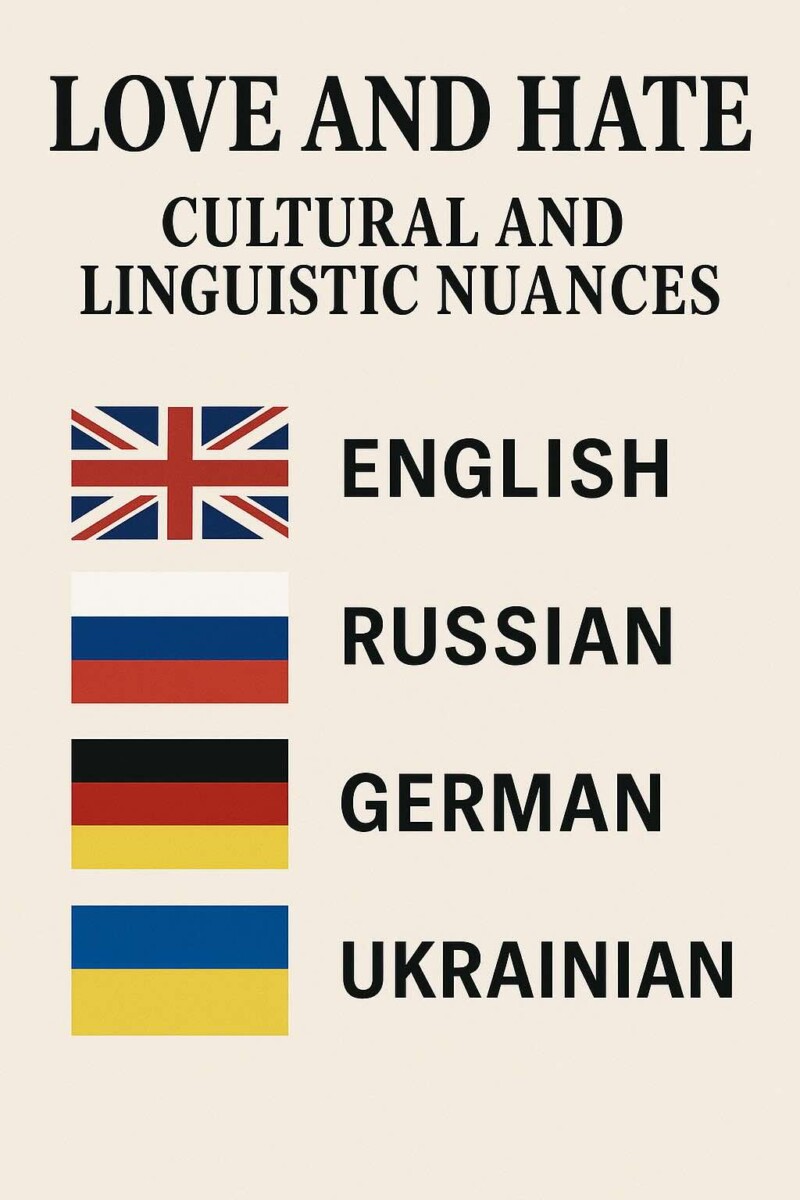
- Russian tradition: love as destiny, a burden, something beyond choice.
- Ukrainian tradition: softer, lyrical, blending sorrow with tenderness.
- English tradition: pragmatic — love as choice and action.
- German tradition: structural — love rationalized into categories, less emotional openness.
Each culture bends the same phrase into a different worldview.
Teaching and Translating Lessons
- For Teachers: use songs and film lines to show how literal translation misses emotional reality.
- For Translators: accept that “accuracy” is not enough; you must carry mood, register, cultural code.
- For Learners: discover how language changes not only what you say but how you feel.
Author’s Reflection
I am not interested in whether Kamik or Emin are “better” singers, or whether a film is “just a melodrama.” What matters to me is how their words travel — or fail to travel — across languages, generations, and cultures.
A phrase like “My soul lives by you” is never just a phrase. At twenty, it is passion. At forty, it is loss. At sixty, it is memory. In Russian, it sounds mystical; in English, awkward; in German, abstract; in Ukrainian, natural. This is why teaching and translating are not about replacing words but about finding the human thread between them.
Explore More → Stop Memorizing. Start Thinking.
© Tymur Levitin — Author’s Column. Founder and Director of Levitin Language School / Start Language School by Tymur Levitin.