





































I’ve noticed something over the years.
People call me different things.
Some say teacher.
Others say mentor.
Some say I’m not a school at all — that coming to me makes sense only when you already have questions you can’t sort out on your own.
A few call me a conversation partner.
Others say I help them think more clearly — in language and beyond it.
And sometimes people say I’m “almost a psychologist”.
I’m not.
I’ve never called myself a mentor.
I’ve never called myself a coach.
I don’t sell transformation.
I don’t promise results.
I don’t explain who I am supposed to be.
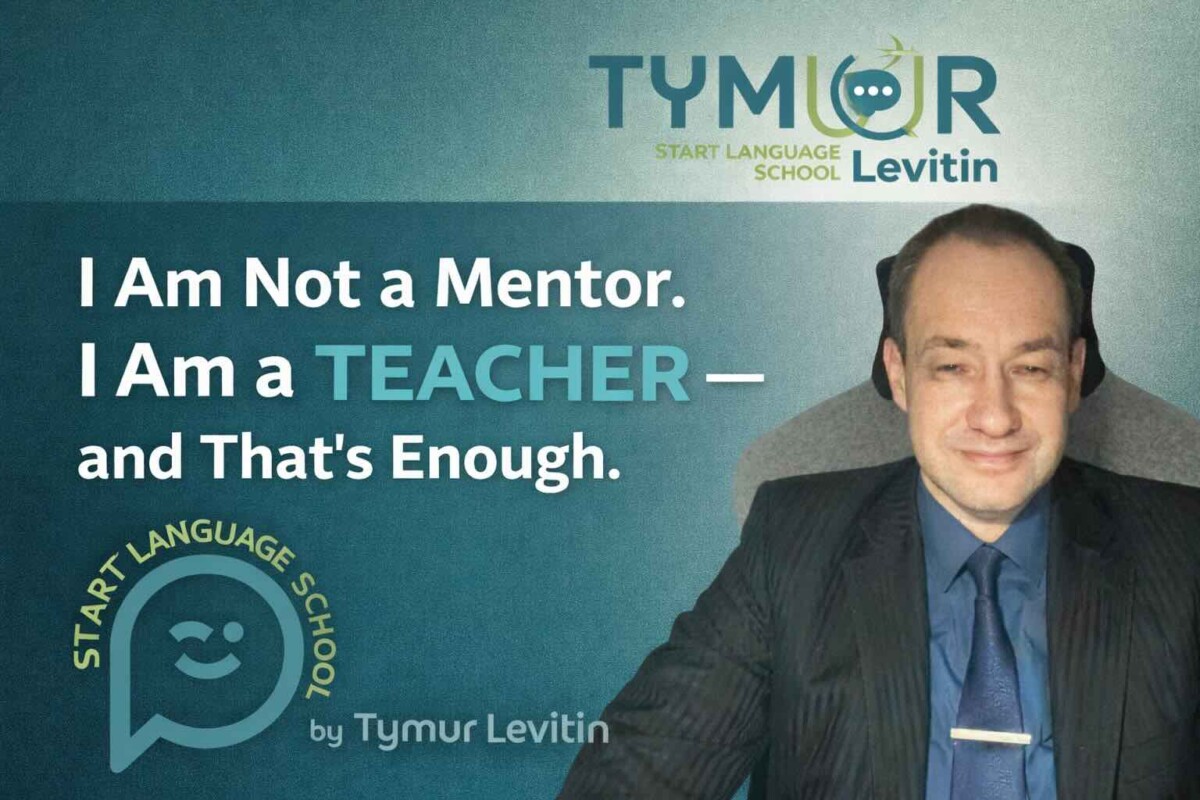
I call myself a teacher. Sometimes an instructor. That’s it.
Everything else is how people see the work — not how I define it.
Different People Come for Different Reasons
One of the biggest misunderstandings about teaching is the idea that everyone comes for the same thing.
They don’t.
Some come because they need structure.
Some come because they need clarity.
Some come because they already know the language — but don’t understand why it works the way it does.
Some come to keep themselves in shape.
Some come to practice speaking without fear of sounding stupid.
Some come because language helps them put their thoughts in order.
Some come because they finally want to ask questions they were never allowed to ask before.
The same lesson doesn’t exist for all of them.
And neither does a single role.
Why Some People Call Me a Mentor
People often use the word mentor when something goes beyond vocabulary and grammar.
Not because I guide their lives.
Not because I give advice.
Not because I tell them what to do.
But because language is never just language.
When you learn to speak more precisely, you think more precisely.
When you learn to hear nuance, you start noticing nuance elsewhere.
When you stop being afraid of mistakes, you stop being afraid of your own voice.
For some people, that feels like mentoring.
I don’t argue with that — but I don’t adopt the title either.
Why I Don’t Build Mosaics
Many teaching systems work like mosaics.
Piece by piece.
Rule by rule.
Unit after unit.
That approach works — up to a point.
But some students come not because they lack pieces, but because the picture itself feels too small.
They don’t need another tile.
They need a wider view.
So instead of assembling, we expand.
Instead of narrowing, we step back.
Instead of memorizing, we question.
Not to complicate things — but to make them finally make sense.
I Am Not a Psychologist — and That Matters
I don’t analyze childhoods.
I don’t diagnose.
I don’t “work through trauma”.
But confidence often appears when someone is finally allowed to speak freely — without being corrected every second, without being judged for sounding imperfect.
For some people, that feels therapeutic.
It isn’t therapy.
It’s language meeting honesty.
I Don’t Sell Myself — and I Don’t Defend Myself
I don’t say I’m the best.
I don’t say everyone needs my approach.
I don’t say this is the only right way.
Some people resonate with it.
Some don’t.
That’s normal.
If someone criticizes — that’s their right.
If someone dislikes — they can move on.
I’m not here to convince anyone.
Why I Still Do This
I do this work because this is who I am.
I was here before trends.
I’ll be here after them.
School or no school — I’m not going anywhere.
Those who need this kind of conversation will find it.
Those who don’t — won’t.
And that’s exactly how it should be.
Author: Tymur Levitin
Founder, Director & Senior Teacher
Levitin Language School / Start Language School by Tymur Levitin
© Tymur Levitin. All rights reserved.