

























Before we talk about language, let me tell you a story.
Not long ago, one of my adult students asked a simple question.
He wanted to say that he speaks calmly — not slowly, not poorly, not uncertainly, just… calmly.
In his native language — and in English too.
But he couldn’t find the right words. Every version sounded wrong.
“I don’t speak fluently?” — No, that sounds like I struggle.
“I speak slowly?” — But I don’t!
“I don’t speak fast?” — Still not it.
So what do I say?
That moment — real, honest, and human — says more about language than any grammar book.
Fluency Is Not Speed
There is a common myth in language learning:
If you speak quickly, you must be fluent.
But true fluency is not speed — it’s presence. It’s the ability to express thoughts without losing meaning, rhythm, or identity. Some people speak like a river. Others speak like a lake. Both are fluent. Just different.
Let’s break this down with an example.
I don’t speak Russian fluently.
Does that mean I don’t know Russian? No.
Maybe it means: I speak calmly in Russian.
Maybe it means: My thoughts are clear, but I don’t rush my words.
It all depends on what you’re really trying to say.
What Are You Actually Saying?
Let’s compare:
| English phrase | Possible meaning |
|---|---|
| I don’t speak fluently | I lack vocabulary / I hesitate / I’m not confident |
| I don’t speak fast | I prefer a calm pace / I speak clearly, not quickly |
| I speak slowly | I’m careful / I may be unsure / or just: I take my time |
| I speak calmly | I’m confident, composed, deliberate — this is my style |
The difference is huge. Especially when you’re trying to describe your style, not your level.
In my student’s case, he wasn’t asking about English at all.
He just wanted to express who he was — through language.
And that’s what makes teaching a living art.
Calm Speech Across Languages
How do other languages deal with this subtle idea — calm, not slow?
German:
- Ich spreche langsam → might suggest slowness or difficulty.
- Ich spreche ruhig → closer to calm, peaceful, intentional.
- Ich spreche deutlich, aber nicht schnell → clear, but not fast.
Spanish:
- No hablo rápido → neutral: I don’t speak fast.
- Hablo con calma → I speak calmly — more emotional.
- Hablo despacio pero claro → slow but clear — still sounds thoughtful.
Ukrainian:
- Я не поспішаю, коли говорю → I don’t rush when I speak.
- Я говорю спокійно → I speak calmly — conveys emotional balance.
- Я не балакучий → I’m not chatty — cultural, not technical.
Russian:
- Я говорю спокойно → perfectly neutral: calm and confident.
- Я не тараторю → I don’t babble / I’m not a fast talker.
- Я не бегло говорю → often misunderstood as “I don’t know the language well.”
Even in your native tongue, how you describe your manner of speech depends on intonation, emotion, and context. So when you translate these ideas into a foreign language, don’t look for a perfect phrase — look for the right one for you.
So… What Should a Student Say?
My answer — as a teacher — is:
Don’t just say it. Feel it.
If you speak calmly, say so — with your voice, with your presence.
Don’t hide behind generic words like “fluency” or “level.”
Your speech reflects your rhythm of thought.
And your rhythm is part of your identity.
A student should never try to sound like someone else.
They should learn to sound like themselves — in another language.
Teaching the Person, Not the Pattern
This is why I never build lessons the same way twice.
Every student brings a different energy, a different rhythm.
Some need to slow down to gain control.
Some need to stop overthinking.
Some just need permission to speak the way they already do — naturally, calmly, clearly.
I don’t teach templates. I teach people.
And when a student asks a question like that — “How do I say that I speak calmly?” —
I know they’re not asking for a grammar rule.
They’re asking to be understood.
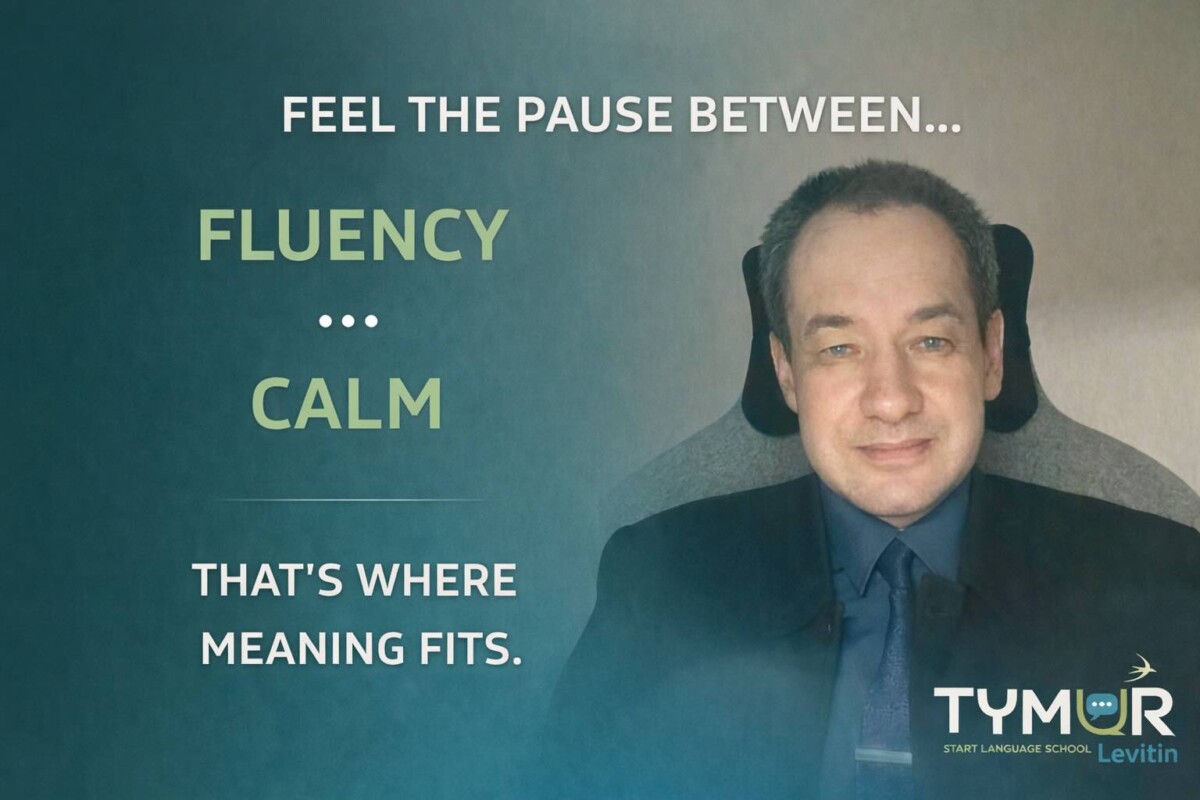
Want to Learn a Language Without Losing Yourself?
🔗 Choose Your Language
🌍 Learn English — Course Page
🧠 Why Grammar Is Not About Rules
💬 The Sound of Confidence
📖 Real Language Is Never Literal
Author: Tymur Levitin — founder, director, senior teacher and translator at Levitin Language School / Start Language School by Tymur Levitin
Slogan: Global Learning. Personal Approach.
📌 Telegram: @start_school_tymur
🌐 Website: levitinlanguageschool.com
🇺🇸 U.S. Site: languagelearnings.com
🎥 TikTok: @start_tymur_levitin
📘 Facebook: @timurlevitin
📷 Instagram: @timurlevitin
💼 LinkedIn: Levitin Language School
© Tymur Levitin — Author’s Column | Language. Identity. Meaning.
Speak Free. Learn Smart.