








































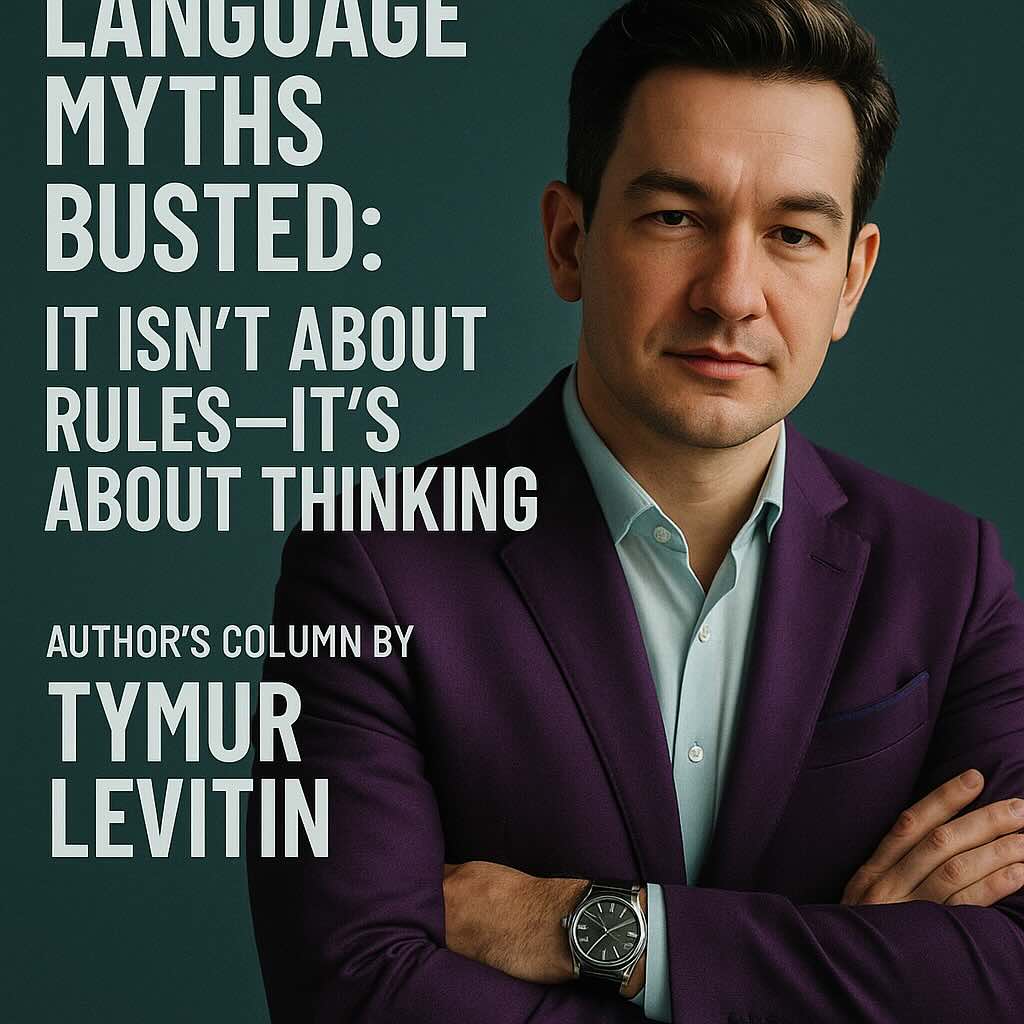

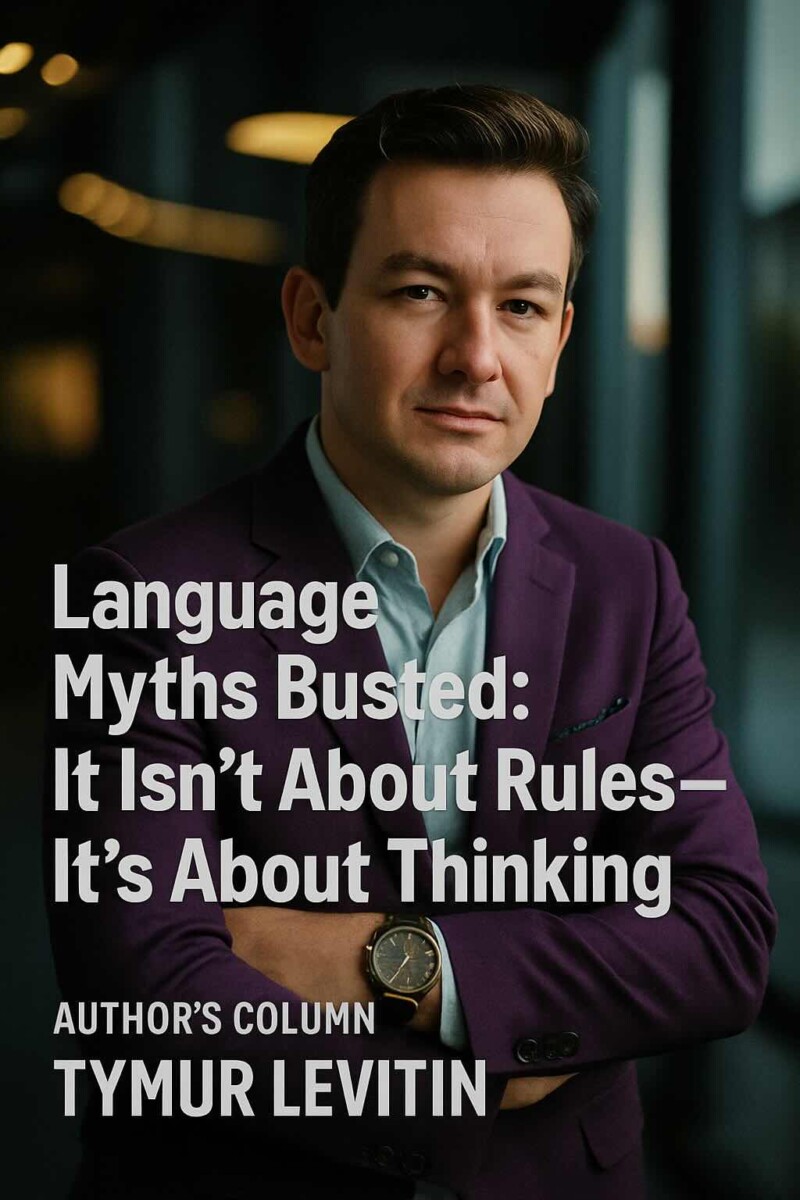
Author’s Column by Tymur Levitin
Levitin Language School / Start Language School by Tymur Levitin
Global Learning. Personal Approach.
Choose your language
https://levitinlanguageschool.com/#languages
The Myth of “Rules First”: Why It Breaks More Than It Builds
Students often believe that language learning is about memorizing rules.
“If I know the rules, I will speak.”
“If I follow the rules, I won’t make mistakes.”
“If I repeat the rules enough, they will finally ‘stick’.”
This myth is universal. It appears in English learners who chase grammar tables, German learners who fear der/die/das, Spanish learners who memorize conjugation charts, and everyone who thinks fluency is a checklist.
But language isn’t a legal code.
Language is thinking, logic, intuition, intention, reaction, association, meaning.
Rules describe language.
They do not create it.
This is the core mistake millions make.
And this — the shift from rules to thinking — is where real progress begins.
Why Rules Fail (Even When You “Know” Them)
1. Rules are static. Real speech is dynamic.
You can memorize the rule about the English Present Perfect —
and still not understand why a native says:
“I’ve just eaten.” instead of “I ate just now.”
You can memorize the German word order rule —
and still panic when someone tells you:
“Dann hätte ich es dir sofort gesagt.”
Rules cannot predict context, tone, emotional intent, speed, implication.
2. Rules don’t teach you why speakers choose one structure over another
Grammar gives the shape.
Thinking gives the reason.
A student once asked me:
“Why do Germans say Ich denke, dass… but also Ich denke, ich sollte…?
What’s the rule?”
There isn’t a rule.
There is meaning:
- Ich denke, dass… → distant, neutral, factual
- Ich denke, ich sollte… → personal reasoning, softer tone
Understanding comes from logic, not memorization.
3. Rules don’t teach interpretation
Knowing the conditional forms doesn’t help you understand why:
- “You could try…”
doesn’t mean you are able to try — it means I’m politely suggesting something. - “You should’ve told me.”
isn’t only grammar — it’s emotion, frustration, implication.
Grammar doesn’t explain human intention.
Thinking does.
The Real Mechanism: Thinking Through Language
Languages aren’t learned by stacking rules.
They are learned by understanding how the language thinks.
English thinks in direction and intention.
Time → movement → intention
That’s why tenses behave like pathways, not formulas.
German thinks in structure and hierarchy.
Meaning is organized into blocks.
Information is layered.
The end of the sentence carries the key.
Ukrainian and Russian think in nuance and category.
Meaning changes through aspect, tone, particles, stress.
Spanish thinks in flow and perspective.
Where you stand in the situation defines the form you choose.
Rules alone cannot give you this.
Thinking can.
From “Rule Memorizer” to “Language Thinker”: The Shift That Changes Everything
When students begin learning with logic instead of rules, everything changes:
1. They stop translating.
Because thinking in the target language becomes natural.
2. They stop fearing mistakes.
Because the language begins to make sense, not feel like a trap.
3. They become faster.
Fluency grows when analysis replaces fear.
4. They choose words consciously.
Communication becomes intentional, not mechanical.
This is what we teach at
Levitin Language School / Start Language School by Tymur Levitin —
not rules, not memorization, but linguistic thinking.
If It’s Not About Rules, What Is It About?
It is about:
• Logic rather than repetition
If something makes sense, you remember it forever.
• Connections rather than drills
You see how ideas are linked across English, German, Spanish, Ukrainian.
• Context rather than formulas
The same grammar produces different meanings depending on situation.
• Identity rather than correctness
Your language is your voice.
This is the foundation of my author’s method — the method that built this school.
Related Articles You May Like
To deepen the topic, read the previous article in the series:
- Language Myths Busted: Why Repetition Alone Doesn’t Work
https://levitinlanguageschool.com/authors-column-tymur-levitin-on-language-meaning-and-respect/language-myths-busted-why-repetition-alone-doesnt-work/
Additional recommended articles from the school:
- Stop Memorizing. Start Thinking.
(Author’s Column)
https://levitinlanguageschool.com/authors-column-tymur-levitin-on-language-meaning-and-respect/stop-memorizing-start-thinking/ - Why “a apples” Doesn’t Exist — Grammar as Logic
https://levitinlanguageschool.com/interesting-information/why-a-apples-doesnt-exist-when-grammar-is-just-logic/ - Tense Shift Series (all parts)
https://levitinlanguageschool.com/authors-column-tymur-levitin-on-language-meaning-and-respect/tense-shift-in-translation-why-time-always-matters/
Start Learning Languages the Right Way
If you want:
- to stop memorizing rules,
- to understand languages intuitively,
- to think in English, German, Ukrainian, Spanish,
- to learn through logic, not drills,
then join us.
Learn languages with Tymur Levitin
My teacher profile:
https://levitinlanguageschool.com/teachers/tymur-levitin/
Choose your language
- German → https://levitinlanguageschool.com/languages/learning-german/
- English → https://levitinlanguageschool.com/languages/english/
- Spanish → https://levitinlanguageschool.com/languages/spanish/
- Ukrainian → https://levitinlanguageschool.com/languages/ukrainian/
- And all languages on the US site → https://languagelearnings.com
We teach students from all over the world — adults, professionals, migrants, expats, students — individually, online, with complete flexibility.
Final Thought
You don’t learn a language by obeying rules.
You learn it by understanding how it thinks.
And once you understand the thinking —
every rule suddenly becomes obvious.