







































Many students carry a quiet illusion with them.
They believe that once they learn a foreign language well enough, the world will change its attitude toward them.
That doors will open automatically.
That respect will come by default.
That they will arrive in another country and suddenly become someone important.
This illusion is dangerous.
Not because ambition is wrong — ambition is necessary.
But because language does not grant status. It reveals it.
You can speak perfectly.
You can sound fluent.
You can know the rules, the idioms, the accents.
And still arrive in another country as nobody.
That is not humiliation.
That is reality.
No country owes you recognition.
No society is waiting for you with open arms.
No language guarantees power, influence, or authority.
Language does not crown you.
It exposes you.
One of the biggest mistakes I see in students is not grammatical.
It is existential.
They start playing roles they cannot carry.
They choose words that do not belong to their real voice.
They imitate tones they have not earned.
They borrow confidence instead of building it.
They speak as if language itself will compensate for what is not yet formed inside.
It never does.
The moment pressure appears — emotional, social, professional — borrowed language collapses.
And then comes the question no one can escape:
“What did you mean?”
At that moment, grammar will not help you.
Vocabulary will not save you.
Fluency will not protect you.
Because if you do not know what you meant, no language in the world will clarify it for you.
People often misunderstand what freedom in language actually means.
Freedom is not the absence of rules.
Freedom is not dominance over others.
Freedom is not sounding impressive.
True freedom in language begins when you stop pretending.
When you speak only what you can stand behind.
When you choose expressions that match your inner position.
When your words, tone, and intention align.
Freedom is not speaking “above” others.
Freedom is speaking as yourself — without masks.
There is nothing wrong with starting from zero.
In fact, starting from zero is honest.
Every new country resets you.
Every new language strips away illusions.
Every real conversation reminds you that nobody owes you understanding.
When you speak, it is not their duty to decode your chaos.
When emotions overflow, it is your responsibility to slow down.
When misunderstandings arise, they are not always injustice — often they are signals.
Language does not remove responsibility.
It increases it.
There is only one rule that matters more than fluency, more than accuracy, more than elegance.
Remain human.
Do not put yourself above others through language.
Do not take roles you cannot sustain.
Do not use words as armor when you are not ready to carry their weight.
Speak simply when needed.
Stay quiet when unsure.
Clarify when asked.
And when someone looks at you and says:
“What did you want to say?”
Be prepared to answer — not as a performer, not as a role, not as an illusion —
but as a person who knows their meaning.
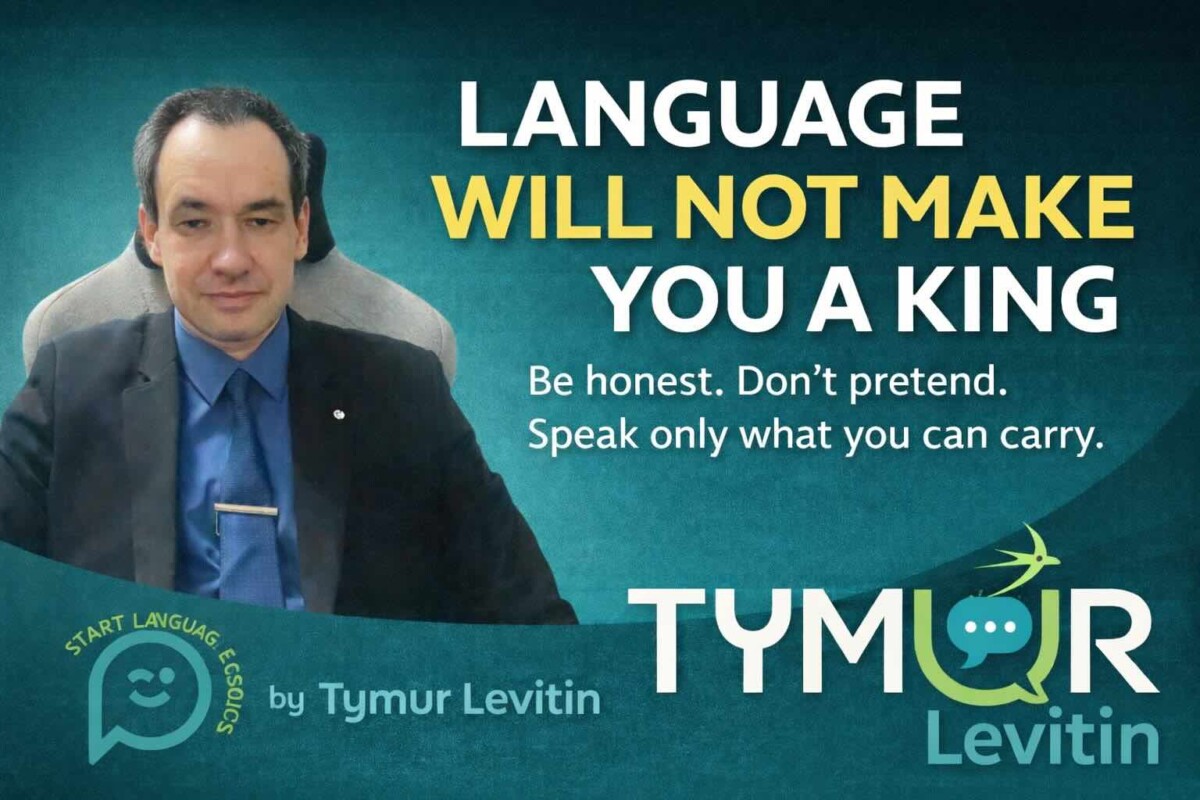
Language will not make you a king.
But it will always show who you really are.
© Tymur Levitin
Founder & Director, Levitin Language School / Start Language School by Tymur Levitin
Language. Identity. Responsibility.