























From the series “The Language That Seems Not to Exist”
Author: Tymur Levitin — Founder, Director, and Head Teacher at Levitin Language School / Start Language School by Tymur Levitin
🎓 Teacher’s page → Tymur Levitin
🌍 Choose your language
Russian & Ukrainian versions available
This article is also available in Russian and Ukrainian — with full cultural and linguistic adaptation, not abridged translations.
• 🇷🇺 Русская версия — анализ ромского влияния на сленг Восточной Европы
• 🇺🇦 Українська версія — повна адаптація з урахуванням мовних і культурних нюансівLanguage changes when it crosses borders — and so does meaning.
“When the world calls you an outsider, you create your own language — and sooner or later, the world starts borrowing it.”
1. Words from the Road
The Romani language — often called “Gypsy language” in historical sources — has never been fully standardized.
It traveled, mixed, adapted, and survived — along the roads, in markets, at borders, in songs and warnings.
And like all languages born outside of power, it became a language of coded survival.
A whisper, a signal, a warning, a joke.
What’s fascinating is how many of these words escaped into the mainstream.
Today, you can hear Romani-origin slang in Russian, Ukrainian, Polish, German, Yiddish, and even English —
without most speakers knowing where it came from.
2. “Raclo” and “Rakli”: The Outsider and the Mirror
In this article, the form raclo / racli is used as a common English transliteration.
In linguistic and Romani studies, the same words are often rendered as raklo / rakli.
These are variant spellings of the same lexical items.
In Romani,
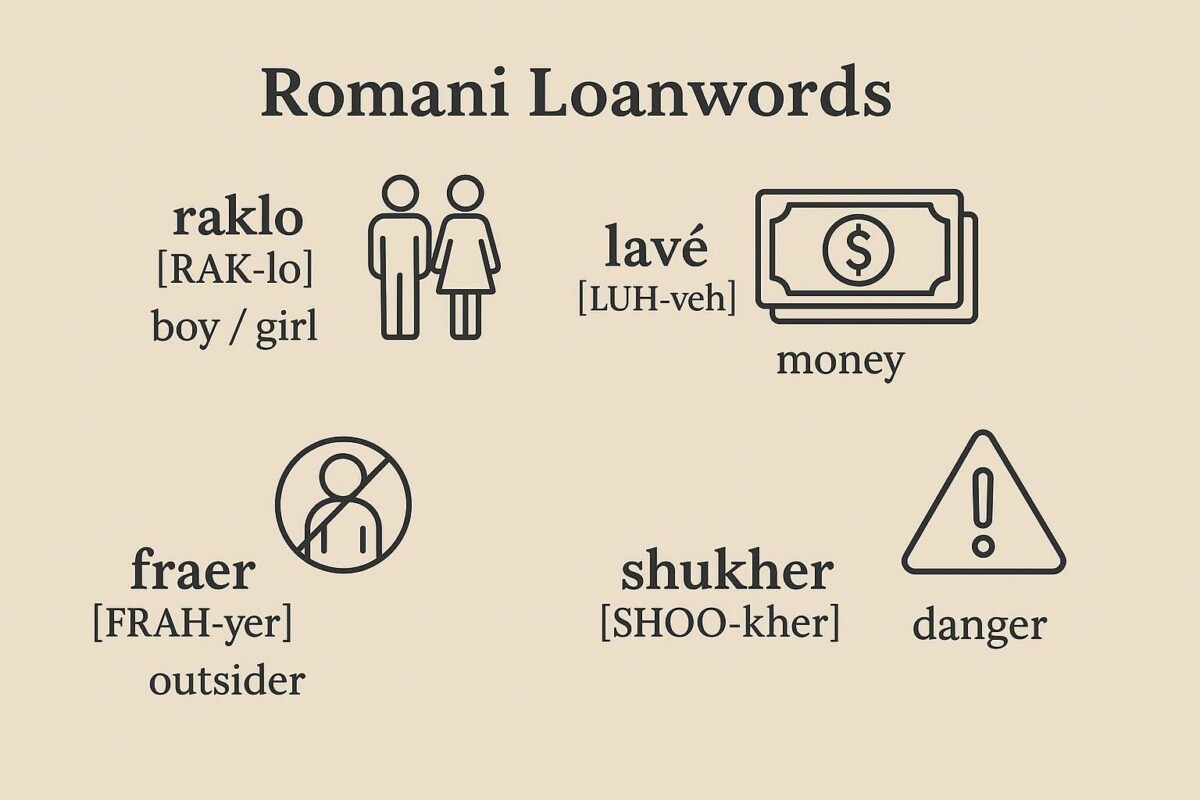
- raklo means a non-Romani boy, sometimes a young man in general.
- rakli is the feminine form — a non-Romani girl, or simply girl, young woman.
Phonetically, they sound warm, rhythmic — but semantically, they draw a line:
one of us vs one of them.
As the words spread through Eastern Europe, they changed roles.
In Ukrainian and Russian urban slang of the early 20th century, raklo could mean a “simple guy,”
a person outside the circle — not a criminal, not an insider.
Later, in some dialects, it even became ironic:
“Raklo” — a regular, law-abiding person (literally “outsider” turned “decent man”).
The word flipped its meaning — a linguistic act of rebellion,
where being normal became not belonging to the underworld.
Language has a sense of justice.
Even the word for “stranger” can become a sign of respect when time changes.
3. “Lavé”: When Money Starts Speaking Romani
If there’s one Romani word that truly went global, it’s lavé — money.
From Romani lav (“word, speech”) + a suffix meaning “things spoken about” → that which talks.
Money, too, speaks.
In Russian, лавэ became street slang for cash.
In Polish criminal argot of the 19th century, lawa meant the same.
The connection is poetic: words have power, and so does money.
A word that once meant “talk” came to mean “the thing everyone talks about.”
4. “Fraer”: The Honest Man Who Wasn’t Supposed to Exist
The word fraer is one of the most misunderstood in the entire region.
In Romani and old Yiddish, fraer originally meant a naïve outsider, not a thief, not a “professional.”
In the criminal slang that borrowed it, it meant “non-criminal person” —
the one who doesn’t live by the gang’s code.
The presence of Yiddish is not incidental here: through Jewish communities of Central and Eastern Europe, the word entered urban slang, where Romani and Yiddish layers often overlapped and reinforced each other.
But later — irony again —
in colloquial Russian and Ukrainian, fraer came to mean “respectable guy,”
or even a man of dignity.
So, in one world, fraer was an insult.
In another, it became a compliment.
A perfect example of semantic inversion — when subculture and society change places.
5. “Shukher!” — When Danger Has No Accent
If you’ve ever watched a crime movie from Eastern Europe, you’ve probably heard:
“Shukher!” — “Watch out!”, “Run!”, “Cops!”
It comes straight from Romani.
From the root meaning danger, noise, disturbance.
The word is short, sharp, onomatopoetic — it sounds like a hiss, a shout, a siren.
That’s why it survived: language keeps what works fast.
You can whisper shukher and everyone will move before they think.
It’s more than slang — it’s linguistic adrenaline.
6. Table: Romani Words That Live Among Us
| Romani Word | Transliteration | Meaning in Romani | Adopted Meaning (Russian/Ukrainian/Polish slang) | Notes |
|---|---|---|---|---|
| raklo | [ˈraklo] | non-Romani boy / man | outsider, decent man | male form |
| rakli | [ˈrakli] | non-Romani girl / woman | girl, woman | female form |
| lavé | [laˈve] | money (lit. “that which speaks”) | cash, money | extremely common |
| fraer | [ˈfra.er] | outsider, non-criminal | respectable man | Yiddish + Romani mix |
| shukher | [ˈʃukʰer] | danger, alarm | warning, police alert | high-frequency slang |
| chush | [tʃuʃ] | nothing / nonsense | rubbish, nonsense | softened meaning |
7. Why “Outlaw Words” Survive Longer
Languages of the street, the road, and the border survive because they carry what textbooks erase:
urgency, humor, and truth.
When a word comes from below — from those who had to hide, escape, or trade across languages —
it often tells you more about reality than official speech ever will.
Raklo, lavé, fraer, shukher — they’re fossils of emotion.
Pieces of code from a culture that had to stay invisible to stay alive.
8. Teaching and Translating the Unofficial Language
As teachers and translators, we don’t promote slang —
we explain what it reveals about how people really think and survive.
When you know these words, you don’t have to use them —
you just hear the hidden rhythm of a language that was never meant to be written.
That’s real linguistic empathy.
For a deeper cultural analysis of meaning and translation, see:
👉 Understanding Realia in Translation: Cultural Nuances Across Languages
9. Conclusion
The Romani language is alive in European speech — not in grammar books,
but in every alley, market, and joke that hides a borrowed word.
These words are not “dirty” or “criminal.”
They are linguistic fingerprints of survival.
Language borrows from those who live fully — even if they live on the edge.
And the words of “outsiders” remind us that human meaning is always bigger than social borders.
Author
© Tymur Levitin — Founder, Director, and Head Teacher of Levitin Language School
Author, linguist, translator with over 20 years of teaching experience.
Specialist in intercultural communication, cultural linguistics, and the translation of “untranslatable” meanings.
🔗 Teacher’s Page — Tymur Levitin
🌐 Levitin Language School
🇺🇸 Start Language School by Tymur Levitin
📚 Translation & Meaning — Understanding Realia Across Languages
📲 Telegram: @START_SCHOOL_TYMUR_LEVITIN
📞 WhatsApp / Viber: +380 93 291 34 29