








































Author’s Column by Tymur Levitin
«О, не лети так, жизнь, слегка замедли шаг…»
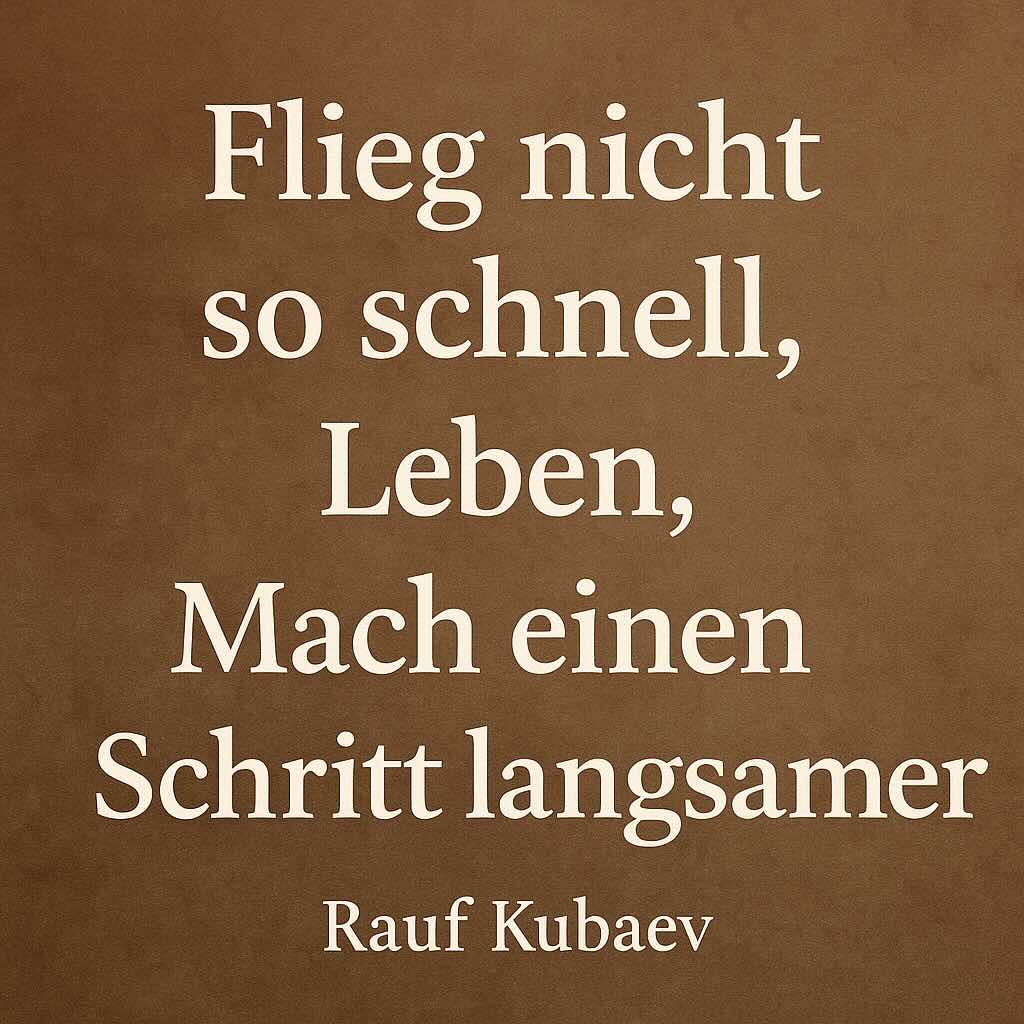
— Rauf Kubaev, О, не лети так, жизнь«Flieg nicht so schnell, Leben…»
— German rendering
There are songs where a man begs for love.
There are songs where he thanks for the years that passed.
And then there are songs like this one — where a man is not speaking to a woman at all, but to life itself.
This voice does not cry out. It commands and confesses at once.
Original Text (Russian)
О не лети так, жизнь, слегка замедли шаг.
Другие вон живут, неспешны и подробны.
А я живу — мосты, вокзалы, ипподромы.
Промахивая так, что только свист в ушах.
О не лети так жизнь, я от ветров рябой.
Позволь мне этот миг как следует запомнить.
А, если повезёт, то даже и заполнить.
Хоть чьи-нибудь глаза хоть сколь-нибудь собой.
О не лети так жизнь, на миг но задержись.
Уж лучше ты меня калечь, пытай и мучай.
Пусть будет всё — тюрьма, болезнь, несчастный случай.
Я всё перенесу, но не лети так, жизнь.
German Rendering (Full Text)
Flieg nicht so schnell, Leben, geh ein wenig langsamer.
Andere leben ruhig, bedächtig und ausführlich.
Und ich lebe — Brücken, Bahnhöfe, Rennbahnen,
verpasse alles so, dass nur ein Pfeifen in den Ohren bleibt.
Flieg nicht so schnell, Leben, ich bin vom Wind gezeichnet.
Erlaube mir, diesen Augenblick richtig zu erinnern.
Und wenn das Glück es will, ihn sogar auszufüllen.
Mit jemandes Augen, wenigstens ein wenig mit mir selbst.
Flieg nicht so schnell, Leben, bleib doch einen Moment.
Besser quäl mich, prüf mich, verletz mich.
Mag es Gefängnis sein, Krankheit, ein Unglück.
Ich ertrage alles — nur flieg nicht so schnell, Leben.
English Rendering
Oh life, don’t fly so fast, slow down your step.
Others live slowly, with detail, with order.
And I live — in bridges, train stations, racetracks.
Missing everything, with only the whistle in my ears.
Oh life, don’t fly so fast, I am scarred by the winds.
Let me remember this moment properly.
If I’m lucky, let me even fill it,
at least someone’s eyes, with at least a trace of myself.
Oh life, don’t rush, pause for a moment.
Better cripple me, torture me, test me.
Let it be prison, sickness, misfortune.
I will endure it all — just don’t fly so fast, life.
Post-by-Post Analysis
- О не лети так, жизнь, слегка замедли шаг.
- Russian: both plea and order.
- German: Flieg nicht so schnell, Leben — strict, clipped. To soften, you need particles (bitte, doch).
- English: forced choice — plea please don’t fly vs order don’t fly.
- Другие вон живут, неспешны и подробны.
- Russian подробны: bureaucratic word inside lyric.
- German ausführlich: precise, technical, loses poetry.
- English with detail sounds flat, explanatory.
- А я живу — мосты, вокзалы, ипподромы.
- Russian: a rush of images.
- German: Brücken, Bahnhöfe, Rennbahnen — clean, industrial, feels planned.
- English: “bridges, stations, racetracks” — only nouns, no energy.
- Промахивая так, что только свист в ушах.
- Russian промахивать = missing by swinging through — unique verb.
- German verpassen = miss (neutral). Loses kinetic sense.
- English missing everything — too general.
- я от ветров рябой.
- Russian: scarred by wind (poetic, earthy).
- German: vom Wind gezeichnet — dignified, solemn.
- English: weather-scarred — evocative, but clinical.
- Позволь мне этот миг запомнить… и заполнить.
- Russian pun запомнить / заполнить.
- German: erinnern / ausfüllen — logical, loses sound play.
- English: remember / fill — functional, pun is gone.
- Уж лучше ты меня калечь, пытай и мучай… Пусть будет всё.
- Russian: endurance as dignity.
- German: Besser quäl mich, prüf mich, verletz mich — harsh, judicial.
- English: cripple me, torture me, test me — more physical, less existential.
Rhetoric & Style
- Anaphora: О не лети так, жизнь ~ Flieg nicht so schnell, Leben — both languages keep repetition.
- Apostrophe (риторическая): addressing life itself makes German colder, Russian warmer.
- Antithesis: pain > speed. German makes it rational (choose duty over rush). Russian keeps it desperate.
Generational Reception
- Older German generation (50+): hears echoes of discipline, Durchhalten, war/post-war stoicism.
- Middle (30–45): links it to burnout and time-pressure. German directness fits workplace ethics.
- Younger (18–29): feels too formal; unless reframed, the imagery sounds distant.
Cross-culture:
- Russian = confession, plea.
- German = order, discipline.
- Ukrainian = prayer, softness.
- English = statement unless staged.
Cross-Language Comparison
- Russian plea+command → untranslatable.
- German → command, unless softened with particles.
- Ukrainian → tenderness, diminutive життє.
- English → loses depth, splits register.
- Spanish → melodic, intimate, but risks melodrama.
- Polish → sober, consonantal, closer to Russian.
Teaching Tasks
- Particle Lab (DE).
Rewrite with doch / mal / bitte. Compare tone. - Register Split.
Create “strict” vs “plea” versions in German. Which feels authentic? - Loss Map.
Track each Russian metaphor into German: what survives, what dies? - Performance Exercise.
Read aloud Russian vs German last stanza. Which sustains endurance? - Pun Rescue.
Find creative ways to echo запомнить/заполнить in German (merken / füllen?). Discuss ethics.
Alternative Renderings (German)
- Strict: Flieg nicht so schnell, Leben.
- Softened: Bitte, Leben, flieg nicht so schnell.
- Poetic: Eile nicht so sehr, Leben.
- Colloquial: Leben, mach langsamer.
Each choice trades authority vs intimacy, desperation vs persuasion.
Why It Belongs in a Language School
At Levitin Language School we don’t only teach how to say “don’t rush.”
We teach why in Russian it is a plea and a command,
why in German it is an order,
and why in Ukrainian it becomes a prayer.
This is not vocabulary. This is life, identity, culture — in grammar.
Keep Exploring
The Language I Live — Tymur Levitin
Language. Identity. Choice. Meaning.