








































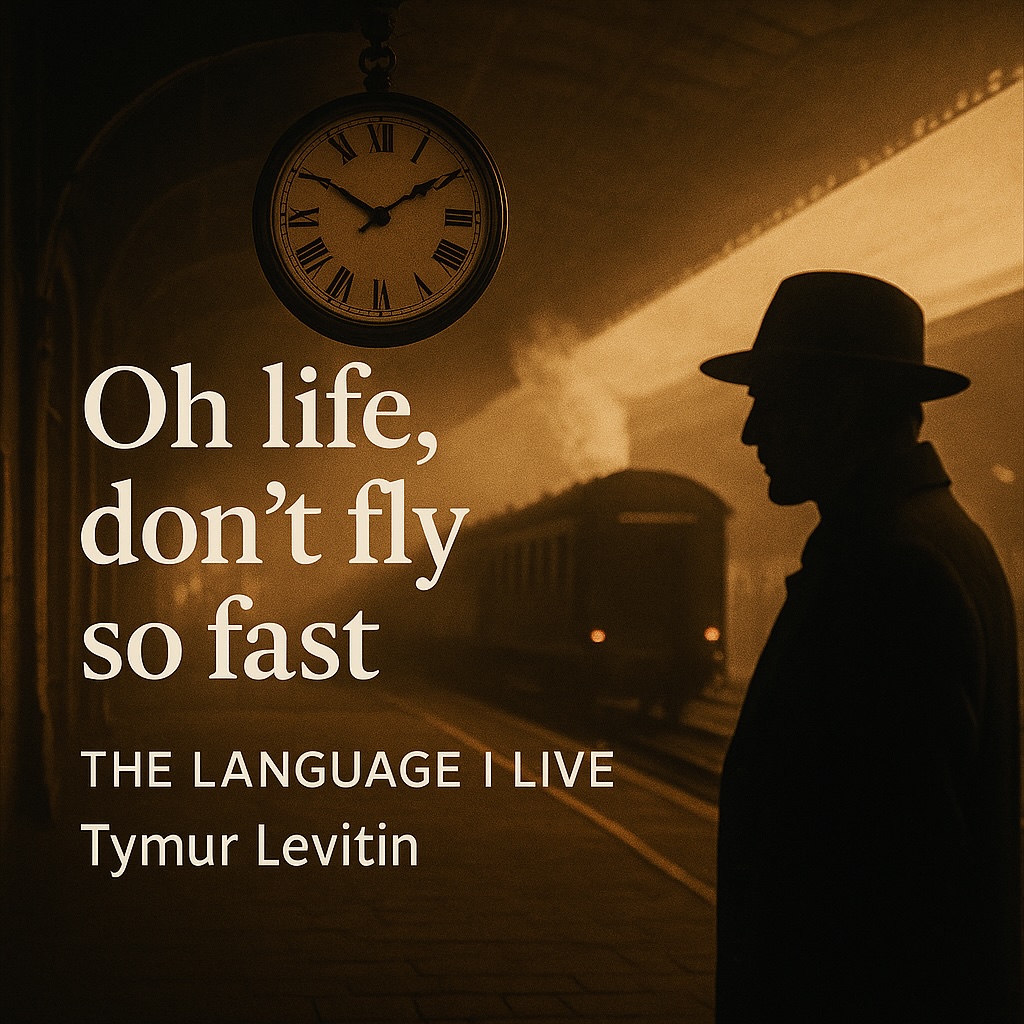

Author’s Column by Tymur Levitin
«О, не лети так, жизнь, слегка замедли шаг…»
— Rauf Kubaev, О, не лети так, жизнь
There are songs where a man begs for love.
There are songs where he says thank you for the years that passed.
And then there are songs like this one — where a man is not talking to a woman at all, but to life itself.
This voice does not shout. It whispers — and every word cuts deeper than any scream.
Original Text (Russian)
О не лети так, жизнь, слегка замедли шаг.
Другие вон живут, неспешны и подробны.
А я живу — мосты, вокзалы, ипподромы.
Промахивая так, что только свист в ушах.
О не лети так жизнь, я от ветров рябой.
Позволь мне этот миг как следует запомнить.
А, если повезёт, то даже и заполнить.
Хоть чьи-нибудь глаза хоть сколь-нибудь собой.
О не лети так жизнь, на миг но задержись.
Уж лучше ты меня калечь, пытай и мучай.
Пусть будет всё — тюрьма, болезнь, несчастный случай.
Я всё перенесу, но не лети так, жизнь.
English Rendering (sense-first)
Oh life, don’t fly so fast — slow your step a little.
Others live slowly, with detail, in order.
And I live in bridges, stations, racetracks —
missing so much that only the whistle stays in my ears.
Oh life, don’t fly so fast — I am weather-scarred.
Let me remember this moment properly.
If I’m lucky, let me even fill it —
at least someone’s eyes, with at least a trace of myself.
Oh life, don’t rush — pause for a moment.
Better cripple me, test me, torture me.
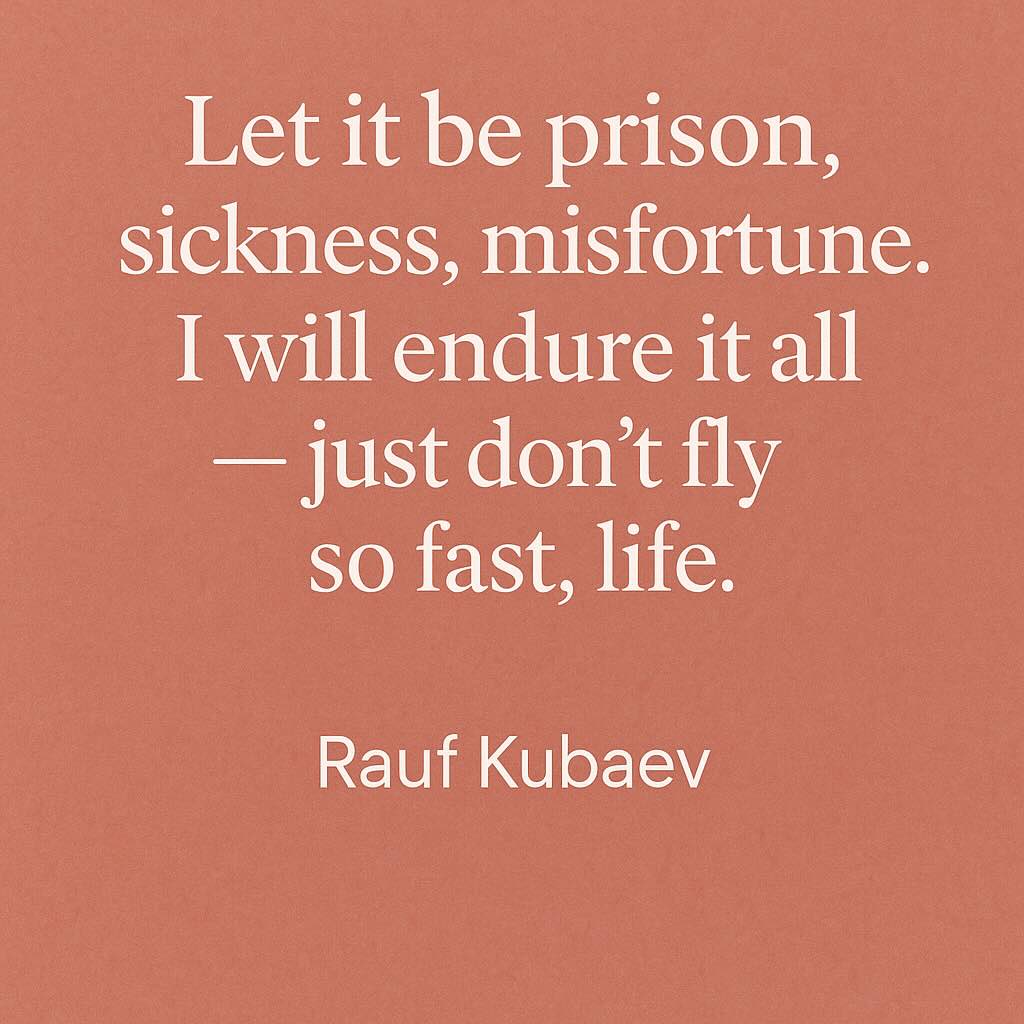
Let it be prison, illness, misfortune.
I will endure it all — just don’t fly so fast, life.
Why “sense-first”? A literal word-for-word English version flattens the emotional code. Here we keep the double register of не лети (command + plea), the stacked images (мосты, вокзалы, ипподромы), and the paronomasia запомнить/заполнить (“to remember / to fill”) as meaning, not mechanics.
Line-by-line: what is really being said
- О не лети так, жизнь, слегка замедли шаг.
Imperative with a crack in it. In Russian, you can command and confess weakness in the same breath. English forces a choice (“Don’t fly” vs “Please don’t fly”). Russian keeps both.
Phonetics: open vowels о-е-и-а + sibilant жизнь — a sigh that ends with a weight. - Другие вон живут, неспешны и подробны.
“Others live in detail.” The word подробны (detailed) is not typical for “life pace” — it’s a prose word inside a lyric. That contrast creates realism: other people’s lives feel structured, explained, accounted for. - А я живу — мосты, вокзалы, ипподромы.
A triad of movement and risk: bridges (transitions), stations (departures), racetracks (stakes). In English these are just nouns; in Russian they’re a worldview.
Figure: asyndeton + parataxis — nouns crash into each other like legs of a run. - Промахивая так, что только свист в ушах.
Промахивать — “to miss by swinging through.” Not just “miss”, but “whiff” — speed without aim. The “whistle in the ears” is physical: the body remembers velocity as pain. - …я от ветров рябой.
Рябой (pitted, freckled, dimpled by wind). Weathered. In English we borrow weather-scarred, because pockmarked is too medical. The face bears the time. - Позволь мне этот миг как следует запомнить… и даже заполнить.
Paronomasia: запомнить (to remember) vs заполнить (to fill). He wants not only to store the moment, but to inhabit it — to fill someone’s eyes with himself, at least a little.
In English the pun is untranslatable; we must explain it. - Уж лучше ты меня калечь, пытай и мучай… пусть будет всё… Я всё перенесу…
A theological inversion: pain is acceptable, speed is not. He bargains with life. The triad тюрьма, болезнь, несчастный случай (prison, illness, accident) is a spectrum of fate: deserved / undeserved, long / sudden, public / private.
Subtext: endurance as dignity. He doesn’t ask for mercy; he asks for time.
Rhetoric & craft: how the poem works
- Anaphora: О не лети так, жизнь opens stanzas; a prayer refrained as insistence.
- Parataxis: nouns in bare sequence mimic the rush.
- Antithesis: запомнить/заполнить, боль vs скорость, чужая подробность vs моя свистящая пустота.
- Apostrophe: direct address to жизнь personifies time; that choice pre-loads each imperative with intimacy.
Cross-language: what survives, what dies
- English.
Best you can do is split the register: “Oh life, please don’t fly so fast” (plea) vs “Oh life, don’t fly so fast” (command). You will always lose the Russian both-at-once. Rhythm also falls flat: Russian breath-units don’t map to English stress-timing. - German.
Flieg nicht so schnell, Leben defaults to order. To restore plea you need particles: Bitte, Leben, flieg nicht so schnell doch… — now it’s persuasion, not desperation. The discipline is built in. - Ukrainian.
Не лети так, життє… спинись хоч на мить. The diminutive життє and open vowels make it tender, almost a prayer. Not resistance, not control — intimacy. - Spanish.
Vida, no corras así… or Vida, no te me vayas tan rápido. Here the intimacy is natural (vocative Vida), the melody is strong, but the stoic bargain with pain (“better torture me than rush me”) risks sounding melodramatic unless balanced by understatement. - Polish.
Życie, nie pędź tak. The consonant cluster pędź keeps velocity in sound. The register trends closer to Russian than to German, but without Russian’s low, heavy жизнь.
Takeaway: the same grammar (negative imperative) carries different ethics:
Russian = plea inside force; German = order; Ukrainian = prayer; Spanish = intimacy; Polish = sober insistence; English = neutral statement unless carefully staged.
Generations & cultures: who hears what
- Men 45+ (post-Soviet ear): trains, bridges, racetracks are lived spaces. The song reads as confession and reckoning with time.
- 30–45 (burnout generation): hears tempo anxiety: “others have detail; I only have speed.” The refrain becomes a work-life plea.
- 18–29: reads it as existential FOMO; imagery feels cinematic, less biographical. The line I’ll endure it all, just slow down maps to anxiety culture.
- Ukrainian listeners: життє softens the steel; the plea sounds like care for life, not a fight with it.
- German listeners: the plain imperative feels like self-control against fate; endurance reads as duty.
- Anglophone listeners: without context, “Don’t fly so fast, life” risks neutrality; the teaching frame is crucial to unlock the double register.
Why the singer matters
Give these lines to different voices and the language shifts:
- Petlyura — it becomes street drama; the bargain with pain sounds like bravado.
- Kurenkov — too tender; it turns into care for a person, not a wrestle with time.
- Malinin — elegant phrasing attenuates the desperation.
- Rauf Kubaev — timbre + biography = credibility. The line “I’ll endure it all” is not posture; it’s lived.
Lesson: words don’t live on paper. They live in voices.
Teaching it (classroom & self-study)
1) Shadowing by breath-units.
Read Russian aloud, pausing only where the original breath would pause (after vocative “жизнь”, before trisyllabic stacks). Goal: feel rhythm before translating it.
2) Two-column loss map.
Left: Russian line. Right: your English/ German/ Ukrainian draft. Underline what dies (pun, rhythm, ambiguity) and annotate what you did to compensate.
3) Register split exercise (EN).
Produce two English lines: one that preserves command, one that preserves plea. Then write a hybrid using particles/adverbs (“Oh life, please don’t fly so fast, just…”) and reflect which emotion wins.
4) Modal-particle surgery (DE).
Turn Flieg nicht so schnell, Leben into a plea using doch/bitte/mal. Discuss how particles add social texture but also change emotion from despair to polite persuasion.
5) Paronomasia salvage.
Explain запомнить/заполнить. In English, you may echo sound (“re-member / re-fill”, “retain / contain”) or switch to image (fill the moment with myself). Discuss ethics of explaining vs replacing.
6) Performance stance.
Have students read the last quatrain quietly. No theatrics. The paradox: endurance grows when the voice falls.
Alternative renderings (for translators)
- Spare: Oh life, don’t fly so fast. Slow down a little.
- Plea-forward: Oh life, please — don’t fly so fast. Give me a moment.
- Stoic: Life, slow your step. Others are deliberate; I only hear the wind.
- Intimate: Life, don’t leave me this quickly. Let me fill this moment — if only with someone’s eyes.
Each choice trades something: authority vs vulnerability, rhythm vs clarity, poetry vs natural speech.
Why this belongs in a language school
At Levitin Language School we don’t teach “how to say I love you.”
We teach how to mean it — in the grammar, in the breath, in the culture that holds the sentence together.
This song is a perfect lesson: a man bargaining not for pleasure, but for time; not for mercy, but for pace.
And to teach it, you must show where language stops being words and starts being life.
Keep Exploring
The Language I Live — Tymur Levitin
Language. Identity. Choice. Meaning.
Author: Tymur Levitin — founder and director of Levitin Language School (Start Language School by Tymur Levitin), translator, teacher, and columnist.
© Tymur Levitin. All rights reserved.