








































Author’s Column by Tymur Levitin — Founder, Director, Senior Teacher of Levitin Language School / Start Language School by Tymur Levitin
Global Learning. Personal Approach. | Speak free!
Choose your language: https://levitinlanguageschool.com/#languages
We rarely meet ideology first. We meet a form.
For most people, complex social topics don’t start with debates or theories.
They start quietly — with a form.
A university application.
An immigration document.
An HR questionnaire.
An exam text.
Boxes to tick.
Categories to choose from.
Limited space for answers.
And very often, an uncomfortable feeling:
“This doesn’t describe me.”
This article is not about whether forms are right or wrong.
It is about how language inside forms works, and why misunderstanding this creates unnecessary tension — especially for non-native speakers.
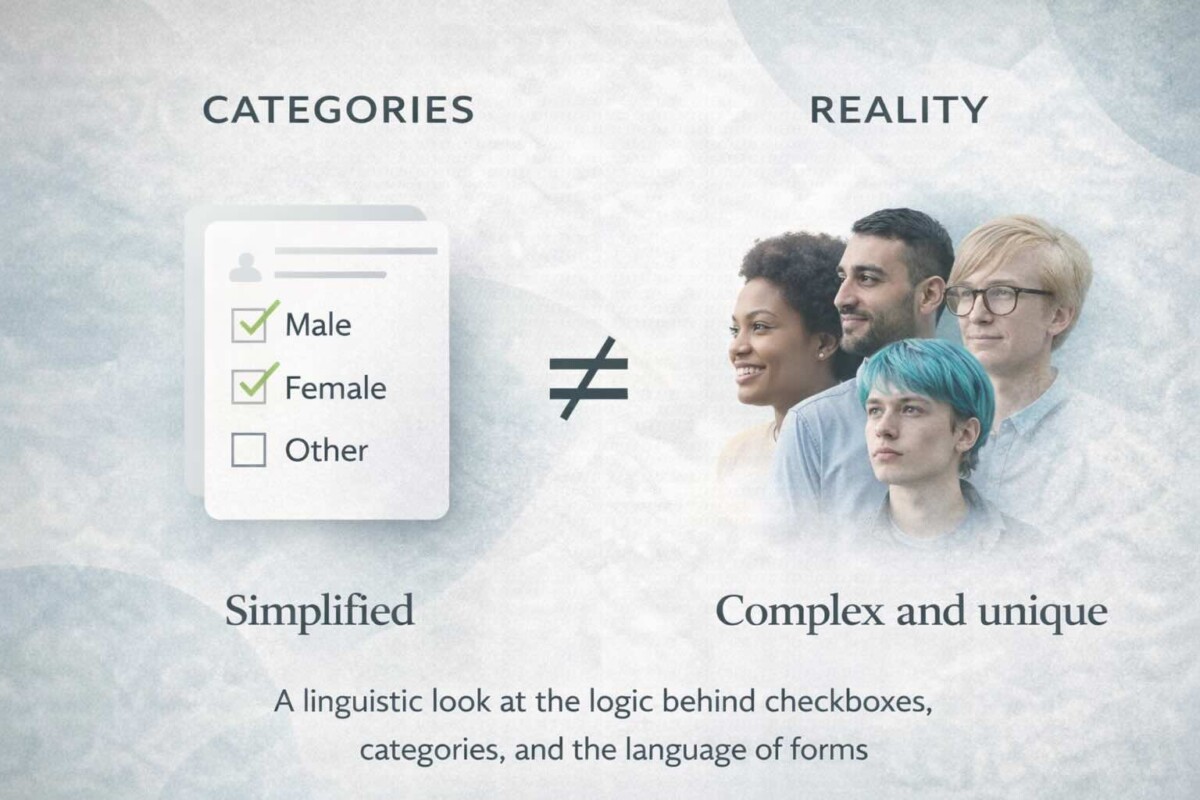
Forms do not describe reality. They compress it.
This is the first linguistic principle to understand.
A form is not a mirror.
A form is a compression tool.
Its task is not to capture human complexity, but to:
- standardize information,
- make data comparable,
- reduce ambiguity,
- allow systems to function.
Language inside forms is therefore:
- simplified,
- categorical,
- impersonal,
- intentionally limited.
When people expect personal accuracy from a form, frustration is inevitable — but linguistically misplaced.
Categories are not identities
One of the biggest mistakes readers make is treating categories as statements about who they are.
In reality, a category is a functional label used by a system.
For example:
- “gender” on a form is not a philosophical claim,
- “marital status” is not a moral judgment,
- “nationality” is not a full description of cultural identity.
Each category answers one specific operational question, nothing more.
Understanding this removes emotional overload and restores clarity.
Why “Prefer not to say” exists (and why it’s linguistic, not political)
Many modern forms include options like:
- Other
- Prefer not to say
These are not ideological inventions.
They are linguistic solutions.
From a language-design perspective, they serve three functions:
- acknowledge that categories are imperfect,
- reduce forced misclassification,
- keep the system operational without infinite branching.
In other words, they are pressure-release valves in categorical language.
Why forms often feel aggressive — even when they aren’t
Forms feel harsh because:
- they remove context,
- they remove tone,
- they remove dialogue.
Human communication relies on nuance.
Forms deliberately eliminate nuance.
This creates a clash:
- human expectation → “understand me”
- system requirement → “classify me”
The discomfort comes from expecting one mode of language to behave like the other.
The non-native speaker’s trap
For language learners, the problem doubles.
They must:
- decode the vocabulary,
- understand institutional logic,
- and suppress the instinct to translate emotionally.
Common traps include:
- reading categories as personal judgments,
- overthinking word choice,
- assuming hidden meanings,
- panicking when no option feels “correct.”
The professional solution is calm semantic reading:
What function does this category serve in this system?
Not:
What does this say about me?
Exams: what is actually being tested
When exams include texts with forms, surveys, or institutional language, they are rarely testing ideology.
They test:
- comprehension of categorical language,
- ability to read neutral register,
- recognition of functional vocabulary,
- separation of personal reaction from semantic meaning.
Students who understand this consistently perform better — not because they agree, but because they read accurately.
A practical rule for real life
If you remember only one thing, remember this:
Forms speak the language of systems.
People speak the language of meaning.
Confusing the two creates noise.
Once you separate them, interaction becomes calmer, clearer, and far less intimidating.
Why this matters in language education
Language education is not only about grammar and vocabulary.
It is about navigating reality through language.
Forms, documents, and institutional texts are part of that reality — whether we like them or not.
Teaching students how to read them correctly is not politics.
It is linguistic literacy.
Conclusion
Forms simplify reality because they must.
Language makes this simplification possible.
Understanding that mechanism:
- removes fear,
- reduces conflict,
- and gives learners control.
Not over the system — but over their interpretation of it.
And that is where real language competence begins.
Related reading
- Previous article: Gender, Sex, and LGBTQ+ Terms: What They Mean and How to Use Them Correctly
- Blog hub: https://levitinlanguageschool.com/blog/
- US blog hub: https://languagelearnings.com/blog/
- Video lessons (supporting): https://levitinlanguageschool.com/videos/
Author’s development by Tymur Levitin — Founder, Director, Senior Teacher of Levitin Language School / Start Language School by Tymur Levitin.
© Tymur Levitin