































Author: Tymur Levitin
Founder and Director of Levitin Language School / Start Language School by Tymur Levitin
© Tymur Levitin
Global Learning. Personal Approach.
Meaning Is Not a Dictionary Entry
Many people believe that meaning lives in words.
It doesn’t.
Meaning lives in how a word positions a speaker — emotionally, socially, and internally.
That is why languages that look similar on the surface often behave very differently in real life.
Belarusian is one of the clearest examples of this phenomenon.
At first glance, Belarusian seems “close” to Ukrainian or Russian.
Many words look familiar.
Many structures feel predictable.
And yet, the moment you listen carefully, something changes.
This article is not about learning Belarusian.
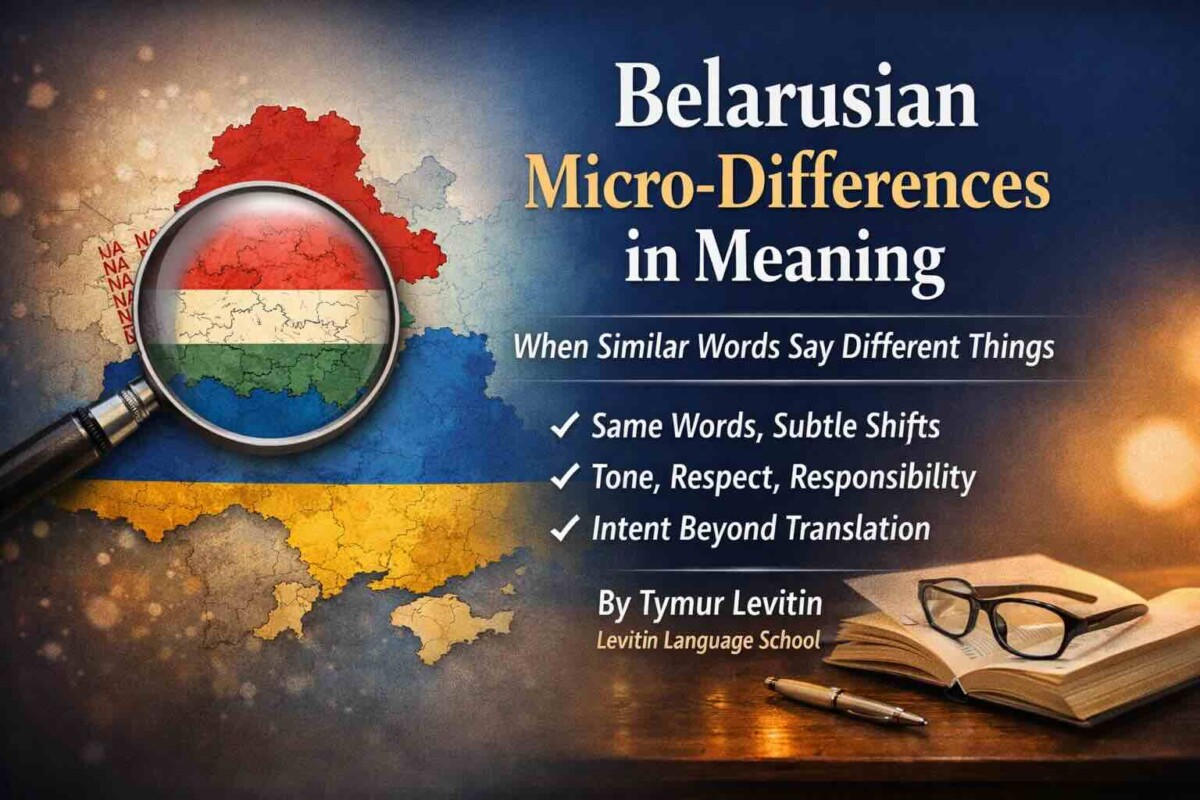
It is about micro-differences in meaning — subtle semantic shifts that reveal how language shapes thought, tone, and responsibility.
What Are Micro-Differences in Meaning?
Micro-differences are not grammar mistakes.
They are not pronunciation issues.
They are not “wrong translations.”
They are moments when:
- the same-looking word
- in a similar-looking sentence
- produces a different inner effect
These differences are small — but they decide:
- whether a phrase sounds neutral or heavy
- whether it feels respectful or intrusive
- whether responsibility is owned or blurred
Belarusian exposes these differences particularly clearly, because it resists automatic, mechanical usage.
Belarusian as a Lens, Not a Target
In this article, Belarusian is not treated as an object to be mastered.
It functions as a semantic lens.
Why?
Because Belarusian often preserves:
- clearer internal causality
- less aggressive abstraction
- more precise emotional distance
As a result, it becomes harder to “hide behind words.”
You cannot rely on habit.
You cannot rely on borrowed formulas.
You have to mean what you say.
“Understand” Is Not Always the Same Thing
Let us look at a deceptively simple concept.
| Language | Verb |
|---|---|
| English | understand |
| Belarusian | разумець |
| Ukrainian | розуміти |
| Russian | понимать |
On the surface, these verbs align perfectly.
In reality, they do not.
In English, understand often signals cognitive grasp.
In Belarusian, разумець more strongly implies internal alignment — not just knowing, but standing inside the logic of something.
This difference matters.
A speaker may understand information without accepting its weight.
Belarusian subtly resists that separation.
The language quietly asks:
Do you merely know — or do you actually carry this meaning?
“Can” and “May”: Permission Is Not Neutral
Another classic trap involves possibility and permission.
| Language | Common form |
|---|---|
| English | can / may |
| Belarusian | можна |
| Ukrainian | можна |
| Russian | можно |
Despite visual similarity, the communicative behavior differs.
In Belarusian, можна often feels less like a casual allowance and more like a measured opening.
It implies awareness of boundaries.
What sounds light in English may sound premature in Belarusian.
What sounds neutral elsewhere may sound careless.
The language does not forbid — it frames responsibility.
Why Literal Translation Breaks First in Belarusian
Belarusian is unforgiving to mechanical translation.
If you translate word-for-word:
- tone slips
- intent shifts
- meaning thins out
This is not a flaw of the language.
It is a protective mechanism.
Belarusian demands that a speaker:
- knows why they are speaking
- understands what position they take
- accepts the weight of their phrasing
That is why it is such a powerful detector of meaning distortion.
Why This Matters Beyond Belarusian
Micro-differences are not “academic details.”
They directly affect real communication.
People misunderstand each other not because they lack vocabulary, but because:
- they transfer meaning incorrectly
- they assume equivalence where none exists
- they speak from habit, not awareness
By observing how Belarusian handles meaning, learners of any language become more attentive to:
- tone
- implication
- responsibility encoded in speech
This is not about fluency.
It is about linguistic integrity.
Meaning Comes Before Language
Languages do not mirror each other.
They organize reality differently.
Belarusian reminds us of something essential:
Similar words do not guarantee similar meaning.
And understanding a language begins long before speaking it.
Language Versions
🔁 This article is available in other language versions:
🇧🇾 Беларуская версія