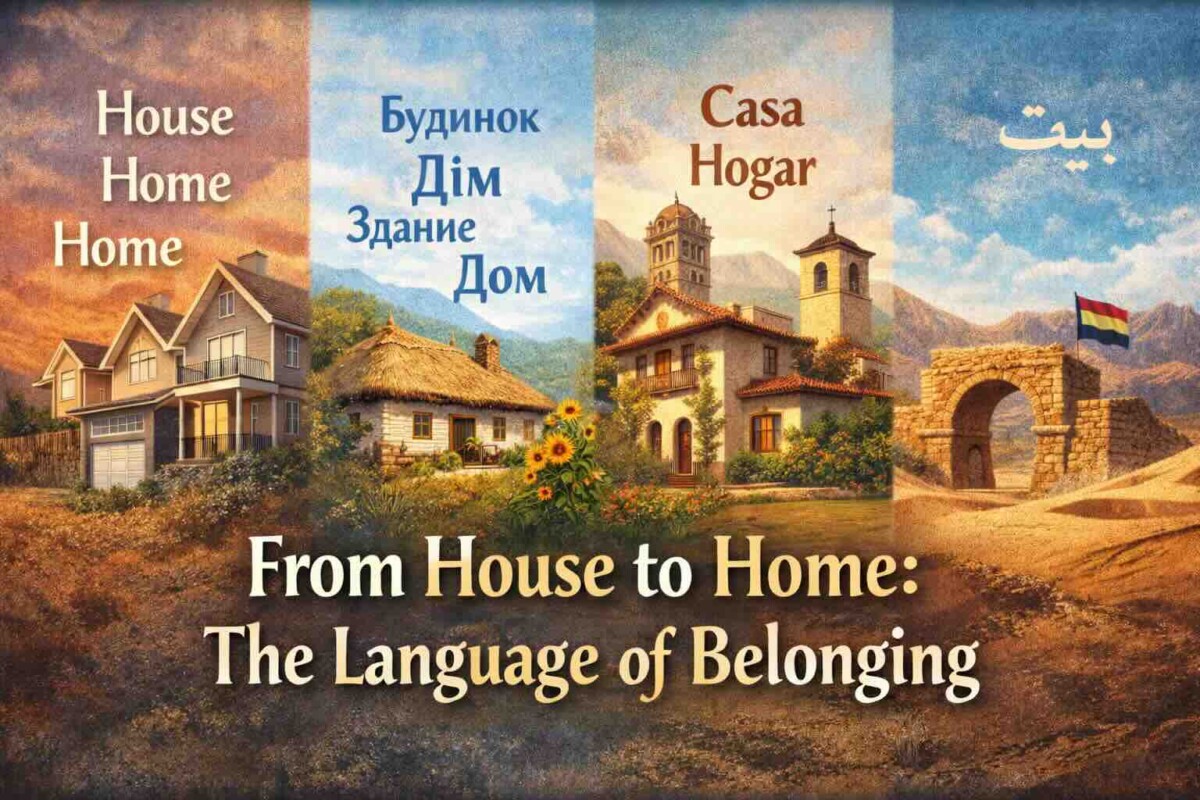


































Where do you feel “at home”?
Not where your name is registered. Not the house you bought.
But the place — or feeling — where you belong.
As a language teacher, I’ve seen students hesitate when translating the word дом or дім. They ask:
“Should I say house or home?”
And I always reply:
“Depends. What do you mean — the building, or the emotion?”
Words That Should Mean the Same… But Don’t
In English, the difference is clear:
- House — a physical structure: four walls and a roof.
- Home — a space of emotional attachment, comfort, identity.
A refugee may be given a house.
But it might never become a home.
German: Haus vs Heimat
In German, Haus is the building.
But the closest equivalent to home — is not a noun, it’s a concept: Heimat.
Heimat means where your soul belongs.
It may be the town you left.
The scent of childhood.
Or even a dialect no one speaks anymore.
We explore this deeply in our German language program — because no one can master German without grasping the emotional power of Heimat.
Ukrainian: Дім vs Будинок
Ukrainian makes a similar distinction:
- Будинок — building, neutral, architectural.
- Дім — warm, close, familial. It evokes care, memory, return.
You don’t say “повертаюсь у будинок”.
You say: “Я їду додому” — I’m going home.
These subtleties matter when we teach Ukrainian online — especially to those who are rediscovering their roots.
Russian: Дом vs Здание
Russian, too, has the contrast:
- Дом — both a building and a feeling.
- Здание — impersonal structure, like an office block.
But here, context does the heavy lifting.
A Soviet-era phrase like “дом — полная чаша” speaks of love and presence.
Yet дом can also mean a tenement — not a home at all.
Language learners struggle here. Because the same word can carry warmth or coldness, depending on tone.
Spanish: Casa vs Hogar
In Spanish, casa is the building.
But hogar — that’s where the fire is.
Literally, hogar comes from hoguera — a hearth.
So when someone says mi hogar, they mean more than four walls.
They mean life, warmth, family, memory.
This becomes especially meaningful for Latin American students rediscovering identity through language.
We dive into these layers in our Spanish immersion program, where language is not just taught — it’s lived.
Arabic and Japanese: Belonging Without a House
In Arabic, بيت (bayt) can mean both a house and a home. But culturally, it extends to the people inside — the family, the tribe, the story.
You don’t belong to a building. You belong to your bayt.
In Japanese, the word うち (uchi) doesn’t just mean “home.” It means our space — the inside, the safe, the known. It stands opposite to そと (soto) — the outside world.
When teaching cross-cultural expression, these contrasts become a gateway into how languages shape not just vocabulary, but worldview.
Why This Isn’t Just Semantics
If you don’t know the difference between house and home, you can still survive abroad.
But if you don’t feel the difference — you may never feel at home in the language you’re learning.
That’s why, at Start Language School by Tymur Levitin, we teach languages through meaning, memory, and identity.
We don’t just give words — we give understanding.
So when a student asks me how to say “дом,”
I ask them:
“Where do you want to arrive — at a house, or at yourself?”
Because language isn’t just about where you live.
It’s about who you are, when you say it.
✍️ Author: Tymur Levitin
Founder, Director and Head Teacher at Start Language School by Tymur Levitin (Levitin Language School)
© Tymur Levitin