









































Why One Small Ending Changes the Whole Meaning
At first glance, speak free and speak freely seem almost identical.
Most learners translate both as “говорить свободно” and move on.
And that is exactly where the real problem begins.
Because English does not choose forms randomly.
And the difference here is not grammatical — it is conceptual.
This Is Not About the Suffix -ly
Students are usually taught a simple rule:
Adjectives describe nouns.
Adverbs describe verbs.
To make an adverb, add -ly.
Neat. Logical.
And deeply misleading.
If this rule were truly sufficient, English would not allow expressions like:
- feel free
- speak free
- go slow
- drive safe
- think big
- stay strong
Yet all of them exist — and are natural.
The reason is simple:
English does not always describe the action.
Sometimes it describes the state of the person.
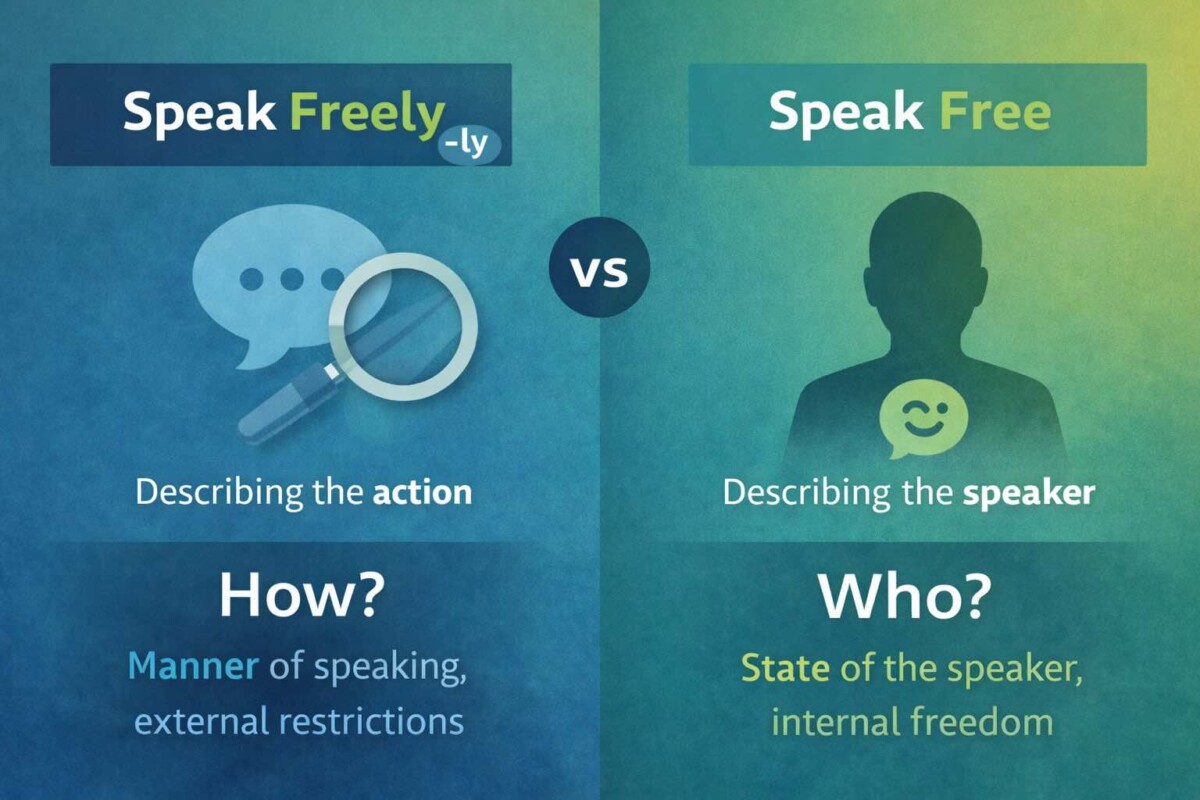
Speak Freely: Describing the Action
When you say speak freely, the focus is on how the action is performed.
- freely = without restriction
- freely = openly
- freely = without external limitation
The language zooms in on the manner of speaking.
It answers the question:
How do you speak?
This is classical adverb territory.
Nothing controversial here.
Speak Free: Describing the Speaker
Now comes the part most learners were never taught.
In speak free, English is not describing the verb.
It is describing the person who speaks.
- free = not constrained
- free = not afraid
- free = not internally blocked
The focus shifts away from the mechanics of speech
and toward the state of the speaker.
The sentence does not ask how you speak.
It states who you are while speaking.
This is not about technique.
This is about identity.
Action vs State: The Core Distinction
This contrast reveals something much deeper than a suffix choice.
- Adverbs describe processes
- Adjectives after verbs describe states
English allows adjectives after verbs when the verb acts as a bridge between action and being.
Compare:
- He spoke freely. → description of performance
- He spoke free. → description of inner condition
Same translation.
Different mental model.
Why Translation Hides the Difference
In many languages, this distinction collapses into one form.
Russian, Ukrainian, German — all tend to use a single structure that can mean both:
- manner of speaking
- internal freedom
English refuses to blur that line.
It forces a choice:
- Are you talking about speech mechanics?
- Or about psychological freedom?
And the form changes accordingly.
Why Learners Get Stuck
Students who rely on rules ask:
“Which one is correct?”
Native speakers never ask that question.
They ask a different one — often unconsciously:
“What exactly do I want to express?”
As long as learning is about rules, this difference feels confusing.
Once learning becomes about meaning, the difference becomes obvious.
Language Is Not a Tool. It Is a Position.
This is why Speak free! works as a statement — not just a slogan.
It does not promise eloquence.
It does not promise correctness.
It does not promise perfect grammar.
It expresses a stance:
Speak without fear.
Speak without inner censorship.
Speak as yourself.
That meaning would be weakened — not strengthened — by -ly.
What This Teaches Us About English
The English language constantly asks:
- Are you describing what happens?
- Or who someone is while it happens?
Grammar follows meaning — not the other way around.
And once you see that,
suffixes stop being rules
and start being signals of thought.
Understanding Before Fluency
This distinction is rarely taught because it cannot be memorized.
It must be understood.
And once understood, it changes far more than one phrase.
It changes how you listen.
How you choose words.
How you think in the language.
Not freely.
But free.
Author’s column by Tymur Levitin
Founder, Director, Senior Teacher
Levitin Language School / Start Language School by Tymur Levitin
© Tymur Levitin