









































Why English Is Not About Rules but About Perspective
People often ask whether teacher profile is “correct English” or whether it should always be teacher’s profile.
This question looks grammatical on the surface.
In reality, it is not about correctness at all.
It is about how English encodes perspective.
English does not simply describe objects.
It describes how the speaker positions themselves toward what they describe.
That is why both forms exist — and why they are not interchangeable.
Why Grammar Alone Cannot Explain This Difference
Traditional grammar tries to reduce the question to possession:
- teacher’s profile → something belonging to a teacher
- teacher profile → “shortened form”
This explanation is incomplete.
If English only cared about possession, then teacher profile would sound wrong.
It doesn’t.
Because English is not only a language of ownership.
It is a language of functional framing.
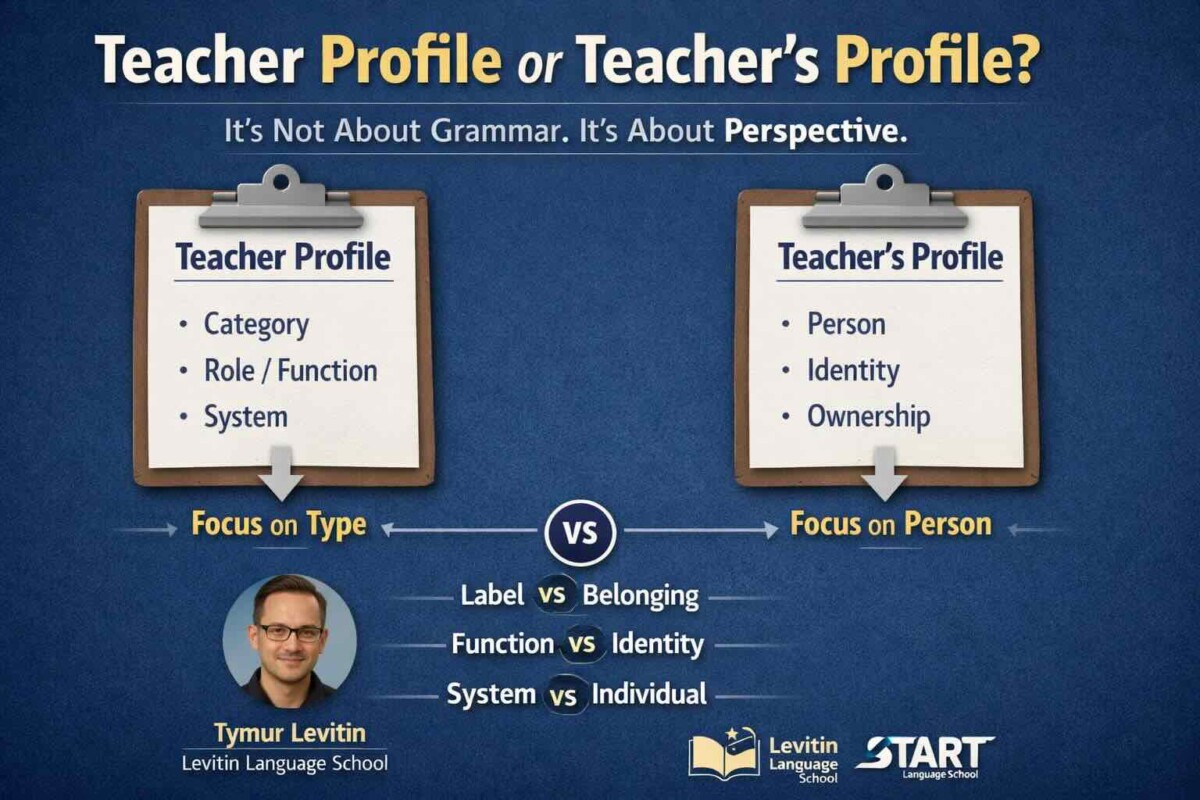
Teacher’s Profile: The Human Perspective
When we say teacher’s profile, the focus is on the person.
The profile is seen as:
- something personal,
- something belonging to an individual,
- something connected to identity.
This form appears naturally when:
- the teacher is already present in the conversation,
- the speaker mentally starts from the person,
- the profile is perceived as an extension of someone’s self.
In this structure, the teacher comes first cognitively, not grammatically.
Teacher Profile: The Structural Perspective
Now compare this with teacher profile.
Here, English does something different.
The teacher is no longer a starting point.
The teacher becomes a category.
Teacher profile functions as:
- a type of profile,
- a classification label,
- a structural unit within a system.
This is why this form dominates:
- websites,
- platforms,
- interfaces,
- menus,
- professional listings.
English drops possession not because it is lazy,
but because possession is irrelevant in this perspective.
The profile is not “someone’s”.
It is what kind of profile it is.
This Is Not Simplification. This Is Precision.
Many learners assume that noun-noun structures are informal or simplified.
That assumption is wrong.
Teacher profile is often more precise than teacher’s profile.
Why?
Because it removes the human angle and introduces a functional frame:
- role over person,
- type over ownership,
- system over individuality.
English constantly makes this choice — quietly, without rules.
The Same Logic Everywhere in English
This is not an isolated case.
The same logic explains:
- English language vs the English language
- student profile vs student’s profile
- company policy vs company’s policy
- language learning vs the learning of a language
English switches structures when the perspective changes, not when rules demand it.
What This Reveals About English Thinking
English grammar is not built around forms.
It is built around points of view.
The language constantly asks:
- Are we talking about a person or a function?
- About identity or classification?
- About experience or structure?
Grammar is the visible surface of this choice.

Why This Matters for Real Language Use
If you try to “apply rules”, you will hesitate.
If you understand perspective, the choice becomes obvious.
Native speakers do not choose forms consciously.
They choose frames.
And English grammar follows.
Final Thought
English does not tell you what is correct.
It tells you where you are standing when you speak.
Once you understand that, grammar stops being a problem.
It becomes a map.
© Tymur Levitin
Founder & Senior Teacher
Levitin Language School / Start Language School by Tymur Levitin