








































Before you start:
👉 Choose your language: https://levitinlanguageschool.com/#languages
Why Collocations Matter More Than Grammar
You can know hundreds of words and dozens of rules — and still sound unnatural.
Most learners struggle not because of grammar, but because they don’t know which German words belong together.
Collocations are the hidden system behind native fluency:
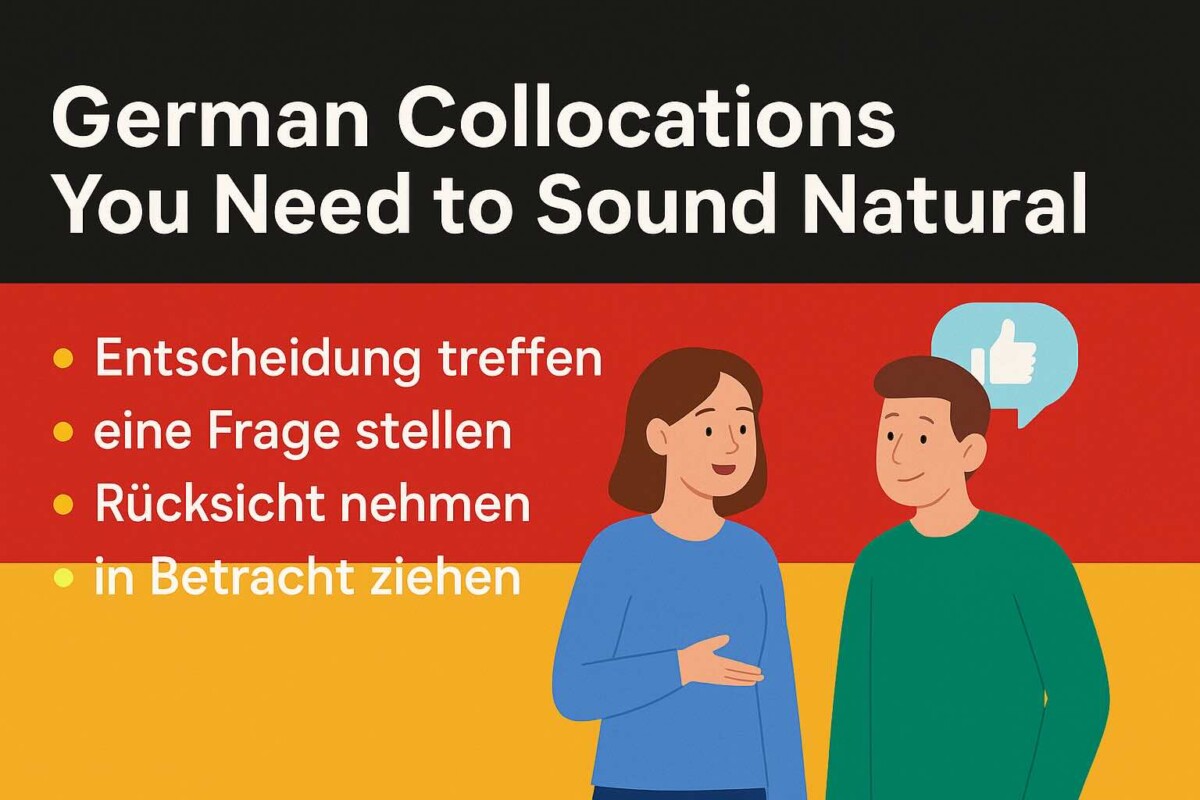
- Entscheidung treffen
- Interesse zeigen
- eine Frage stellen
- eine Rolle spielen
These combinations are not logical from the outside — but they are predictable from the inside of the German system.
This article continues the series on real-life vocabulary:
German Vocabulary in Context — Learn Words You’ll Actually Use
German Words in Real Conversations — Learn How People Actually Speak
How to Learn German Words That Stick — Logic, Emotion, and Repetition
Collocations That Every German Actually Uses
1. Entscheidungen treffen
“Make decisions” does not translate word-for-word.
In German, you hit decisions — you treffen them.
The word treffen communicates precision:
→ something deliberate, intentional, important.
That is why Germans don’t say:
❌ Entscheidungen machen
but always:
✔ Entscheidungen treffen
2. Eine Frage stellen
You don’t “ask” a question — you place it.
This reflects the German cultural logic of structure and clarity: a question is something you put on the table.
✔ Ich möchte Ihnen eine Frage stellen.
3. Rücksicht nehmen
“Take consideration” is intuitive for English speakers — but in German it means
→ actively creating mental space for another person.
✔ Wir müssen mehr Rücksicht aufeinander nehmen.
✔ Danke, dass du Rücksicht nimmst.
This collocation is deeply social and emotional — and appears constantly in everyday speech.
4. In Betracht ziehen
Literally: “pull into consideration.”
Used in spoken, formal and academic German.
✔ Wir ziehen alle Optionen in Betracht.
✔ Hast du das in Betracht gezogen?
It signals thoughtfulness, structure and respect.
5. Einen Eindruck machen / hinterlassen
German splits the English “impress” into two emotionally distinct ideas:
- einen guten Eindruck machen — active behavior in the moment
- einen Eindruck hinterlassen — long-term emotional impact
This difference matters. It reflects German cultural precision in describing human behavior.
Why Collocations Build Real Fluency
Collocations help you:
- speak faster
- sound natural
- avoid literal translations
- understand native speakers
- think in German patterns
They also link vocabulary into systems:
Eindruck → Eindruck machen → beeindruckend → eindrucksvoll → Eindruck hinterlassen
One idea turns into five new words and patterns.
This is how vocabulary becomes fluency.
Learn Collocations Through Real Context, Not Lists
Memorizing lists of collocations rarely works.
But meeting them inside real conversations creates memory anchors.
Examples:
✔ Lass uns Rücksicht nehmen — ich weiß, dass du gestresst bist.
✔ Sie hat wirklich einen Eindruck hinterlassen — das Gespräch war tief.
This is the method we use at Levitin Language School:
learn the pattern → use it → revisit it naturally → anchor it emotionally.
Start learning German the natural way:
https://levitinlanguageschool.com/languages/learning-german/
Learn with a teacher who explains real German logic:
https://levitinlanguageschool.com/teachers/tymur-levitin/
More German Learning Resources
German Vocabulary in Context — Learn Words You’ll Actually Use
German Words in Real Conversations — Learn How People Actually Speak
How to Learn German Words That Stick — Logic, Emotion, and Repetition
German Tenses Explained Simply — Learn to Use Time Naturally
German for Travel — Learn to Speak and Understand with Ease
Author’s Note
Author’s development by Tymur Levitin — founder, director and senior teacher of Levitin Language School / Start Language School by Tymur Levitin.
22+ years of teaching German, English and Ukrainian to students from more than 20 countries.
Global Learning. Personal Approach.
Official websites:
https://levitinlanguageschool.com
https://languagelearnings.com
© Tymur Levitin