








































Before you start:
👉 Choose your language: https://levitinlanguageschool.com/#languages
Why Germans Sound Natural Even When They Say Very Little
Sometimes Germans use only one extra word — and the whole sentence changes.
Not grammatically.
Emotionally.
These words are called modal particles.
They are small, untranslatable, and absolutely essential.
If you don’t understand them, you understand the sentence — but miss the person.
This article continues the series on real German meaning and natural speech:
German Vocabulary in Context — Learn Words You’ll Actually Use
German Words in Real Conversations — Learn How People Actually Speak
German Collocations You Need to Sound Natural
Thinking in German — Stop Translating and Start Speaking Naturally
German Synonyms You Must Know — Same Meaning, Different Feeling
What Modal Particles Really Do
Modal particles do not add information.
They add attitude.
They show:
- how sure the speaker is
- how close or distant they feel
- whether they soften, insist or challenge
- how much they expect agreement
This is why they cannot be translated literally.
The Most Important German Modal Particles
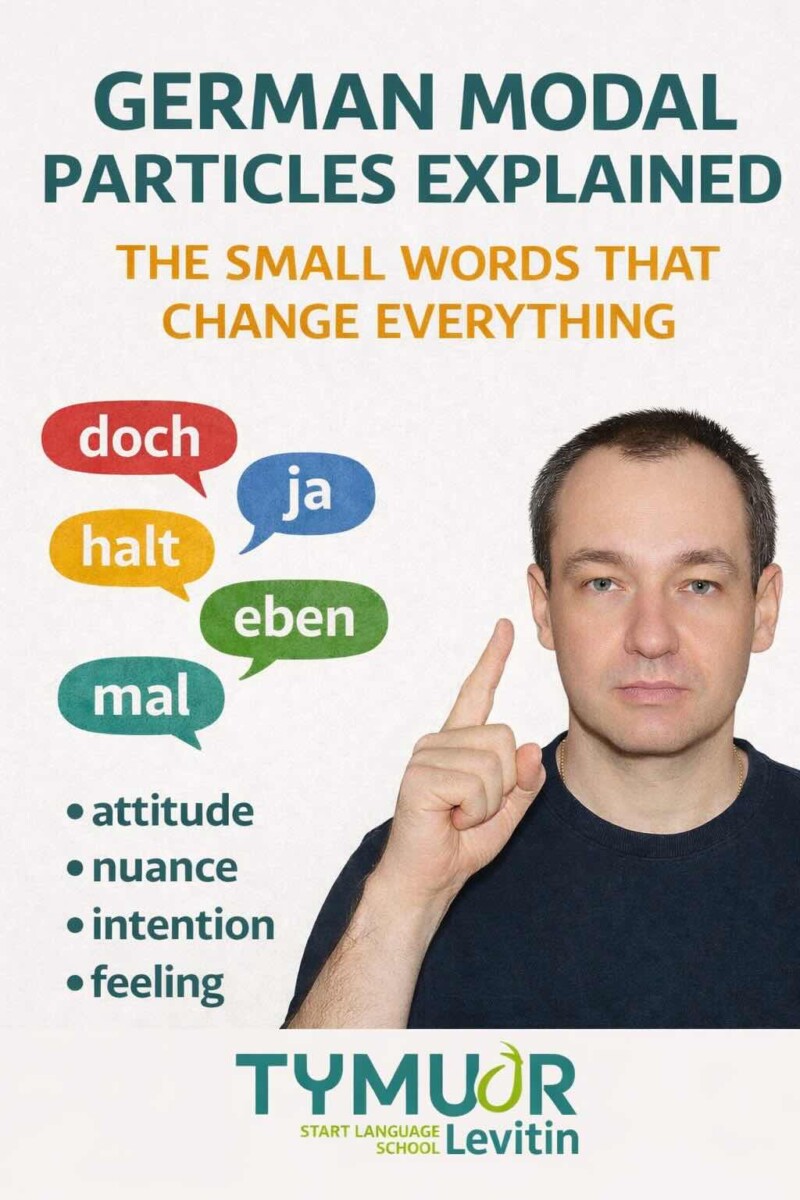
doch — correction, encouragement, gentle contradiction
- Komm.
- Komm doch.
Same verb.
Different emotional pressure.
Doch can mean:
- “you know this”
- “I gently disagree”
- “I expect you to understand”
This word alone can turn a command into a human invitation.
ja — shared knowledge, obviousness
- Das ist wichtig.
- Das ist ja wichtig.
Ja here does not mean “yes”.
It means: we both know this.
Used correctly, it builds trust.
Used incorrectly, it sounds arrogant.
halt — acceptance, inevitability
- So ist das.
- So ist das halt.
Halt expresses:
- resignation
- realism
- emotional closure
It often signals maturity — not passivity.
eben — clarity, conclusion
- Dann machen wir das so.
- Dann machen wir das eben so.
Eben closes discussion politely but firmly.
It is calm authority.
mal — softening, politeness, casual tone
- Hör zu.
- Hör mal zu.
Mal makes requests human.
Without it, speech often sounds too sharp.
Why Learners Avoid These Words — And Why They Shouldn’t
Learners avoid modal particles because:
- they are not “necessary”
- they are hard to translate
- they feel risky
But native speakers feel them instantly.
If you don’t use them, you sound:
- distant
- stiff
- translated
- emotionally flat
Understanding German is not enough.
You must be understood as a person.
How to Learn Modal Particles the Right Way
Do not memorize definitions.
Instead:
- Learn particles in pairs of sentences
- Notice what changes emotionally
- Pay attention to tone and situation
- Use them first in listening, then in speaking
This is how intuition develops.
To practice this safely and correctly:
https://levitinlanguageschool.com/teachers/tymur-levitin/
Modal Particles Are the Final Step to Natural German
Grammar builds correctness.
Vocabulary builds meaning.
Modal particles build human presence.
This is where German stops being a foreign language — and becomes communication.
Start learning German through real usage, not translation:
https://levitinlanguageschool.com/languages/learning-german/
Explore More German Learning Articles
German Vocabulary in Context — Learn Words You’ll Actually Use
German Words in Real Conversations — Learn How People Actually Speak
How to Learn German Words That Stick — Logic, Emotion, and Repetition
German Collocations You Need to Sound Natural
Thinking in German — Stop Translating and Start Speaking Naturally
German Synonyms You Must Know — Same Meaning, Different Feeling
Author’s Note
Author’s development by Tymur Levitin — founder, director and senior teacher of Levitin Language School / Start Language School by Tymur Levitin.
22+ years of teaching German, English and Ukrainian to students from more than 20 countries.
Global Learning. Personal Approach.
Official websites:
https://levitinlanguageschool.com
https://languagelearnings.com
© Tymur Levitin