








































Before you start:
👉 Choose your language: https://levitinlanguageschool.com/#languages
Why Correct German Can Still Sound Wrong
Many learners reach a point where:
- grammar is correct
- vocabulary is sufficient
- sentences are well-structured
And still — something feels off.
Native speakers understand you, but they hear immediately:
you are not thinking in German.
The reason is not words.
The reason is sentence melody.
This article continues the series on natural German speech and meaning:
German Vocabulary in Context — Learn Words You’ll Actually Use
German Words in Real Conversations — Learn How People Actually Speak
German Collocations You Need to Sound Natural
Thinking in German — Stop Translating and Start Speaking Naturally
German Synonyms You Must Know — Same Meaning, Different Feeling
German Modal Particles Explained — The Small Words That Change Everything
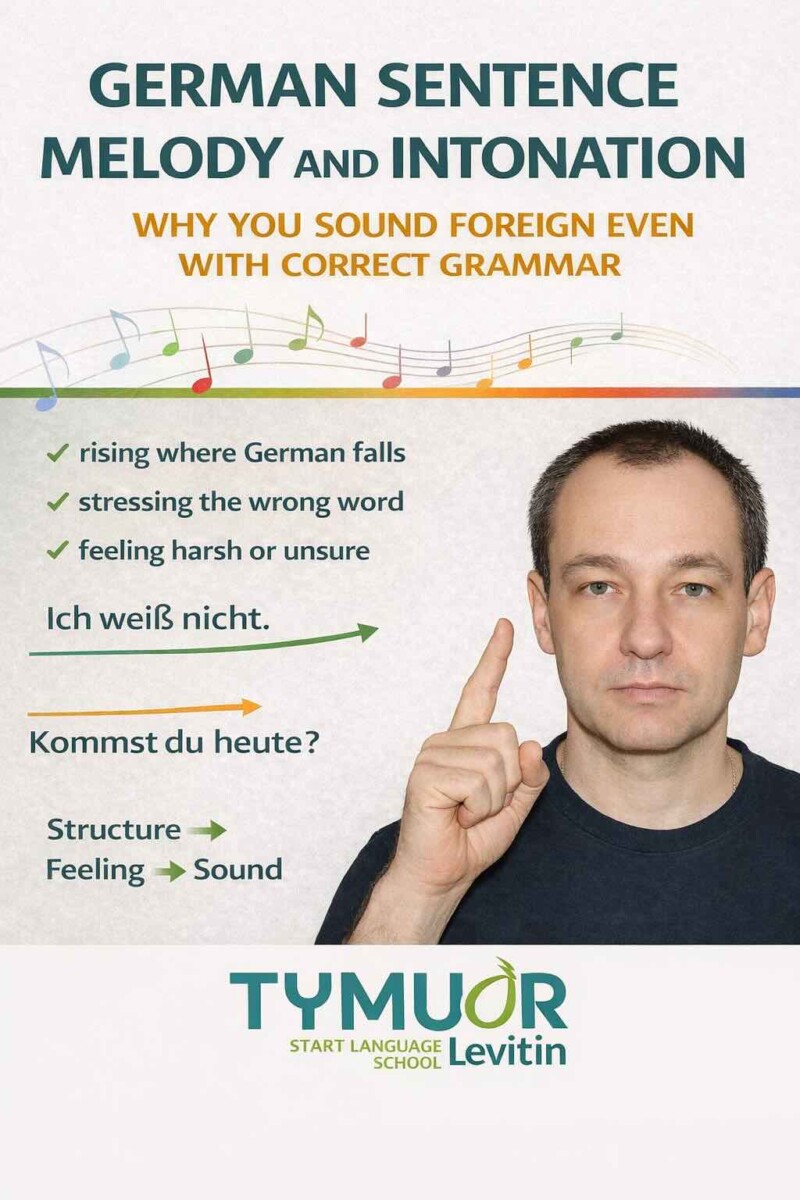
German Is a Language of Falling Intonation
German sentences tend to fall, not rise.
Learners often keep the intonation of their native language — and that creates tension, sharpness or unnatural rhythm.
Compare:
- Ich weiß nicht.
(flat, falling → neutral, calm) - Ich weiß nicht?
(rising → uncertainty, sometimes irritation)
German prefers:
- controlled endings
- clear sentence closure
- stable rhythm
This is why German can sound “hard” — but in reality it is precise and calm.
Where Germans Place the Intonation Peak
In German, the intonation peak is usually not at the end.
It often appears:
- on the main information block
- or just before the verb cluster
Example:
Das habe ich gestern zum ersten Mal gehört.
The stress is not random.
It follows the logic of meaning, not emotion alone.
If you stress the wrong word, you change the focus — or sound translated.
Why Questions in German Sound Different
Yes–no questions rise slightly — but much less than learners expect.
- Kommst du heute?
The rise is minimal.
Wh-questions often fall:
- Warum machst du das?
Not emotional — analytical.
Rising too much makes German sound:
- insecure
- nervous
- overly emotional
This is one of the strongest foreign markers.
Sentence Melody Is Connected to Word Order
German melody follows structure.
Because verbs often come at the end, Germans:
- hold the voice
- wait for closure
- release intonation at the end
Learners often “finish” the sentence too early — because they think in another language.
Understanding German word order is not grammar.
It is time control in speech.
To understand this deeper:
Thinking in German — Stop Translating and Start Speaking Naturally
Modal Particles and Melody Work Together
Modal particles are useless without correct intonation.
Compare:
- Komm doch.
(calm, falling → encouragement) - Komm doch!
(sharp rise → pressure, irritation)
Same words.
Different relationship.
This is why Germans feel intention before meaning.
To see how particles change tone:
German Modal Particles Explained — The Small Words That Change Everything
How to Train German Sentence Melody
Do not imitate accents.
Train patterns.
- Listen for where the voice falls
- Notice which word carries weight
- Copy short sentences, not long ones
- Speak slower — German needs time
- Finish sentences fully
This builds:
- confidence
- calm
- authority in speech
To practice this with guidance and feedback:
https://levitinlanguageschool.com/teachers/tymur-levitin/
Sounding Natural Is Not About Softer German
German is not meant to be soft.
It is meant to be clear.
Natural German sounds:
- stable
- grounded
- structured
- intentional
That comes from melody, not politeness.
Learn to Speak German the Way It Is Meant to Sound
If you want to sound natural, you must learn:
- how Germans structure thoughts
- where they place stress
- how they finish sentences
This is what transforms knowledge into presence.
Learn German online with a system built for real communication:
https://levitinlanguageschool.com/languages/learning-german/
Explore More German Learning Articles
German Vocabulary in Context — Learn Words You’ll Actually Use
German Words in Real Conversations — Learn How People Actually Speak
How to Learn German Words That Stick — Logic, Emotion, and Repetition
German Collocations You Need to Sound Natural
Thinking in German — Stop Translating and Start Speaking Naturally
German Synonyms You Must Know — Same Meaning, Different Feeling
German Modal Particles Explained — The Small Words That Change Everything
Author’s Note
Author’s development by Tymur Levitin — founder, director and senior teacher of Levitin Language School / Start Language School by Tymur Levitin.
22+ years of teaching German and English to students from more than 20 countries.
Global Learning. Personal Approach.
Official websites:
https://levitinlanguageschool.com
https://languagelearnings.com
© Tymur Levitin