















Language. Identity. Choice. Meaning.
👉 Choose your language
One Fruit, Two Words
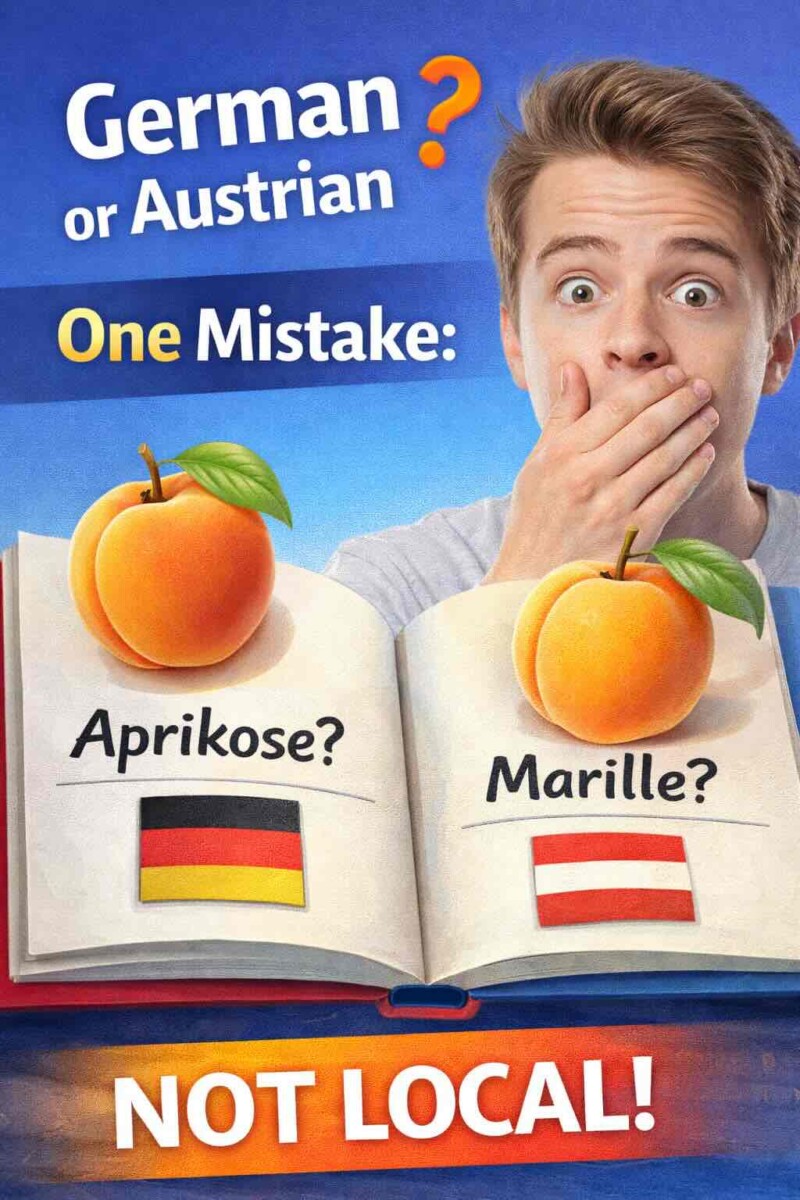
In Germany, it’s an Aprikose.
In Austria, it’s a Marille.
Same fruit — two completely different sounds, stories, and smiles.
Why the Difference?
- Aprikose comes from Latin praecoquum → “early ripening.”
Borrowed through French and used in standard German. - Marille comes from an older Italian form armellino — the version that stayed in southern regions and Austria.
So both names traveled through Europe — and simply stopped in different places.
What Austrians and Germans Hear
In Austria, Marille sounds warm, local, and deeply connected to culinary tradition.
Think Marillenknödel (apricot dumplings) — a national classic.
In Germany, Aprikose is standard — neutral, not emotional.
If you say Marille in Berlin, you sound Austrian or poetic.
If you say Aprikose in Vienna, you sound northern — or from TV.
Mini Dialogues
In Germany:
— Ich liebe Aprikosenmarmelade!
— Wirklich? Ich auch, am liebsten mit Pfannkuchen.
In Austria:
— Marillenmarmelade ist die beste!
— Freilich, nix geht über Marillenknödel.
Read and Watch in Other Languages
This article is available in four full versions.
Each language explains the same phenomenon from a slightly different cultural perspective — because language is never only vocabulary.
Read the article:
- 🇬🇧 English version — you are here
- 🇩🇪 German version — https://timurlevitin.blogspot.com/2026/02/marille-oder-aprikose.html
- 🇺🇦 Ukrainian version — https://timurlevitin.blogspot.com/2026/02/blog-post_97.html
- 🇷🇺 Russian version — https://timurlevitin.blogspot.com/2026/02/blog-post_10.html
Short video explanations (1 minute each):
- English
- German
- Ukrainian
- Russian
The videos show how native speakers actually hear these words — not just how dictionaries translate them.
Cross-Language Echoes
- English: apricot (from Latin through Arabic al-barqūq).
- French: abricot — same as German Aprikose.
- Italian: albicocca — the source of both forms.
- Hungarian: sárgabarack — literally “yellow plum.”
Beyond Fruits
Every regional difference — Paradeiser, Erdapfel, Marille —
is not just about food, but about identity and belonging.
It’s the taste of home, the rhythm of how people really speak.
Why This Actually Matters to Learners
Students often think vocabulary differences are small details.
They are not.
When you choose a regional word, native speakers immediately place you:
not by your grammar level,
not by your accent,
but by social belonging.
“Marille” doesn’t just mean a fruit.
It signals familiarity, warmth, and local identity.
“Aprikose” doesn’t just name an object.
It signals neutrality and distance.
You can speak perfect German — and still sound foreign.
Or you can make one small lexical choice — and suddenly sound local.
This is why language learning is not memorizing words.
It is learning how people recognize each other.

Learning German in Reality, Not Only in Textbooks
If regional words like Marille and Aprikose can change how people perceive you,
then learning German is not only about grammar and vocabulary lists.
It is about understanding how speakers actually use the language in real life — across Germany, Austria and Switzerland.
If you want to see how German is taught with real speech, cultural context and communication logic, you can explore our German learning program here:
👉 https://levitinlanguageschool.com/languages/learning-german/
Because language competence is not memorizing rules —
it is learning how people recognize each other through speech.
Conclusion
Whether you say Marille or Aprikose, you’re naming the same fruit —
but also showing where you come from.
In Austria, words are like flavors — sweet, local, and personal.
So next time you eat an apricot, remember:
Language can be just as delicious. 🍑
🔗 Related articles
- Paradeiser vs Tomate: Why Austrians Don’t Eat Tomatoes
- Kartoffel vs Erdapfel: Why Austrians Don’t Eat Potatoes
- Semmel vs Brötchen: How Germany and Austria Order the Same Bread
Series: Regional German
👤 Author: Tymur Levitin — founder, director & lead teacher, Levitin Language School
© Tymur Levitin, Levitin Language School