


























The Logic of Time, Space, and Experience in German
«Повтор — это не возвращение, а другое движение по той же траектории.»
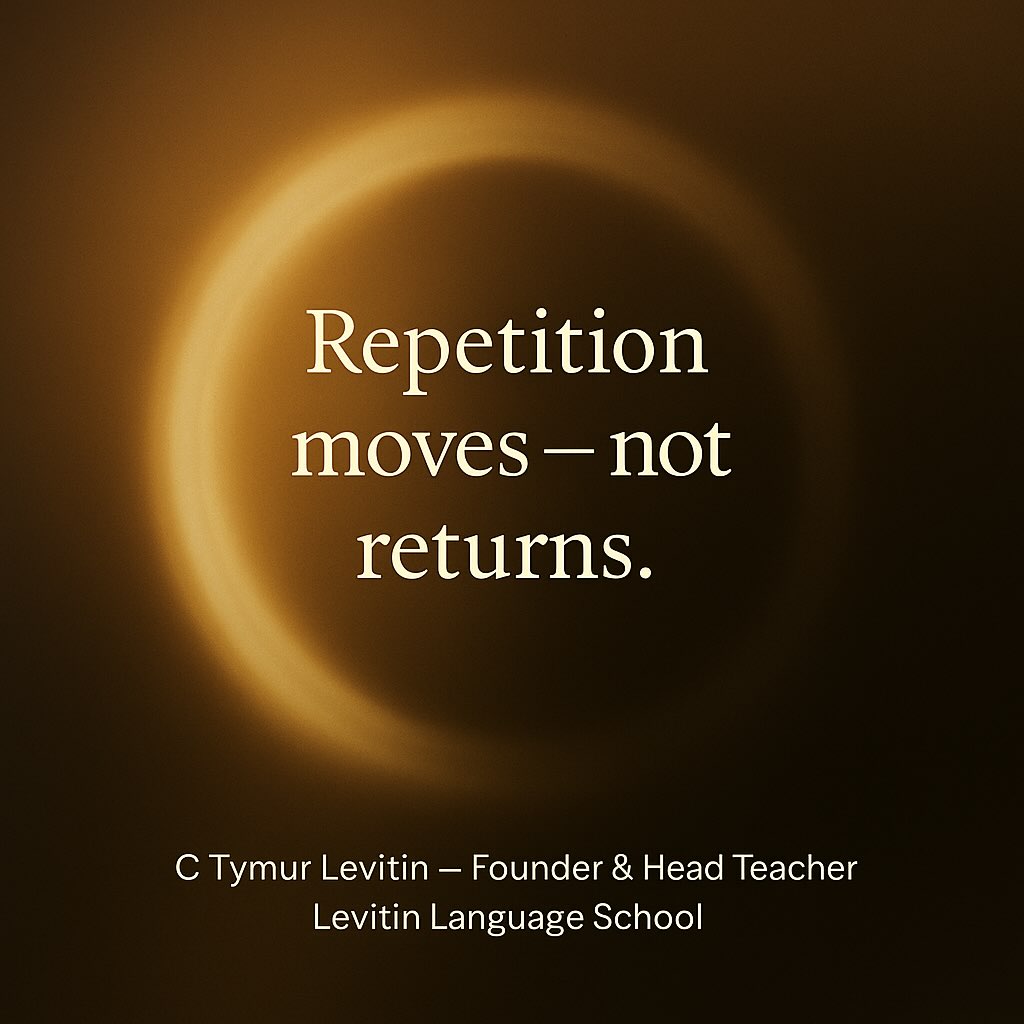
“Repetition is not return — it’s another motion along the same path.”
1. The Puzzle of Repetition
If you ask a native speaker why German needs both nochmal and wieder, they’ll often say, “They mean the same — again.”
But they don’t.
One belongs to time, the other to space.
One says do it once more, the other says go back to where it was before.
And that difference — invisible to most — reveals how German thinks about experience itself.
2. The Roots of Meaning
Nochmal is a fusion: noch (still / yet) + mal (time / occasion).
It literally means one more time. A continuation within the same timeline.
“Sag das nochmal.” — Say it once more.
You stay in the same moment; you simply breathe again inside it.
Wieder comes from Old High German widar — meaning back, against, in return.
It implies restoration — a loop, a return to a previous state.
“Er ist wieder hier.” — He is here again. (He came back.)
It’s not just repetition — it’s reconnection.
So while nochmal moves forward, wieder turns back.
Both mean again, but they travel in opposite directions through time.
3. The Philosophy of Repetition
The Danish philosopher Søren Kierkegaard wrote that repetition is “the condition for all happiness” — because through it we learn whether life is capable of returning.
Nietzsche, in contrast, turned repetition into a test: would you live your life again and again exactly as it was?
And Bergson saw time not as a line but as duration — memory flowing into the present.
German captures all three views at once:
- nochmal — the forward echo, life continuing;
- wieder — the circular return, life revisited;
- and between them — the very idea that repetition never repeats.
4. The Psychology of Doing Something “Again”
When Germans say nochmal, they imply one more attempt.
It carries warmth, momentum, even hope:
“Komm, probier’s nochmal.” — Come on, try again.
Wieder, by contrast, can sound colder — matter-of-fact, sometimes fatalistic:
“Er hat es wieder getan.” — He did it again. (And maybe he shouldn’t have.)
It’s the same event, but a different inner world.
Nochmal belongs to effort.
Wieder belongs to fate.
5. When Language Thinks in Space
English and Slavic languages think about time as motion forward.
German — uniquely — sees time as space to be revisited.
That’s why wieder can mean both again and back.
- “Ich bin wieder gesund.” → I’m healthy again (returned to a previous state).
- “Ich sage es nochmal.” → I’ll say it once more (within this moment).
Every repetition in German carries direction — it’s either horizontal (nochmal) or circular (wieder).
It’s not two words — it’s two geometries of thought.
6. Common Mistakes and Traps
- ❌ Ich mache es wieder. → sounds like undoing and redoing something.
✅ Ich mache es nochmal. → I’ll do it one more time. - ❌ Er kam nochmal nach Hause. → means “He came home one more time (and won’t again).”
✅ Er kam wieder nach Hause. → “He came home again (as before).” - ❌ Kannst du das wieder sagen? → “Can you say that back?” (strange)
✅ Kannst du das nochmal sagen? → “Can you say that again?”
These are not small errors.
They reveal how your brain imagines time.
7. The Philosophy of Error
Every mistake here is not linguistic — it’s ontological.
You either see time as linear, or as returning.
And your grammar quietly betrays that worldview.
The German speaker lives in loops and reappearances; the English speaker moves forward; the Russian speaker sees time as an emotional distance.
No dictionary captures this — but your ear does.
8. How to Feel Repetition in German
At Levitin Language School (Start Language School by Tymur Levitin),
we train students not to memorize “rules,” but to sense linguistic geometry — the inner logic behind words.
To feel the difference between nochmal and wieder:
- Hear the direction.
Nochmal moves forward. Wieder turns back. - Watch your own gesture.
Say nochmal and you lean in.
Say wieder and you pull slightly away. - Read aloud sentences that contrast both.
- “Sag das nochmal.”
- “Er ist wieder da.”
Let your voice decide which feels like repetition and which like return.
- Translate emotion, not words.
“He did it again” may mean nochmal or wieder — depending on whether you admire or disapprove.
This is what we call feeling the axis of meaning — training awareness, not grammar.
9. Translation and Cultural Logic
In translation, nochmal and wieder constantly collapse into the same again.
But translators must rebuild the invisible dimension: direction.
Is the action repeated or restored?
Is time moving or returning?
This is why German challenges translators — not because it’s difficult, but because it’s deeply conscious of structure.
It doesn’t only tell you that something happened again — it tells you how reality folded to let it happen.
10. Beyond Language: The Philosophy of Repetition
When Kierkegaard wrote Repetition, he said:
“Repetition and recollection are the same movement, only in opposite directions.”
That is precisely what German built into its words.
Nochmal is recollection moving forward.
Wieder is recollection returning.
And perhaps that’s why no repetition in life ever feels identical — because the mind, like language, never steps into the same moment twice.
© Tymur Levitin
Founder & Head Teacher of Levitin Language School
(Start Language School by Tymur Levitin)
🔗 Learn German Online
🔗 About the Teacher
Every repetition is a dialogue between memory and motion.
Read this article in other languages
🇩🇪 German Version |
🇷🇺 Russian Version |