








































Choose your language: Levitin Language School – Languages
Thesis: The Genitive Is Alive — Just Selective
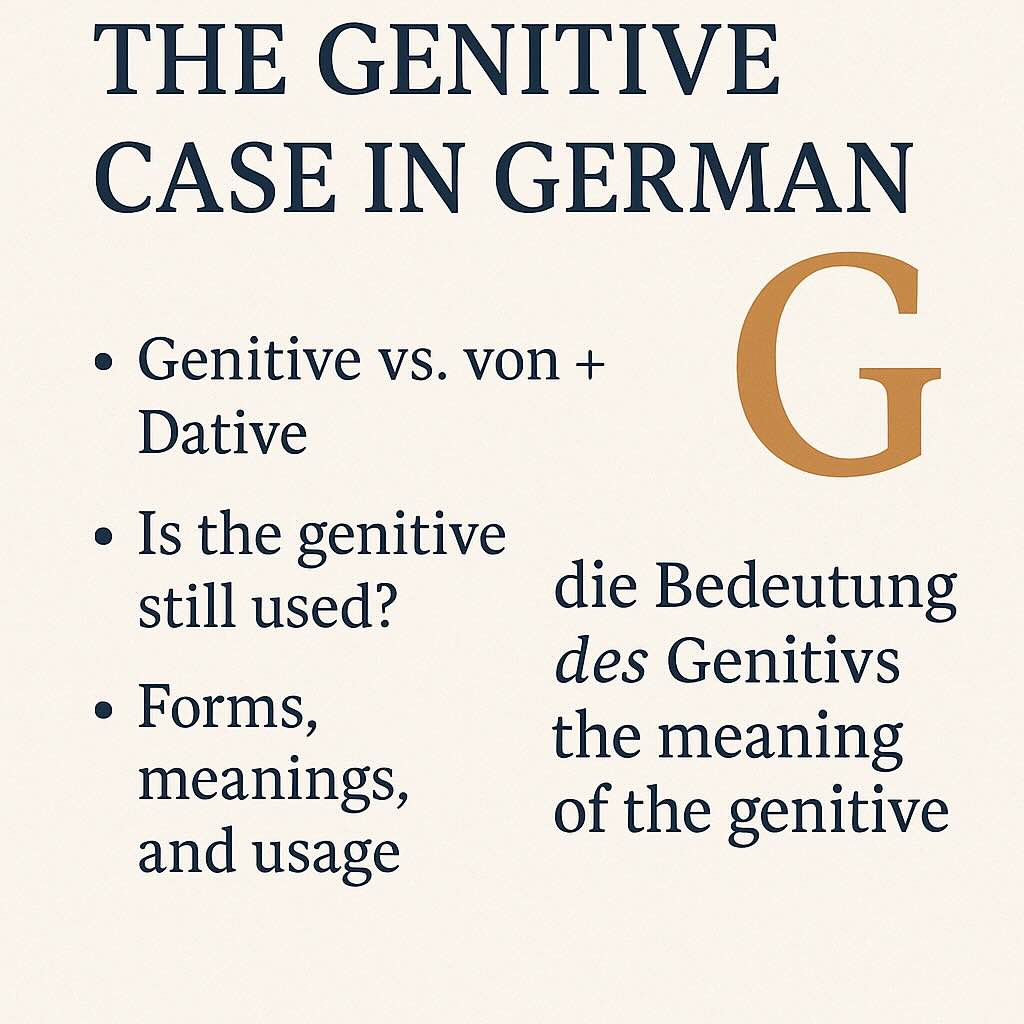
Saying “the genitive is dead” confuses frequency with function. In informal speech you’ll hear more von + dative, yes. But German still relies on the genitive for meanings and registers that von cannot replace without losing precision, flow, or tone.
1) Core Functions You Can’t Replace
A. Tight, Pre-Nominal Attribution
- Natural/concise: die Farbe des Himmels, die Entscheidung des Gerichts.
- Clumsy with von: die Farbe von dem Himmel (spoken, heavy), die Entscheidung von dem Gericht (colloquial, less formal).
Why it matters: pre-nominal genitive keeps the noun phrase compact and formal-neutral; von pushes material to the right and often lowers the register.
B. Abstract Relations (not simple “ownership”)
- die Ursache des Problems, die Folgen des Krieges, die Kritik des Publikums.
Here von is possible but frequently weakens the conceptual tie: die Kritik vom Publikum sounds more concrete/episodic; the genitive sounds analytical.
C. Proper Names & the -s Possessive
- Goethes Sprache, Deutschlands Rolle, Berlins Mitte, Siemens’ Strategie (house style varies on apostrophe).
With von: die Sprache von Goethe is longer and stylistically different; -s is idiomatic with names and many place/brand nouns.
D. Fixed Prepositions Requiring Genitive (Formal to Neutral Register)
- während, trotz, statt/anstatt, innerhalb, außerhalb, oberhalb/unterhalb, infolge, angesichts, mangels, seitens, unweit…
Colloquial alternants exist (wegen dem Wetter), but standard written usage keeps genitive (wegen des Wetters) especially in formal texts.
E. Temporal & Adverbial Genitives (Lexicalized)
- eines Tages, eines Nachts, letzten Endes, meines Erachtens.
These aren’t replaced by von; they’re part of German idiom and style.
F. Substance/Measure/Partitive (where idiomatic)
- eine Tasse Tees, ein Glas Weins (elevated/culinary), ein Stück Brot(e)s (regional/higher register).
Everyday German prefers the bare noun (ein Glas Wein), but genitive remains a licensed stylistic option.
2) Where Von + Dative Works — and Where It Breaks
Works well (neutral/colloquial):
- Human possessors in speech: das Auto von meinem Bruder.
- Long, heavy attributes moved right: die Entscheidung von den Mitgliedern des Aufsichtsrats (improves readability when the left field would explode).
Breaks (loss of tone or grammar):
- Before the head noun (German syntax doesn’t allow von-phrase there).
- Lexicalized genitives: eines Tages, letzten Endes — no von.
- Many abstract/genus-type relations: die Ursache von dem Problem is common in conversation but downgraded in formal prose.
- Prepositions that govern genitive in standard written German (see above).
3) Government: Verbs & Adjectives That Still Take Genitive
Even if rarer in speech, educated and formal registers keep them alive:
Verbs: gedenken (remember), bedürfen (require), sich rühmen (boast of), sich enthalten (abstain from), harren (wait for), sich erfreuen (enjoy).
Wir gedenken der Opfer. / Das Projekt bedarf weiterer Mittel.
Adjectives/Participles: sicher, bewusst, würdig, kundig, mächtig, überdrüssig, fähig (in set frames):
Er ist seiner Verantwortung bewusst. / Sie ist des Preises würdig.
These choices encode register. Replacing them with an/auf/von + Dat is possible but shifts the tone away from legal/administrative/academic German.
4) Register & Region: What Real German Does
- Spoken North/West: more von + Dat in everyday use; genitive retained in set phrases and formal contexts.
- South/Swiss/Austrian: wegen + Dat widely heard (wegen dem Wetter), but formal writing prefers genitive.
- Media/Official: genitive remains default for prepositions like während, trotz, innerhalb/außerhalb, and for compact nominal style.
- Academic/Legal: verb/adjective genitives and abstract noun genitives remain productive.
Bottom line: Not dead — stratified. Frequency down in conversation; function intact where precision/register matter.
5) Typical Errors & How to Teach Against Them
- Over-generalizing von
❌ die Konsequenzen von der Entscheidung → ✅ die Konsequenzen der Entscheidung (formal/neutral).
- Forgetting government
❌ wir gedenken an die Opfer → ✅ wir gedenken der Opfer.
- Article case clash after genitive preps
❌ während dem Krieges → ✅ während des Krieges.
- Stuffing a huge genitive on the left
Split heavy info:
Better use head + von-phrase if the left field becomes unreadable. Teach weight balance, not ideology.
6) Drill Set (ready for classroom)
A. Minimal Pairs (tone shift)
- die Entscheidung des Gerichts ↔ die Entscheidung vom Gericht (discuss register).
- während des Spiels ↔ während dem Spiel (regional colloquial vs standard).
B. Government Cards
Match verb/adjective to case: gedenken — Gen.; sich bewusst sein — Gen.; sich erinnern — Gen./an + Akk? (contrast!).
C. Rewriting for Weight
Turn “Die Bewertung des Projekts des Ministeriums des Innern …” into a fluent sentence using a mix of genitive and von-phrases.
D. Temporal/Idiomatic
Fill in: eines ___, meines ___, letzten ___ (Tages/Nachts/Erachtens/Endes).
7) Quick Reference (keep in the article)
- Use genitive for compact pre-nominal attribution, abstract relations, names with -s, and with genitive-governing prepositions.
- Use von + Dat to relieve overlong left branches and in casual speech with human possessors.
- Respect government (verbs/adjectives/preps).
- Keep temporal & idiomatic genitives intact.
- Choose by register: formal/textbook/legal → more genitive; casual dialogue → more von.
Author’s Reflection
The genitive didn’t die; it specialized. It protects compact structure, formal tone, and certain meanings that von dilutes. Good German is not “only genitive” or “only von” — it’s choosing the tool that preserves meaning, rhythm, and register.
Explore More → Stop Memorizing. Start Thinking.
© Tymur Levitin — Author’s Column. Founder and Director of Levitin Language School / Start Language School by Tymur Levitin.