








































Before you start:
👉 Choose your language: https://levitinlanguageschool.com/#languages
Why Translating Slows You Down
Most learners try to speak German by first thinking in their own language and then “searching” for German words.
That system cannot work.
It is too slow, too heavy and too unnatural for real conversation.
Translation creates:
- hesitation
- broken word order
- incorrect intonation
- stress and insecurity
Real fluency begins the moment you stop translating — and start thinking inside the German structure.
This article builds on the previous materials:
German Collocations You Need to Sound Natural
German Vocabulary in Context — Learn Words You’ll Actually Use
German Words in Real Conversations — Learn How People Actually Speak
How to Learn German Words That Stick — Logic, Emotion, and Repetition
What It Means to “Think in German”
Thinking in German does not mean forcing German words into your brain.
It means:
- seeing situations through German categories
- noticing patterns instead of words
- using ready-made structures, not literal translations
- understanding how Germans connect ideas
German is a system language.
If you learn the system, you gain speed.
If you translate word-by-word, you lose it.
The Secret of German Thinking: Structure First, Detail Second
Native German speakers think in “containers” — blocks of meaning.
Examples:
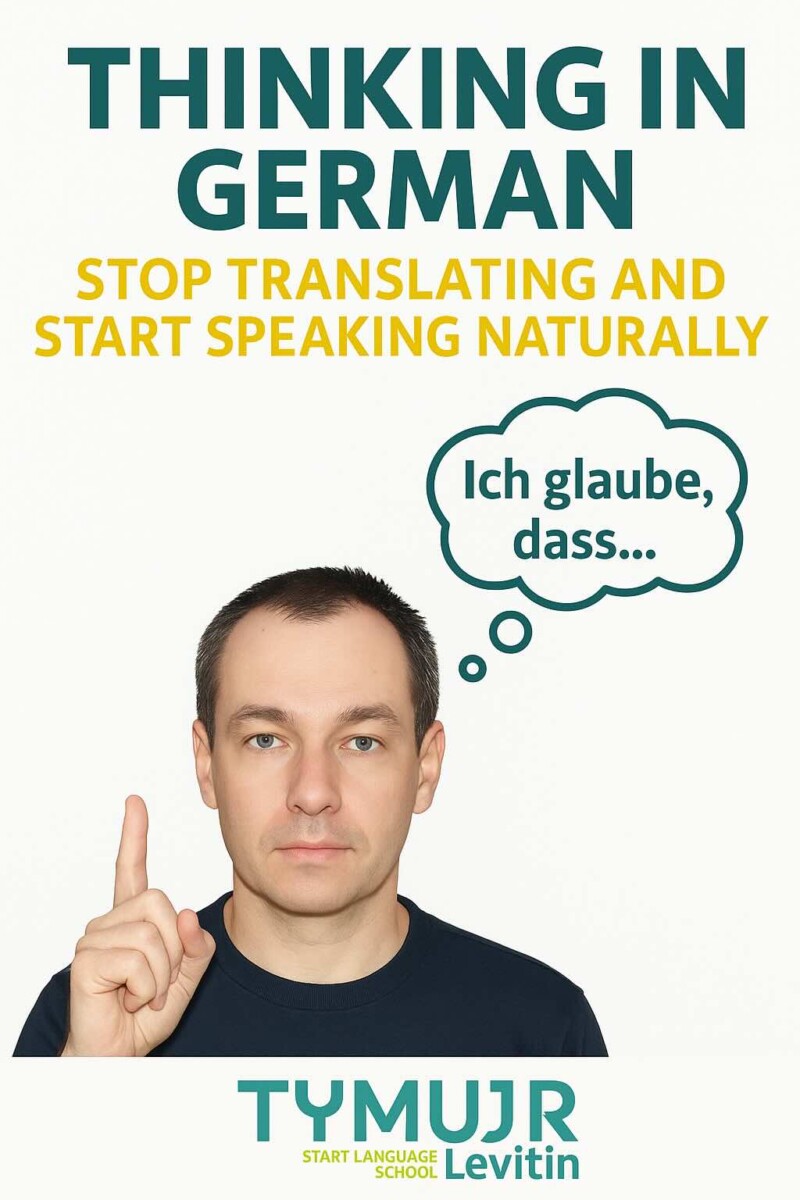
- Ich glaube, dass… → the “opinion container”
- Es geht um… → the “topic container”
- Ich bin dabei… → the “ongoing action container”
- Was ich sagen will, ist… → the “bridge container”
Each container organizes your thoughts before you talk.
Once you master them, sentences flow naturally.
This is why word order is not chaos — it is thought order.
To understand German time logic:
German Tenses Explained Simply — Learn to Use Time Naturally
Why Word Order Is Not Grammar — It Is Meaning
German puts meaning into position:
- what comes at the end is important
- what comes first sets the frame
- what stays in the middle carries emotional weight
Compare:
- Ich habe das gestern gesehen.
- Gestern habe ich das gesehen.
- Gesehen habe ich das gestern.
Same elements — different mental focus.
Thinking in German means knowing what you highlight, not just what you say.
Stop Translating — Use Patterns Instead
Here are the most powerful patterns for instant German thinking:
- Ich muss noch… → tasks and obligations
- Ich würde gern… → polite intentions
- Lass uns… → suggestions and cooperation
- Ich bin mir nicht sicher, ob… → hesitation and nuance
- Es scheint, dass… → impressions and assumptions
- Kaum…, als… → advanced narrative connector
Each pattern replaces 5–10 sentences you would normally translate from your language.
Patterns eliminate hesitation because they let you speak directly from thought.
To deepen your vocabulary through real usage:
German Collocations You Need to Sound Natural
Practice Thinking in German: A Simple Daily Method
- Describe one moment of your day in German.
Not perfectly — structurally. - Attach a pattern to every thought.
For example:
Ich glaube, dass…
Es geht darum, dass… - Use one new collocation inside each thought.
- Use one filler word to sound natural
Zum Beispiel: also, na ja, eigentlich, doch. - Repeat the idea later without translating.
Repetition creates fluency.
Thinking in German grows from repeated contact with real structures.
To learn them in conversation with a real teacher:
https://levitinlanguageschool.com/teachers/tymur-levitin/
Why You’ll Speak Faster When You Stop Translating
Thinking in German:
- increases speed
- reduces mistakes
- improves pronunciation
- activates natural intonation
- lowers stress
- builds real confidence
Translation is a barrier.
German thinking is a bridge.
Start Building Real German Thinking Today
Learn German with a system created for real communication, not memorization.
Understand German logic — and speaking becomes natural.
Learn German online at:
https://levitinlanguageschool.com/languages/learning-german/
Explore more articles:
German Vocabulary in Context — Learn Words You’ll Actually Use
German Words in Real Conversations — Learn How People Actually Speak
How to Learn German Words That Stick — Logic, Emotion, and Repetition
German Collocations You Need to Sound Natural
German Tenses Explained Simply — Learn to Use Time Naturally
Author’s Note
Author’s development by Tymur Levitin — founder, director and senior teacher of Levitin Language School / Start Language School by Tymur Levitin.
22+ years of teaching German, English and Ukrainian to students from more than 20 countries.
Global Learning. Personal Approach.
Official websites:
https://levitinlanguageschool.com
https://languagelearnings.com
© Tymur Levitin