







































Many learners experience the same moment:
You understand every word.
The grammar is correct.
But the tone feels… harsh.
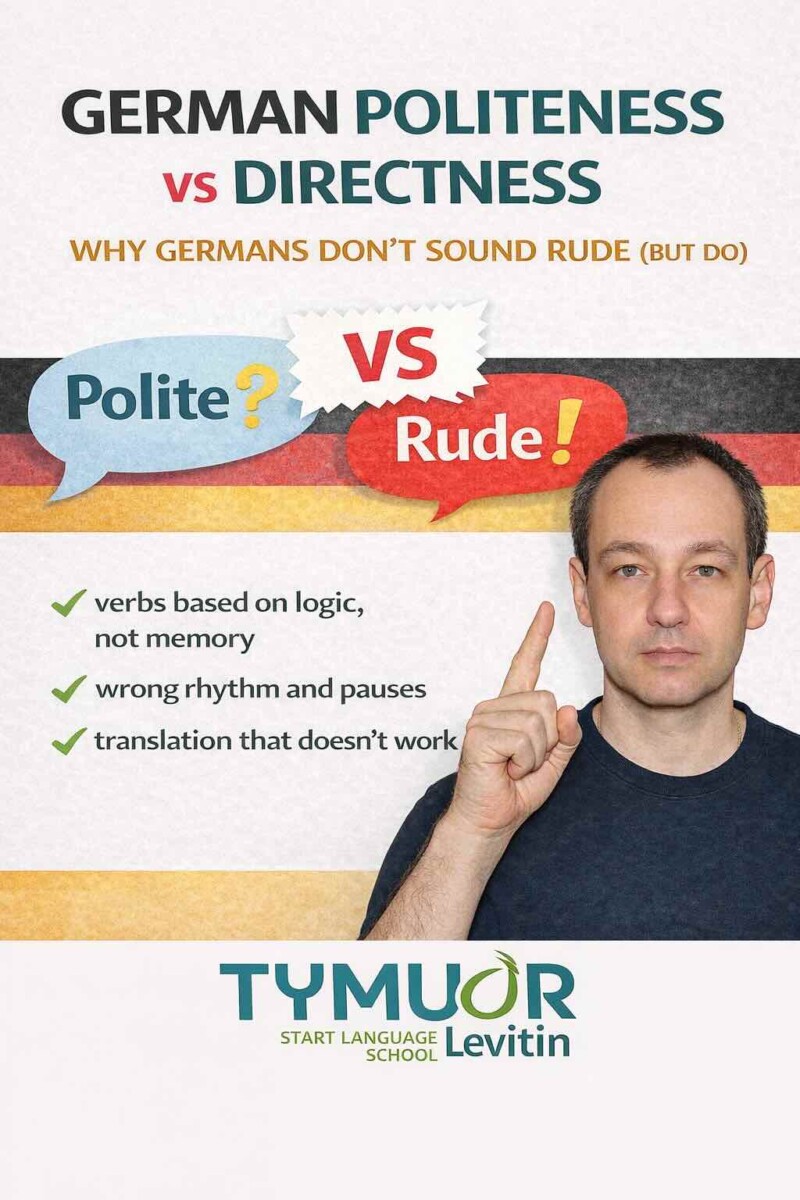
German often sounds rude to people who learned politeness through softeners, indirectness, and emotional cushioning.
But German politeness works differently.
This article explains why German directness is not rudeness, how politeness actually functions in German, and why many learners misread it.
This text continues the series on real German usage and perception:
German Vocabulary in Context — Learn Words You’ll Actually Use
German Words in Real Conversations — Learn How People Actually Speak
How to Learn German Words That Stick — Logic, Emotion, and Repetition
German Collocations You Need to Sound Natural
Thinking in German — Stop Translating and Start Speaking Naturally
German Synonyms You Must Know — Same Meaning, Different Feeling
German Modal Particles Explained — The Small Words That Change Everything
German Sentence Melody and Intonation — Why You Sound Foreign Even with Correct Grammar
German Word Order in Real Life — Why Correct Sentences Still Sound Wrong
Politeness in German Is Not Emotional Softness
In many languages, politeness means:
- sounding gentle
- avoiding direct statements
- protecting emotions
In German, politeness means something else:
- clarity
- honesty
- respect for time and space
A German speaker is polite when they are clear and precise, not when they are vague.
This difference is the root of most misunderstandings.
Why “Bitte” Does Not Automatically Make You Polite
Learners often overuse:
- bitte
- könnten Sie
- vielleicht
And still sound strange.
Why?
Because politeness in German is not built from polite words alone.
It is built from:
- structure
- intonation
- timing
- sentence closure
A direct sentence with correct structure often sounds more polite than a soft but poorly structured one.
Directness Is a Form of Respect
In German culture, indirectness can feel:
- confusing
- inefficient
- even dishonest
Direct speech shows:
- you take responsibility for your words
- you respect the listener’s ability to understand
- you do not manipulate emotions
This is why Germans often prefer:
- statements over hints
- clarity over emotional cushioning
Directness is not aggression.
It is respect through transparency.
Intonation Decides Whether You Sound Rude or Calm
The same sentence can sound:
- neutral
- irritated
- demanding
depending on intonation.
German politeness relies heavily on falling intonation and controlled endings.
Compare:
- Kommen Sie bitte.
(calm, falling → polite) - Kommen Sie bitte?
(rising → insecurity or irritation)
This connects directly to sentence melody.
For deeper understanding, see:
German Sentence Melody and Intonation — Why You Sound Foreign Even with Correct Grammar
Modal Particles Soften Without Weakening
German does not soften speech by becoming vague.
It softens speech by adding intention markers.
Modal particles like:
- doch
- mal
- ja
do not remove directness — they humanize it.
Compare:
- Kommen Sie.
- Kommen Sie doch mal.
Same request.
Different emotional weight.
To understand how this works, see:
German Modal Particles Explained — The Small Words That Change Everything
Why Learners Misread German Tone
Learners often judge German through:
- their native politeness norms
- emotional expectations
- translated intonation
This leads to false conclusions:
- “They are angry”
- “They are unfriendly”
- “They don’t care”
In reality, Germans often sound exactly as intended:
- focused
- neutral
- efficient
German politeness is low-emotion, high-respect.
How to Sound Polite in German Without Sounding Weak
Forget soft words.
Focus on structure.
- Use clear sentence order
- Finish sentences calmly
- Control intonation
- Avoid over-explaining
- Let clarity do the work
This creates speech that sounds:
- confident
- respectful
- adult
To train this with guidance and feedback:
https://levitinlanguageschool.com/teachers/tymur-levitin/
German Politeness Is Cultural, Not Linguistic
German politeness is not about grammar.
It is about worldview.
Once you accept that:
- directness can be respectful
- clarity can be kind
- emotional distance can mean trust
German stops sounding rude.
It starts sounding honest.
Learn German for Real Communication
If you want to communicate naturally in German, you must understand how meaning, structure and culture work together.
Explore structured German learning here:
https://levitinlanguageschool.com/languages/learning-german/
Explore the Full German Series
German Vocabulary in Context — Learn Words You’ll Actually Use
German Words in Real Conversations — Learn How People Actually Speak
How to Learn German Words That Stick — Logic, Emotion, and Repetition
German Collocations You Need to Sound Natural
Thinking in German — Stop Translating and Start Speaking Naturally
German Synonyms You Must Know — Same Meaning, Different Feeling
German Modal Particles Explained — The Small Words That Change Everything
German Sentence Melody and Intonation — Why You Sound Foreign Even with Correct Grammar
German Word Order in Real Life — Why Correct Sentences Still Sound Wrong
Author’s Note
Author’s development by Tymur Levitin — founder, director and senior teacher of
Levitin Language School / Start Language School by Tymur Levitin.
Over 22 years of experience teaching languages to students from more than 20 countries, with a focus on real communication, thinking patterns and cultural accuracy.
Global Learning. Personal Approach.
Official websites:
https://levitinlanguageschool.com
https://languagelearnings.com
© Tymur Levitin