








































Author’s Column — Tymur Levitin
Choose your language
“Should I think in English?”
It’s one of the most common questions I get from students — especially those who already speak two or more languages. They feel blocked. And someone on the internet told them, “You just need to start thinking in English.”
That sounds inspiring — but it’s misleading.
Because the truth is:
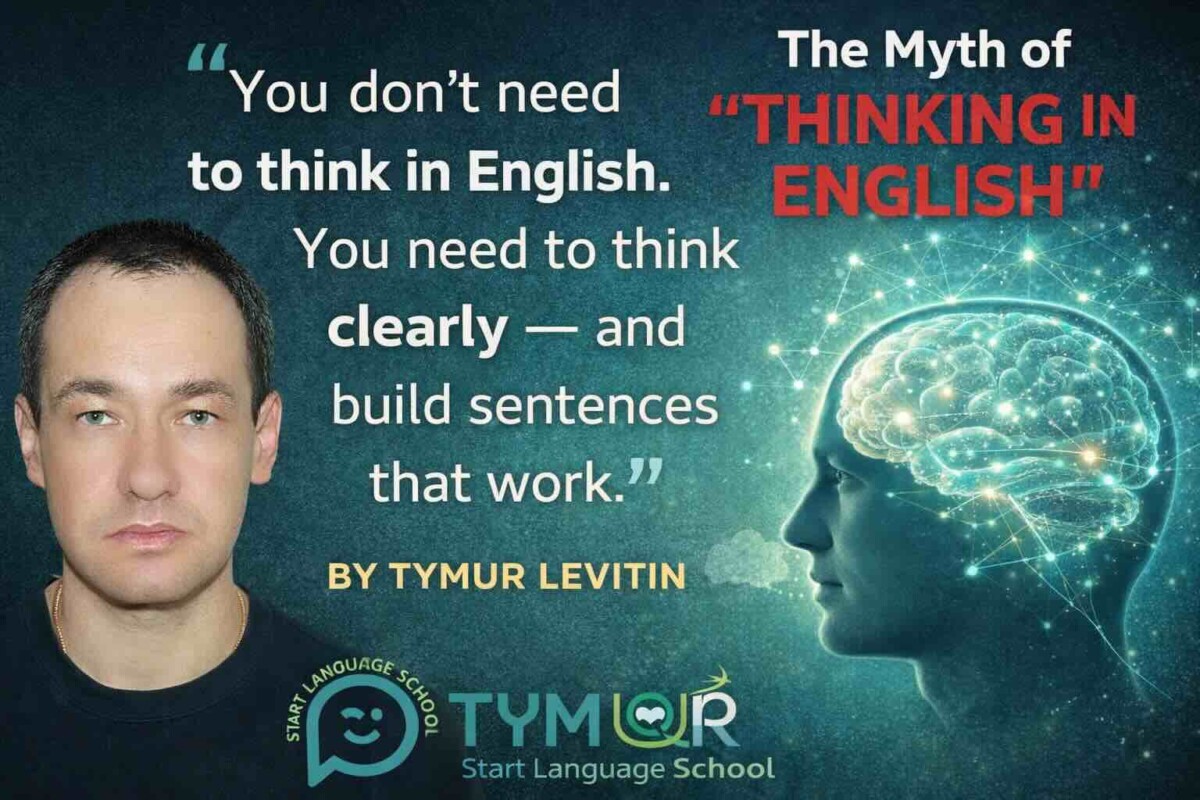
❝You don’t need to think in English. You need to think clearly — and build sentences that work.❞
Let me explain.
What “Thinking in English” Really Means — and Why It Doesn’t Help
There are two ways this idea is usually interpreted:
- “Don’t translate — just think directly in the target language.”
- “Change your whole internal monologue to English.”
But here’s the problem:
- Most learners don’t have enough vocabulary or structure to build full thoughts in a new language.
- Forcing yourself to think in English too early causes mental overload and frustration.
- You’re not thinking — you’re guessing, filling gaps, or freezing.
It’s like trying to build a house without a foundation — you’re jumping to the roof with nothing under your feet.
What You Should Do Instead
Here’s what I recommend:
✅ Think clearly.
Before speaking, know exactly what you want to say — even in your native language.
✅ Visualize structure.
In our lessons, we teach students to understand how sentences work — where the verb goes, how ideas connect, how to mark time or cause.
✅ Use the languages you know to unlock the one you’re learning.
That’s part of our cross-language method. We compare, contrast, and build bridges — not walls.
✅ Trust your brain — but guide it.
You don’t need to shut off your native language. You need to train the transitions.
An Example:
A student once told me:
“I try to think in English, but nothing comes out.”
When we slowed down and built the sentence together — “I wanted to say that I had already been there once” — he realized that he knew all the words.
But thinking in English too early had blocked him.
He needed to understand how the past perfect actually works.
Once he did — the sentence became natural.
We didn’t need tricks. We needed logic.
What “Thinking in a Language” Actually Is
It’s not about replacing your thoughts.
It’s about reorganizing your thinking patterns around meaning, grammar, and sound.
You’ll reach a point where:
- Verbs come out without effort,
- Word order feels right,
- You don’t translate anymore…
…but that’s not thinking in English.
That’s mastering expression through English.
It comes from structure, clarity, and confidence — not slogans.
How We Teach This at Levitin Language School
At Levitin Language School, we guide students through real development:
- Learning German through intuitive logic
- Learning Spanish through immersion in patterns
- Learning Ukrainian through clear thinking and sound
- Learning English through structural awareness and real-life context
We don’t force shortcuts. We build thinking.
You’ll learn to feel the language — but only because you understand it first.
Want More?
Here are other articles that go deeper:
- Language Myths Busted: Learning a Language Isn’t About Tricks — It’s About Thinking
- Don’t Memorize German Prefix Lists — Listen and Understand Instead
- Rethinking German Word Order: Cause ⇄ Effect
© Tymur Levitin — Founder, Director & Head Teacher
Levitin Language School / Start Language School by Tymur Levitin
Global Learning. Personal Approach.