



























Author’s Column by Tymur Levitin
Founder, Director & Senior Teacher — Levitin Language School /
Start Language School by Tymur Levitin
Global Learning. Personal Approach.
If you have ever tried to learn Norwegian, chances are high that the word på started to haunt you at some point.
You see it everywhere.
You recognize it.
You even understand most sentences where it appears.
And yet — when it’s your turn to speak — you hesitate.
You guess.
Sometimes you’re right. Often, you’re not.
This article explains why på cannot be translated, why guessing it is not a learning strategy, and how to build an internal cognitive model that finally makes this word predictable.
This is not a list of rules.
This is about how Norwegian encodes reality.
The Illusion: “på Means ‘On’”
Most learners meet på through English.
On the table → på bordet
So far, so good.
But very soon, the illusion collapses:
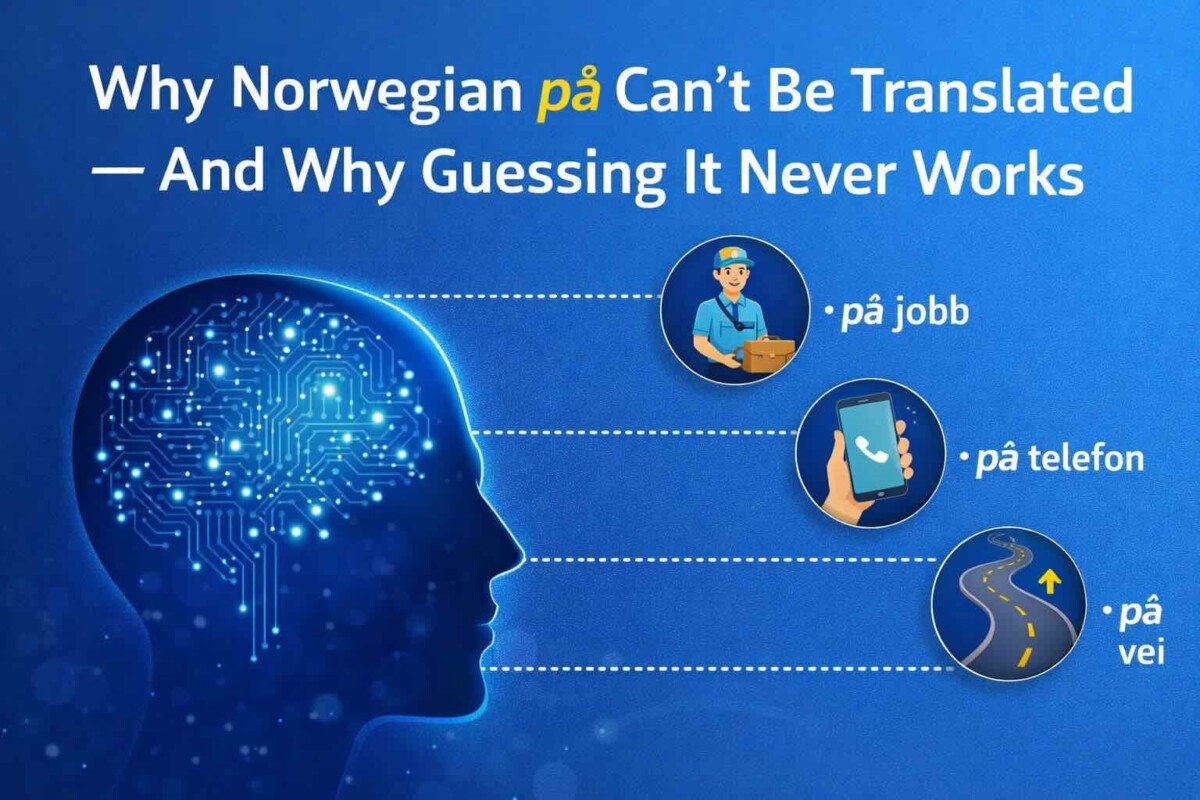
- på jobb — at work
- på telefon — on the phone
- på norsk — in Norwegian
- på tide — time to
- på vei — on the way
At this point, learners usually do one of two things:
- Start memorizing random examples
- Start guessing
Both approaches fail for the same reason:
they treat på as a word, not as a concept.
The Core Problem: You’re Looking for a Translation
Languages do not translate reality the same way.
They categorize it differently.
Norwegian does not use på because of tradition or habit.
It uses på because it reflects a specific way of positioning something in relation to a state, system, or mode.
And here we reach the key insight.
The Cognitive Model of på
På does not describe location.
På describes being positioned within an active surface, system, or mode.
This is the model everything falls into.
Not “on”.
Not “at”.
Not “in”.
But engaged, connected, operating within.
Let’s see how this works.
Physical Surface Is Just the Simplest Case
Yes, på bordet literally means “on the table”.
But that’s only the most primitive manifestation of the model.
A surface in Norwegian is not just physical.
It can be:
- conceptual
- functional
- abstract
Once you understand this, på stops being random.
States, Modes, and Functional Surfaces
på jobb — at work
You are not “inside” work.
You are operating in work mode.
på telefon — on the phone
Not physically on anything.
You are connected to a communication channel.
på norsk — in Norwegian
You are using a linguistic system.
på vei — on the way
You are in a dynamic transitional state, not at a point.
på tide — time to
You are at the activation point of an action, not describing time itself.
Each time, på marks engagement with an active framework.
Why Guessing på Never Works
Guessing assumes that:
- the language works by substitution
- one word equals one equivalent
Norwegian does not work like this.
If you guess på, sometimes you succeed — by coincidence.
But you never build predictability.
And predictability is the only real sign of language competence.
Comparison With English and German
English often uses on where Norwegian uses på, but not always — and for different reasons.
German may use:
- auf
- an
- bei
- or nothing at all
Slavic languages often split the same concept into:
- на
- по
- в
- за
Norwegian compresses these meanings into one cognitive axis:
contact + activation + surface/system involvement
This is why på feels overwhelming — and why it becomes simple once the model is clear.
How to Stop Memorizing and Start Predicting
Ask yourself one question:
Am I describing a position inside a closed space — or a state of active engagement with something?
If it’s the second — på is very likely the answer.
Not always.
But predictably often.
And that is the difference between guessing and understanding.
Video Lesson (English)
▶ Watch the 5-minute video explanation:
In this lesson, you will see:
- a clear visual model of på
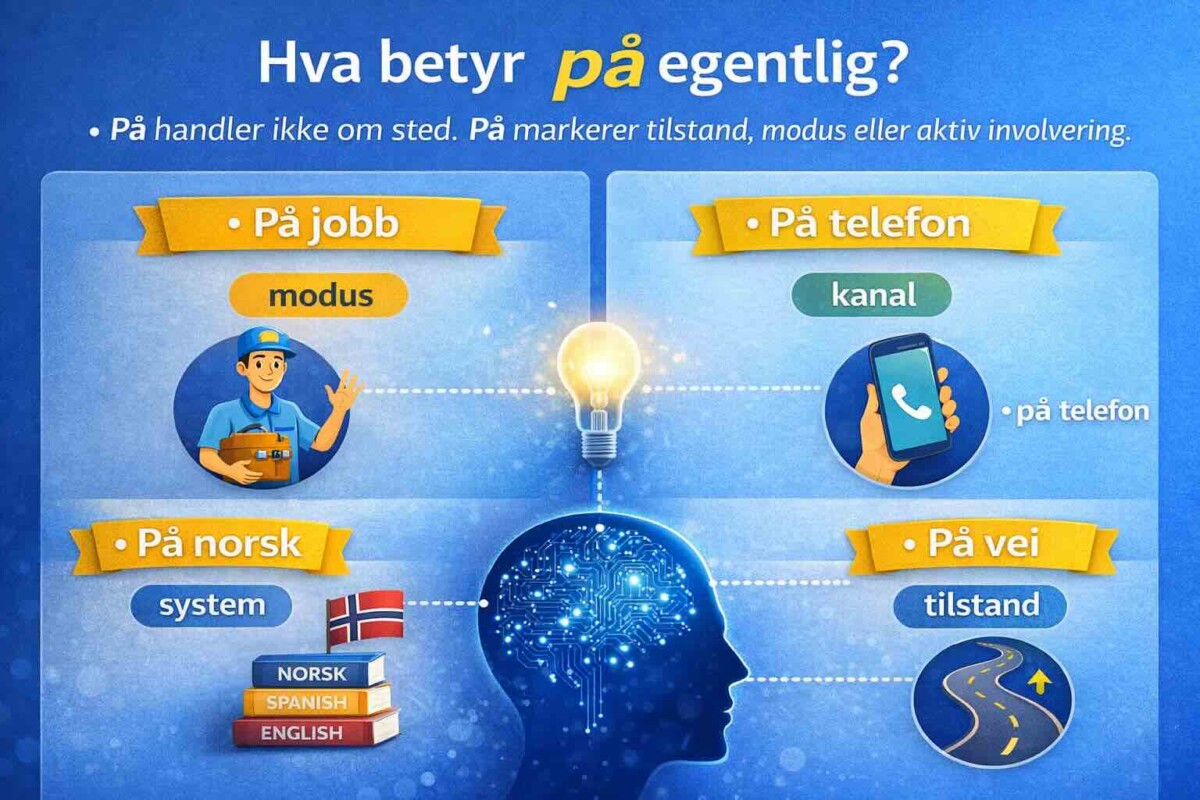
- real-life usage examples
- comparison with English and German
- typical learner mistakes and how to avoid them
Language Versions of This Article
- 🇷🇺 Russian version — Почему норвежское på нельзя переводить
- 🇺🇦 Ukrainian version — Чому норвезьке på не перекладається
- 🇳🇴 Norwegian version — Hva betyr på egentlig?
Short video explanations are available for each language version of this article.
- 🎬 English Short — Why “på” is not “on”
- 🎬 Russian Short — Почему på нельзя угадать
- 🎬 Ukrainian Short — На, по чи… не те
- 🎬 Norwegian Short — På forklart på 60 sekunder
Final Thought
Languages don’t confuse you.
They reveal how you think.
If på feels chaotic, it’s not because Norwegian is illogical.
It’s because your current model is incomplete.
Once the model changes, the chaos disappears.
© Tymur Levitin
Author’s Column — Levitin Language School /
Start Language School by Tymur Levitin