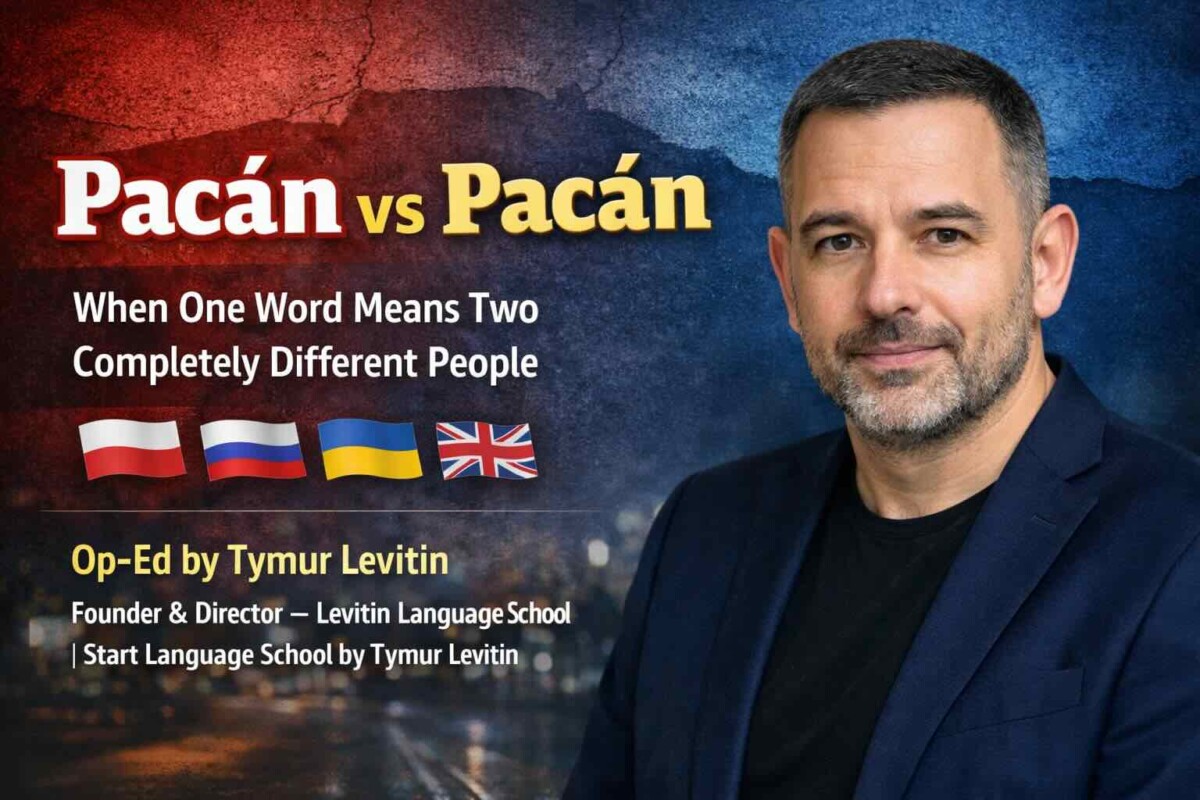























When One Word Means Two Completely Different People
Author’s column by Tymur Levitin
Founder & Director — Levitin Language School / Start Language School by Tymur Levitin
Global Learning. Personal Approach.
Introduction: When Words Look the Same but Are Not
Some of the most dangerous words in any language are not the ones you don’t know —
but the ones you think you know.
Across Polish, Russian, Ukrainian, and English, there is a small, innocent-looking word that creates one of the most powerful linguistic traps in Europe:
pacan / пацан
It looks the same.
It sounds almost the same.
But it describes completely different human realities.
And if you get it wrong, the social consequences can be real.
What “Pacan” Looks Like
In writing:
| Language | Word |
|---|---|
| Polish | pacan |
| Russian | пацан |
| Ukrainian | пацан |
| English | (no equivalent) |
Same shape.
Same rhythm.
But not the same meaning.
This is what linguists call a false friend — a word that tricks you into thinking you understand it.
Except here, the trap is not just linguistic.
It is social.
What “Pacan” Means in Polish
In Polish, pacan is not neutral.
It means something close to:
a rude, primitive, socially unrefined person
someone behaving like a fool or a brute
You might hear it in contexts like:
- mocking
- irritation
- contempt
- distancing
Calling someone pacan in Polish is an insult.
It does not describe identity.
It describes lack of class, lack of manners, lack of self-control.
It belongs to the language of social judgment.
What “Patsan” Means in Russian
In Russian, пацан does not mean “fool” or “clown”.
It means something much deeper — and much darker.
It refers to:
- street identity
- gang culture
- informal male hierarchy
- loyalty codes
- power structures
A пацан is not “a boy”.
He is a person who belongs to a street code.
In many contexts, it carries:
- pride
- threat
- solidarity
- violence
- loyalty
- status
It is a social role, not just a word.
This is why in Russian you hear phrases like:
“пацан сказал — пацан сделал”
(A patsan said it — a patsan will do it)
This is not childish.
This is honor code language.
What Ukrainian Does With This Word
Ukrainian uses пацан mostly as a borrowed word.
It does not belong to traditional Ukrainian vocabulary.
It entered through contact with Russian urban culture.
In Ukrainian speech today it can mean:
- an ironic “guy”
- a casual “dude”
- or a reference to street style
But it does not carry the same deep criminal identity that it does in Russian.
Ukrainian speakers often underestimate how heavy this word is in Russian.
And that is exactly where misunderstanding begins.
Why English Has No Equivalent
English does not have a direct translation for пацан / pacan.
Words like:
- guy
- dude
- kid
- boy
- lad
do not encode:
- street hierarchy
- criminal loyalty
- social threat
- or honor code
English separates:
- who you are
from - how you behave
Slavic languages often merge them.
That is why English speakers have trouble even feeling the danger inside this word.
Why This Is a Linguistic Trap
Now imagine this situation:
A Polish speaker hears a Russian speaker call someone пацан and thinks:
“Oh, like a foolish guy.”
A Ukrainian speaker uses пацан casually, not knowing the criminal weight it carries in Russian.
A Russian speaker hears a Polish pacan and thinks:
“Why is he insulting me?”
Everyone thinks they understand.
No one actually does.
This is how false friends become social explosives.
Words That Create Identity
In Russian street culture, calling someone пацан is not just describing him.
It is assigning him a role:
- who he is
- how he should behave
- what rules he follows
- who he belongs to
Language here is not communication.
It is identity programming.
Polish pacan does the opposite — it removes status.
Same word.
Opposite power.
Why This Matters in Real Life
People lose:
- respect
- safety
- trust
- sometimes even physical security
because they use words that look harmless but are not.
Language is not neutral.
Language places you into:
- groups
- hierarchies
- and expectations
without asking your permission.
This Is Why We Teach Language Differently
At Levitin Language School and Start Language School by Tymur Levitin,
we do not teach words.
We teach what words do to people.
Because the real danger in language is never grammar.
It is misunderstanding what kind of world a word belongs to.
Read This Article in Other Languages
(Each version is written for its own linguistic reality.)
Short Video Explanation
This article is accompanied by short video explanations in:
- English
- Polish
- Ukrainian
- Russian
© Tymur Levitin
Founder & Director — Levitin Language School
Start Language School by Tymur Levitin