








































Author’s Column by Tymur Levitin
Language. Identity. Choice. Meaning.
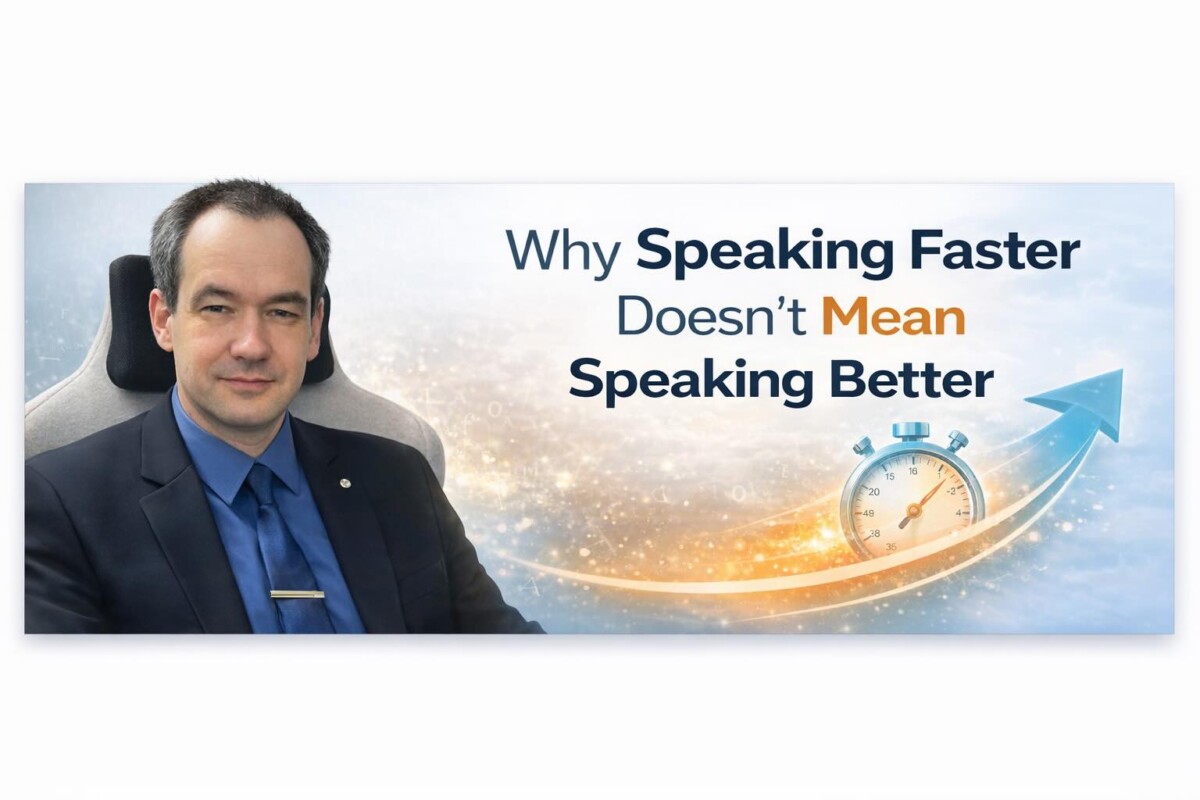
One of the most persistent myths in language learning is the idea that speed equals proficiency.
Students often say: “I need to speak faster”, “Native speakers speak so quickly”, “If I pause, it means my level is low.”
This belief is not only incorrect — it is actively harmful.
In my experience as a language teacher and applied linguist, speed is one of the least reliable indicators of real language competence. In many cases, speaking faster actually signals insecurity, imitation, or a lack of internal structure.
Let’s unpack why.
Speed Is a Surface Feature, Not a Skill
Speaking speed is easy to imitate.
Understanding is not.
A learner can accelerate speech by:
- memorizing chunks,
- copying intonation,
- skipping grammatical accuracy,
- avoiding precise vocabulary,
- filling gaps with noise words.
None of this means the person controls the language.
Real language skill is not about how fast words leave your mouth.
It is about how intentionally they are chosen.
Fast Speech Often Masks Weak Thinking
In many classrooms, students are unconsciously trained to:
- respond immediately,
- avoid silence,
- “keep talking no matter what.”
This creates a dangerous habit: speaking before thinking.
But language is not just output.
Language is structured thought expressed through sound.
When speed replaces reflection, speech turns into:
- approximation instead of meaning,
- fluency instead of clarity,
- rhythm instead of responsibility.
You can hear this clearly in learners who speak quickly but cannot:
- reformulate an idea,
- clarify a misunderstanding,
- adjust register,
- explain what they actually meant.
Native Speakers Pause — A Lot
Another misconception is that native speakers speak continuously and effortlessly.
They don’t.
They pause to:
- choose a word,
- adjust tone,
- reconsider meaning,
- soften or strengthen a statement,
- avoid saying something imprecise.
Pauses are not a weakness.
They are a sign of linguistic awareness.
In professional, academic, and high-stakes communication, controlled pauses increase authority, not reduce it.
Speed Without Accuracy Is Noise
When learners prioritize speed, accuracy becomes negotiable.
That’s where problems begin.
In real communication:
- small grammatical shifts change responsibility,
- tense choices change timelines,
- word order changes emphasis,
- prepositions change intent.
Fast speech often sacrifices these distinctions.
The result may sound fluent — but it is unstable, unreliable, and sometimes misleading.
Language that cannot be trusted loses its value.
Thinking Time Is Not a Problem — It’s a Skill
One of the core principles of my teaching method is simple:
The moment before speaking is part of speaking.
That moment is where:
- structure forms,
- intention becomes clear,
- the sentence chooses its shape.
Students who allow themselves thinking time develop:
- stronger internal grammar,
- better lexical precision,
- calmer delivery,
- long-term independence.
They do not just speak.
They own what they say.
Why Slower Speech Often Sounds More Confident
Paradoxically, speakers who slow down often:
- sound more mature,
- appear more competent,
- are easier to understand,
- make fewer critical errors.
This is not accidental.
Slower speech reflects:
- internal organization,
- conscious choice,
- respect for meaning,
- responsibility for words.
In many cultures and professional environments, measured speech equals credibility.
Language Is Not a Race
Language learning is not a speed competition.
It is not about:
- beating silence,
- matching native tempo,
- performing fluency.
It is about:
- building meaning,
- managing nuance,
- expressing thought safely and accurately.
When speed comes naturally from understanding, it stays.
When it is forced, it collapses under pressure.
Final Thought
If you speak faster than you think, the language controls you.
If you think before you speak, you control the language.
Fluency grows from clarity — not from haste.
© Tymur Levitin
Founder, Director & Senior Teacher
Levitin Language School / Start Language School by Tymur Levitin
Global Learning. Personal Approach.