










































Language learning is often misunderstood.
Most students believe the goal is fluency.
Speak faster. Speak more. Speak without pauses.
But in real communication, speed does not create trust.
Control does.
Precision is not about speaking like a textbook.
It is about speaking so that people understand you exactly the way you intend.
And that changes everything.
What Precision Actually Means
Precision is the difference between:
“I think I understood the contract”
and
“I have reviewed the contract and understand its terms.”
Both sentences are grammatically acceptable.
Only one sounds professional.
Precision is not perfectionism.
It is predictability.
When your speech is predictable, people relax.
They stop decoding your language and start listening to your ideas.
This is the moment when a language stops being a subject
and becomes a tool.
Grammar Is Not Rules — It Is Structure
Many adults carry a school trauma: grammar equals punishment.
In reality, grammar is architecture.
It organizes time, responsibility, certainty, politeness, and distance between people.
Consider these:
- “I work here.”
- “I have been working here.”
- “I will be working here.”
The vocabulary hardly changes.
The message changes completely.
A person who controls tense, aspect, and sentence structure does not simply “know English”.
They manage perception.
You are no longer just answering questions.
You are shaping how others evaluate your competence.
Vocabulary Is Not Decoration — It Is Positioning
Students often ask how many words they need.
The real question is different:
Which words define your professional identity?
Compare:
“I did many tasks.”
“I coordinated the project workflow.”
The first sentence communicates effort.
The second communicates expertise.
Language is social signaling.
Specific vocabulary places you into a category — student, employee, specialist, or authority.
When your vocabulary becomes precise, conversations change.
You are invited into discussions instead of being tolerated in them.
Why “Fluency” Alone Is Not Enough
Fast speech without control creates noise.
Native speakers can still understand you, but they unconsciously simplify their language in response.
Meetings become shorter.
Responsibilities become smaller.
You may not notice it — but your language level quietly defines your professional ceiling.
Precision reverses this.
Controlled speech shows discipline.
Structured sentences show analytical thinking.
Accurate wording shows reliability.
Language becomes reputation.
How We Approach This at Levitin Language School
My teaching work began more than two decades ago with a simple observation:
Students were not failing because they could not learn.
They were failing because they were trained to memorize instead of to control.
At Levitin Language School, we do not train people to “speak more”.
We train them to:
- understand why a structure is used,
- select vocabulary intentionally,
- and construct sentences consciously.
Fluency appears as a result — not as a goal.
I personally teach English and German, while our international teaching team works with many other languages and communication goals.
Each instructor specializes in their field, and students are guided to the language and format that fits their real-life tasks: relocation, studies, career, or everyday communication.
The method remains the same:
Language is not learned by repeating phrases.
Language is learned by building a system.
The Hidden Benefit: Psychological Confidence
Confidence does not come from speaking a lot.
It comes from knowing what you are saying is correct.
When a student knows:
- why the tense is used,
- why the preposition fits,
- why the word is appropriate,
fear disappears.
You stop monitoring yourself after every sentence.
You stop apologizing for your English.
You stop avoiding conversations.
Control removes anxiety faster than any speaking practice.
Precision Builds Trust
In real life, people rarely evaluate grammar consciously.
They evaluate reliability.
Precise language signals:
clarity of thinking, responsibility, attention to detail.
This is why identical knowledge levels can produce completely different results in interviews, negotiations, and academic communication.
The person who sounds structured is perceived as structured.
Your language becomes a professional instrument.
Final Thought
Perfection is impossible.
Control is achievable.
You do not need to sound like a native speaker.
You need to sound consistent.
Because people do not trust perfect speech.
They trust clear speech.
And clear speech is built — deliberately, systematically, and patiently.
At that moment, language stops being something you learn.
It becomes something you use to shape your life.
Read this article in other languages
German version — https://timurlevitin.blogspot.com/2026/02/prazision-ist-keine-perfektion-warum.html
Russian version — https://timurlevitin.blogspot.com/2026/02/blog-post_14.html
Ukrainian version — https://timurlevitin.blogspot.com/2026/02/blog-post_48.html
Podcast versions of this topic
English podcast — https://youtube.com/shorts/SAJMaNAabSk
German podcast — https://youtube.com/shorts/0VvXPwuTCZM
Russian podcast — https://youtube.com/shorts/3YX-XHdy6sQ
Ukrainian podcast — https://youtube.com/shorts/WkfFyd_s2TE
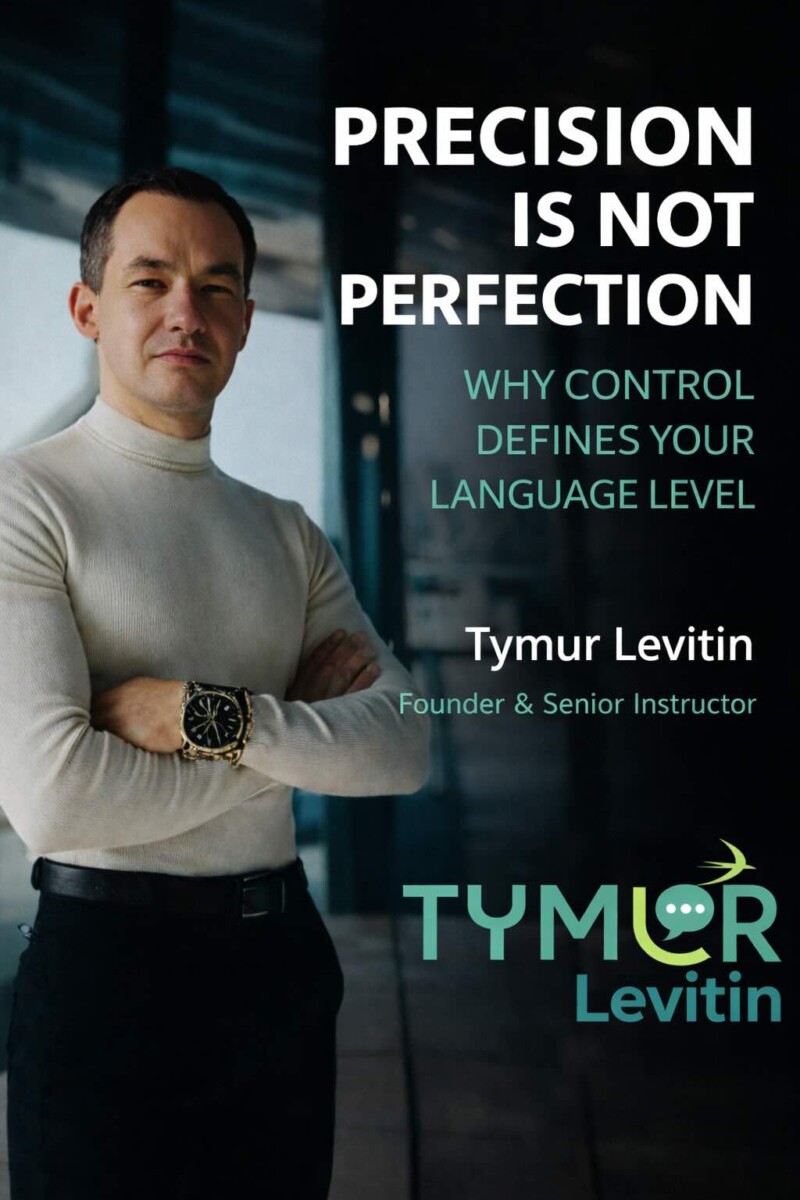
Author: Tymur Levitin
Founder, Director and Senior Instructor — Levitin Language School / Start Language School by Tymur Levitin
Tymur Levitin has over 22 years of teaching experience and works with students from different countries and professional backgrounds. His teaching approach focuses on structured thinking, controlled speech, and conscious language use rather than memorization.
© Tymur Levitin. All rights reserved.