









































Why Inner Order Is Not Calm — and Why It Changes How You Speak
Composure is not calm.
Calm can be passive.
Calm can be numb.
Calm can be avoidance disguised as peace.
Composure is something else entirely.
It is movement without rush.
Action without panic.
Direction without noise.
Composure is not about slowing life down.
It is about knowing what comes next — even if the world around you is unstable.
And that knowledge always shows itself in language.
Composure Is Not Silence
Many people confuse composure with silence.
They think:
If I don’t speak much, I am composed.
If I pause long enough, I look calm.
If I avoid sharp words, I stay balanced.
But silence can be confusion.
Silence can be fear.
Silence can be waiting for someone else to decide for you.
Composure is not silence.
A composed person can speak clearly.
Briefly.
Without emotional noise.
Not because they suppress emotions —
but because emotions no longer drive the steering wheel.
Movement Without Rush
Rush is not speed.
Rush is internal chaos expressed through motion.
You can move fast and still be composed.
You can move slowly and still be scattered.
Composure appears when movement and intention align.
In language, this looks like:
- sentences without verbal padding,
- pauses that are deliberate, not defensive,
- statements that don’t need justification immediately after being spoken.
A composed speaker does not hurry to explain themselves.
They already know where their words are going.
No Haste. No Freeze.
These are the two extremes that betray inner disorder.
Haste:
- speaking too much,
- explaining before being asked,
- filling every pause with sound.
Freeze:
- losing words mid-sentence,
- avoiding answers,
- retreating into vague phrases.
Composure lives between these poles.
It allows response instead of reaction.
Choice instead of reflex.
And language is the first system where this balance becomes visible.
The Language of Someone Who Knows What Comes Next
The most important feature of composure is not tone.
It is sequence.
A composed person knows:
- what they will say next,
- what they will not say,
- where the conversation is heading.
This does not mean control over others.
It means control over oneself.
In teaching languages, this is crucial.
Students often believe they “lack vocabulary” or “grammar.”
In reality, they lack inner sequencing.
They don’t know what comes next —
so language collapses.
Why Language Learners Struggle Without Composure
Many learners experience this paradox:
“I know the words, but I freeze.”
“I understand everything, but I can’t respond.”
“I speak well with my teacher, but not with others.”
This is not a linguistic problem.
It is a composure problem.
When the internal next step is unclear,
language — any language — disintegrates.
That is why real language learning is never just about rules.
It is about building inner order.
Composure Is a Skill, Not a Personality Trait
Some people believe composure is innate.
It is not.
It is trained:
- through structured thinking,
- through intentional pauses,
- through learning to finish thoughts before starting new ones.
Language is one of the most powerful training grounds for this skill.
Because language forces sequence.
And sequence forces responsibility.
Why This Matters Beyond Language
The language of composure is not limited to classrooms.
It shapes:
- professional communication,
- conflict resolution,
- leadership,
- personal boundaries.
People who speak with composure are rarely loud.
Rarely aggressive.
Rarely vague.
They don’t rush.
They don’t freeze.
They move.
Final Thought
Composure is not calm.
It is inner order in motion.
And language is its most honest mirror.
Language Versions
This article is part of a four-language series.
You can read the same text in other languages:
- Deutsch: Die Sprache der Sammlung
- Українська: Мова зібраності
- Русский: Язык собранности
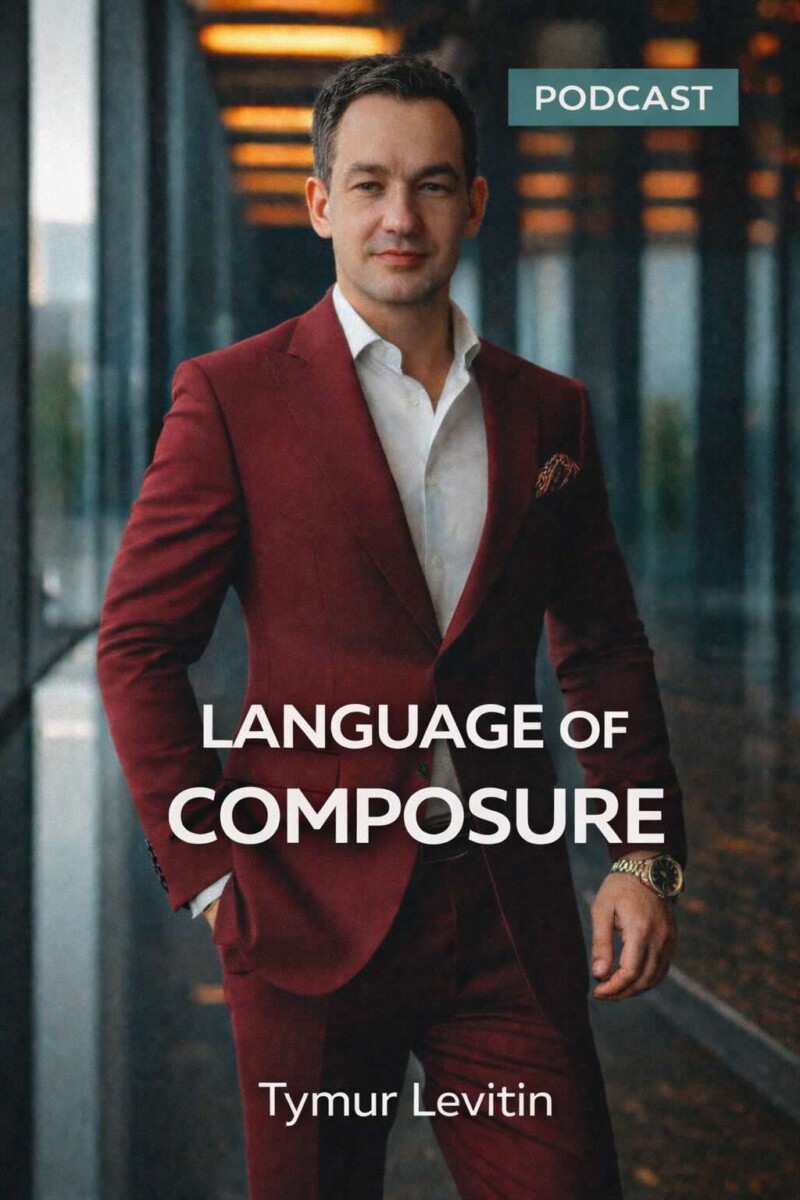
Author: Tymur Levitin
Founder & Senior Teacher
Levitin Language School / Start Language School by Tymur Levitin
Global Learning. Personal Approach.
© Tymur Levitin. All rights reserved.
Unauthorized use, reproduction, or translation without permission is prohibited.