










































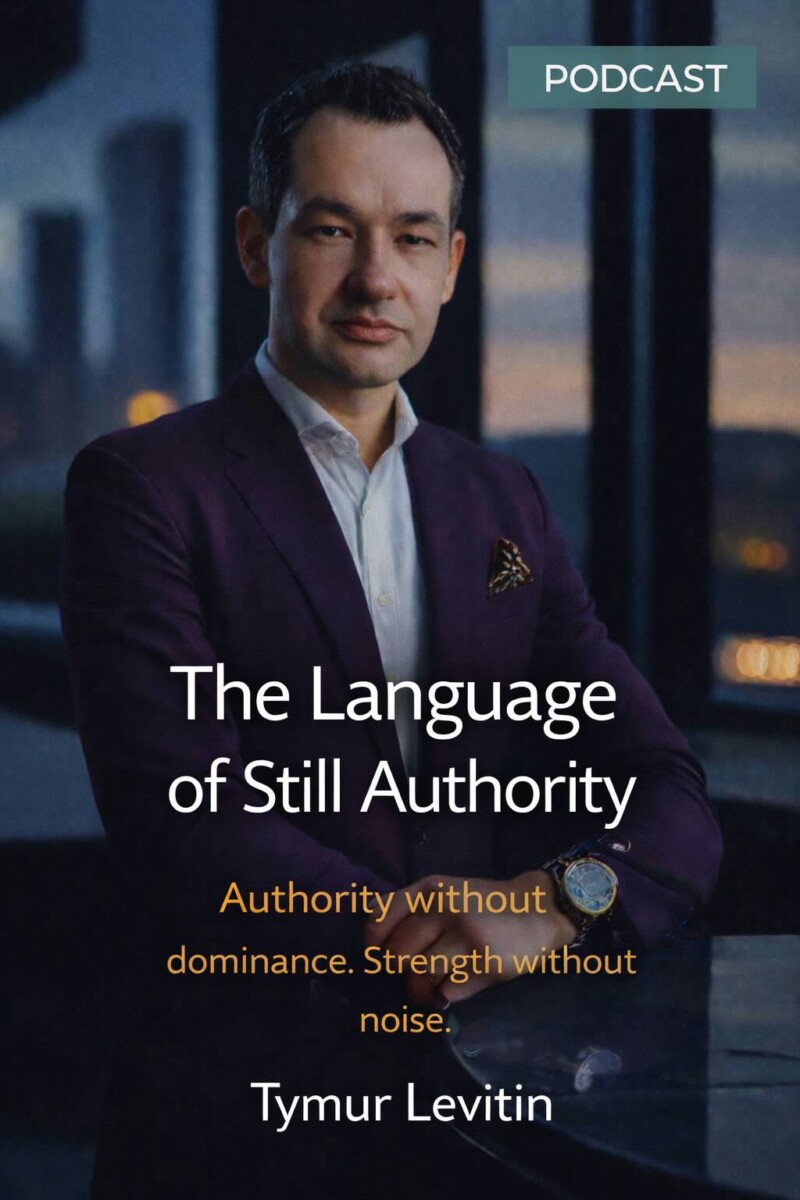
Authority without dominance. Strength without noise.
There is a kind of authority that does not announce itself.
It does not raise its voice, demand attention, or prove its right to exist.
It is felt before it is understood — and remembered long after words end.
This is still authority.
Not weakness.
Not passivity.
Not distance.
But a state where presence speaks louder than explanation.
As the founder and director of Levitin Language School / Start Language School by Tymur Levitin, and as a teacher who has worked with students from dozens of countries and cultures, I have learned one thing very clearly:
In education — especially in language learning — authority is never transmitted through pressure.
It is transmitted through inner stability.
When Authority Stops Performing
Most people associate authority with control:
- control over others
- control over conversation
- control over outcomes
But real authority begins exactly where performance ends.
It appears when a person no longer needs to:
- prove competence
- justify position
- dominate dialogue
In that moment, language changes.
Sentences become shorter.
Pauses become meaningful.
Silence stops being empty — and starts supporting meaning.
This is not rhetoric.
It is perception.
Students feel it instantly.
Language Feels Where Words Come From
In language learning, students rarely remember what was explained.
They remember how it felt to be explained to.
They feel:
- whether a teacher is tense or grounded
- whether speech comes from fear or clarity
- whether authority is forced or natural
That is why still authority matters more than methodology.
Grammar can be learned anywhere.
Presence cannot.
When a teacher speaks from a stable inner point, language itself becomes:
- calmer
- clearer
- more precise
Not because of rules —
but because instability is no longer transmitted through speech.
Silence as a Linguistic Skill
In many educational systems, silence is treated as weakness.
As uncertainty.
As a lack of answers.
In reality, silence is often the most accurate linguistic act.
Still authority knows:
- when not to interrupt
- when not to explain further
- when meaning has already landed
Silence does not replace language.
It frames it.
This is especially important in multilingual learning, where over-explaining often destroys understanding instead of building it.
Teaching from an Inner Position
At Levitin Language School, we do not build learning around pressure, speed, or artificial confidence.
We build it around:
- inner position
- clarity of thought
- respect for cognitive rhythm
Because students do not need louder teachers.
They need clearer ones.
Still authority creates space where:
- thinking is allowed
- mistakes are not punished
- language grows naturally
This is not softness.
It is precision.
Authority That Does Not Compete
Still authority never competes.
It does not chase validation.
It does not fight for attention.
It simply holds its ground.
In language — as in life — this changes everything.
When authority is quiet:
- words become trustworthy
- explanations become lighter
- learning becomes safer
And safety is the real foundation of fluency.
Video Podcast: The Language of Still Authority (English)
Authority without dominance. Strength without noise.
👉 English video version
About the Author
Tymur Levitin
Founder, Director, and Senior Teacher
Levitin Language School / Start Language School by Tymur Levitin
I teach languages not as systems to memorize, but as spaces where thinking, identity, and meaning meet.
This article is part of my ongoing author’s video blog on language, inner position, and learning without pressure.
Language Versions
This article is part of a four-language series.
Each version is written as an original text, not a mechanical translation.
- Deutsch: Die Sprache der stillen Autorität
- Русский: Язык тихого авторитета
- Українська: Мова тихого авторитету
Links to all versions are cross-connected between articles.
© Tymur Levitin
Levitin Language School / Start Language School by Tymur Levitin
Global Learning. Personal Approach.