









































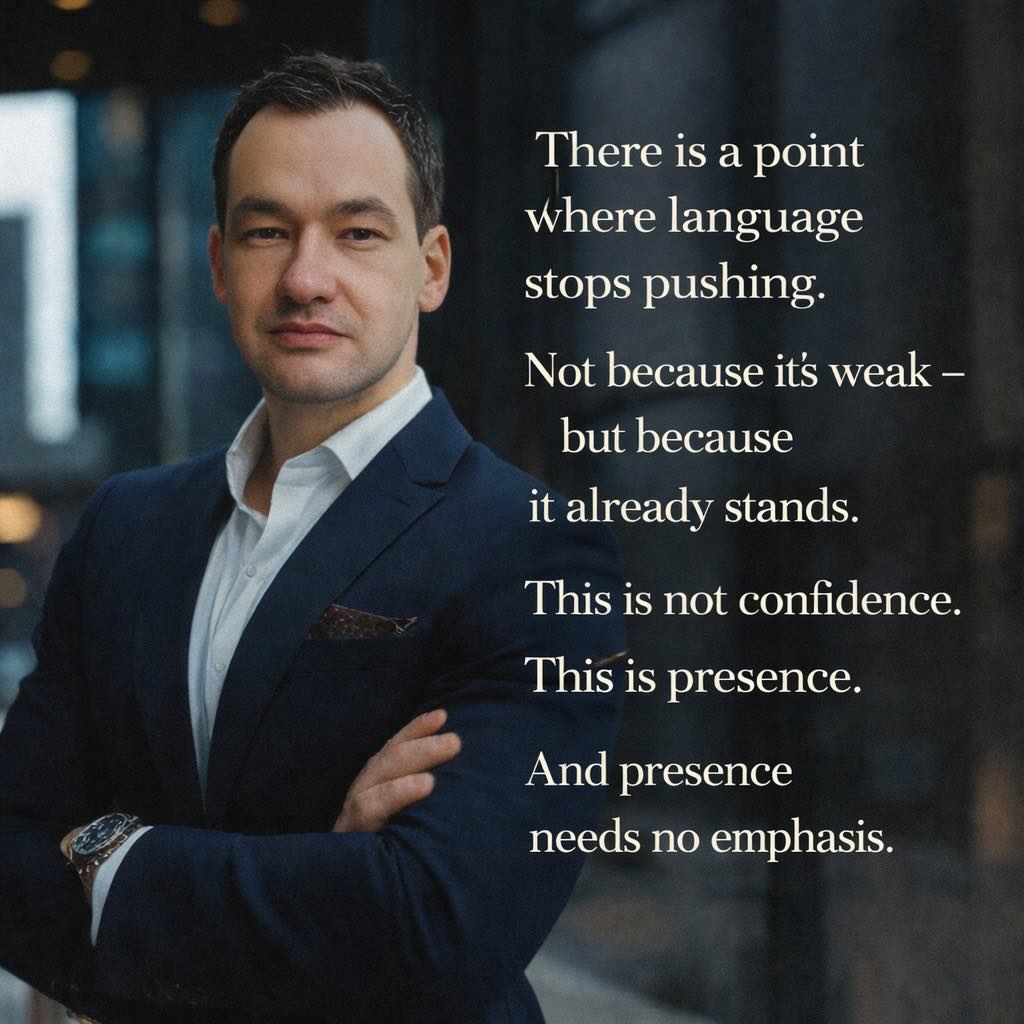

Language doesn’t get louder when it’s strong.
It gets still.
There is a moment in every real conversation when language stops trying to impress.
Not because it fails —
but because it no longer needs to prove itself.
What replaces volume is something far more dangerous and far more powerful:
presence.
Not charisma.
Not confidence.
Not fluency.
Presence.
And this is exactly where most language learning systems collapse.
Why strong language does not push
Modern language education is obsessed with output:
• speak faster
• speak more
• speak louder
• sound confident
• don’t pause
• fill the silence
• keep talking
But real language works the opposite way.
The more weight a sentence has,
the less it needs to move.
When someone speaks from a clear internal position, language does not chase reactions.
It occupies space.
This is not psychology.
This is linguistics.
In English and German — the two languages I teach personally — this principle is visible everywhere:
• in intonation
• in sentence structure
• in pauses
• in modal verbs
• in how much is left unsaid
Strong language does not lean forward.
It stands.
Composure is not silence
It is structural stability
People confuse stillness with silence.
They are not the same.
Silence is absence.
Stillness is presence that does not need movement.
When a speaker has no inner structure, they compensate with:
• fillers
• speed
• nervous rhythm
• unnecessary explanation
• verbal padding
But when a speaker has position, language compresses.
It becomes heavier.
One short sentence can outweigh five minutes of talking.
This is why:
• native speakers pause
• serious professionals speak slower
• people with authority choose simpler words
• strong speakers do not repeat themselves
Language begins to behave like a solid object rather than a flow of noise.
Why learners are trained to sound weak
Most learners are taught to “be fluent.”
But what they are actually trained to do is:
• keep speaking
• avoid silence
• cover uncertainty
• never stop
• never pause
This creates the illusion of fluency —
and the reality of insecurity.
Because language that is always moving
is language that is always unstable.
In real English and real German,
silence is not emptiness.
It is a boundary.
And boundaries create authority.
Presence is not personality
It is linguistic position
Presence is not about being charismatic.
It is about where your words stand in relation to:
• time
• responsibility
• intention
• the other person
A weak sentence tries to get approval.
A strong sentence already assumes legitimacy.
Compare:
“I just wanted to ask if maybe it would be possible…”
vs.
“I need to clarify one thing.”
Same language.
Different position.
One is begging for space.
The other already occupies it.
Why English and German make this visible
Both English and German encode stance into grammar.
Not emotions —
position.
Through:
• tense choice
• modal verbs
• word order
• emphasis
• definiteness
• articles
• aspect
These languages constantly ask:
Is this thing established or still unstable?
Is this event finished or still open?
Is this statement firm or tentative?
This is why advanced speakers do not sound louder —
they sound anchored.
Why this matters for real life
This is not an academic trick.
This is survival language.
In interviews.
In negotiations.
In conflict.
In leadership.
In relationships.
People do not respond to speed.
They respond to weight.
And weight comes from stillness.
The illusion of fluency
Fluency without presence is noise.
You can speak fast and still be ignored.
You can speak perfectly and still sound unsure.
You can know all the grammar and still lose every conversation.
Because what people read is not your words.
They read your position.
And language always betrays it.

How this is taught in my work
This is why in my teaching I do not train people to talk more.
I train them to stand linguistically.
Through:
• sentence structure
• tense control
• silence
• reduction
• weight
• choice of verbs
• responsibility markers
This approach is used in my English and German programs, and supported by our multilingual team at Levitin Language School / Start Language School by Tymur Levitin, where other languages are taught by specialized teachers using the same structural philosophy.
Language is not a performance.
It is a position.
Podcast versions of this episode
You can listen to this article in four parallel language versions:
English – Podcast – When Language Stops Pushing
German – Podcast – Wenn Sprache nicht mehr drängt
Ukrainian – Podcast – Коли мові не потрібне напруження
Russian – Podcast – Когда языку не нужно усилие
Other language versions of this article
This article exists as four equal authorial versions:
• Deutsch – Die Sprache, die bereits steht
• Українська – Мова, що вже стоїть
• Русский – Язык, который уже стоит
Author
Tymur Levitin
Founder, Director and Senior Teacher
Levitin Language School / Start Language School by Tymur Levitin
I teach English and German personally and work with an international team of language professionals who apply the same structural, presence-based approach across many languages.
This text reflects my real classroom practice, not theory.
© Tymur Levitin. All rights reserved.