






































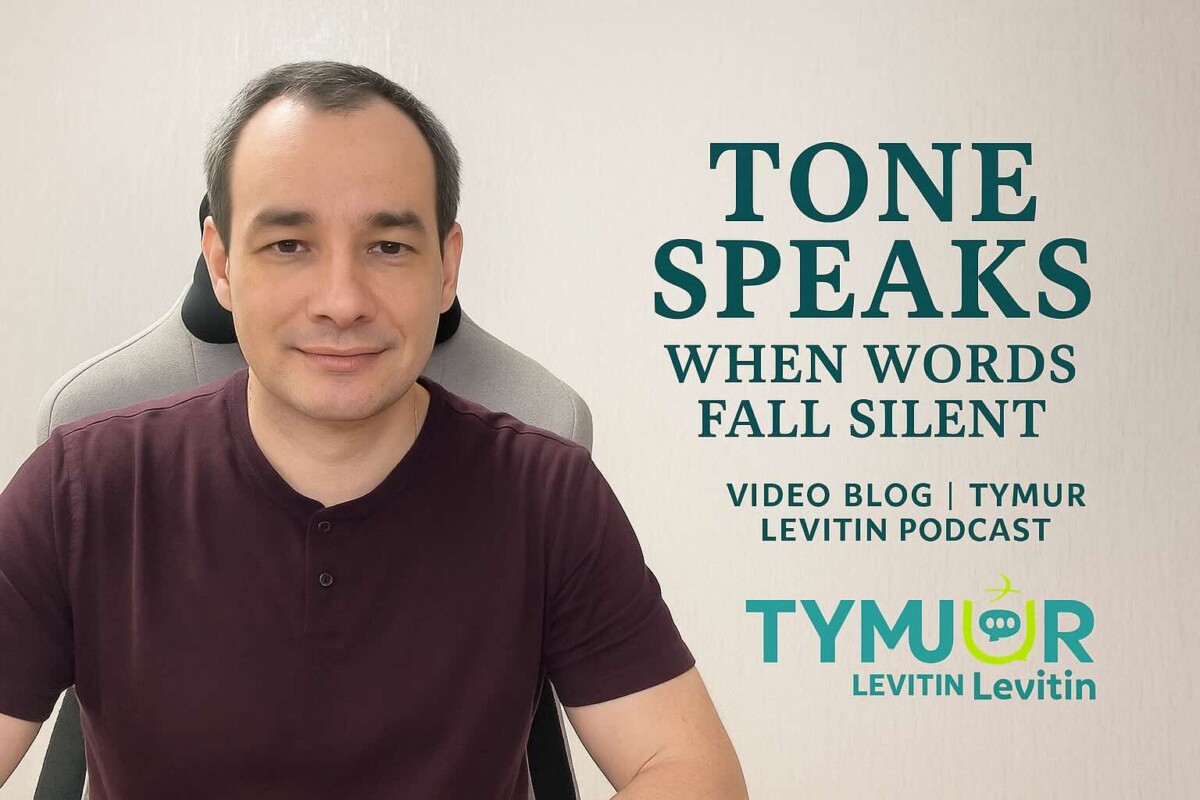
🎙️ Tone speaks when words fall silent.
When we talk about learning a language, we often start with grammar.
We add vocabulary.
We polish pronunciation.
And then… we still sound flat.
Something is missing — something that rules every real conversation.
Tone.
Tone is what turns sound into meaning.
It’s the invisible bridge between language and emotion.
You can say thank you in a dozen ways — and each one means something completely different.
The words stay the same.
The feeling changes everything.
🎧 Why tone matters more than rules
We think language is built on words.
But words are just containers.
What fills them — is tone.
When you learn to hear how people really speak, you begin to understand not only what they say, but what they mean, and how they feel.
That’s when you stop translating and start living the language.
In my lessons at Levitin Language School, we don’t just repeat phrases.
We learn how to breathe with the sentence, how to let tone carry the meaning — naturally, not mechanically.
Because real communication begins with sound, not syntax.
🗣️ The hidden grammar of emotion
Tone is a kind of grammar — but one the textbooks ignore.
It tells you when a question is really a doubt, when a compliment is sincere, or when a silence means more than words.
Mastering this “grammar of emotion” is what makes speech alive.
It’s what turns learning into understanding.
Once you feel the rhythm of tone, you start to connect with the soul of the language — not just its rules.
🔗 Related Episodes from the Podcast Series
🎧 Understanding Before Speaking
🎧 The Role of Books in Language Learning
🎧 The Language Between Words
🌍 Learn Languages with Meaning
Choose your language and start learning to feel it — not just speak it:
🌐 Read this article in other languages:
🇩🇪 German version |
🇷🇺 Russian version |
Author: Tymur Levitin
Founder, Director & Head Teacher — Levitin Language School
© Tymur Levitin | Start Language School by Tymur Levitin