








































Language learning usually begins with lists: word lists, verb tables, grammar rules.
And for a short time it feels productive — you know more.
But then something strange happens.
You still cannot speak.
You recognize sentences, but you cannot build them.
You remember words, but you cannot think with them.
This is not a problem of discipline.
This is a problem of method.
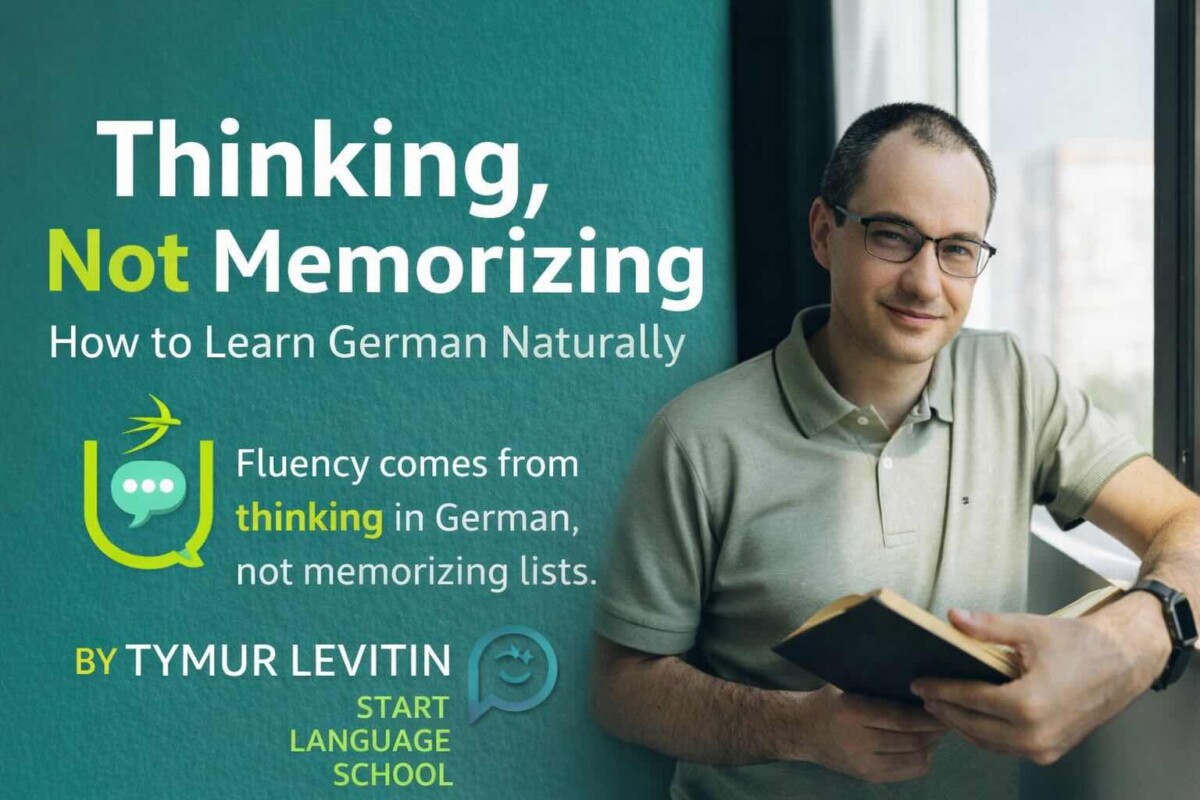
This episode explains the central principle of my teaching:
fluency does not come from memorizing a language — fluency comes from thinking in it.
▶ Watch the episode:
https://www.youtube.com/watch?v=EkH5NOvzscE&list=PLunccfqAabpJTdkEORxefCjHaAvg907yh
Why Memorization Fails
When a student memorizes a word, they attach it to their native language:
Haus = house
gehen = to go
ich habe gemacht = I did
But the brain still processes meaning through translation.
So during conversation, the mind performs four steps:
- Idea appears in your native language
- You search for equivalent words
- You assemble grammar consciously
- Only then you speak
By that moment, the conversation has already moved on.
The problem is not vocabulary size.
The problem is cognitive architecture.
Memorization creates a dictionary.
Fluency requires a language system.
What Real Language Knowledge Looks Like
A fluent speaker does not recall rules while speaking.
They do not mentally say:
“Now I must apply Perfekt with haben because the verb is transitive.”
Instead, they simply feel:
Ich habe das gestern gesehen.
This sentence appears whole — as a thought, not as a construction.
This is how a child speaks.
And this is also how adults must relearn a language.
Language is not a school subject.
Language is a thinking mechanism.
The Core Principle: Language = Thought
The moment you stop translating, something changes.
You no longer search for words.
You begin to anticipate them.
You don’t build sentences.
You recognize patterns.
Instead of:
“How do I say this?”
Your brain moves to:
“This is how it sounds.”
That moment is the true beginning of fluency.
How to Train Thinking in German
You cannot force thinking by memorizing more vocabulary.
You must retrain perception.
1. Learn Sentences, Not Words
Words have no meaning alone.
Meaning lives inside structure.
Do not learn:
gehen — to go
Learn:
Ich gehe nach Hause.
Ich gehe arbeiten.
Ich gehe jetzt.
Now your brain connects action to expression.
2. Understand Logic, Not Rules
Grammar is not a set of laws.
Grammar is a reflection of how speakers perceive reality.
Example:
German uses Perfekt in daily speech because conversation describes experienced reality, not narrative past.
When a student understands this, grammar stops being memorization and becomes predictable.
3. Listen Before Speaking
Speaking early creates translation habits.
Listening creates language intuition.
The goal is not repeating sentences.
The goal is recognizing how meaning flows inside them.
4. Build Internal Dialogue
The turning point in language learning is simple:
You start commenting on your life internally in German.
Ich bin müde.
Das ist interessant.
Ich habe das vergessen.
This is the first moment the language becomes yours.
What “Fluency” Actually Means
Fluency is not speed.
Fluency is not accent.
Fluency is not perfect grammar.
Fluency is automatic meaning expression without translation.
When a student reaches this stage, vocabulary expands naturally, grammar stabilizes, and confidence appears without effort.
Because the brain is no longer performing translation —
it is performing communication.
Learn German Through Thinking
You can begin training this immediately.
Study German here:
🌍 https://levitinlanguageschool.com/languages/learning-german/
🌎 https://languagelearnings.com/german/
About the teacher and methodology:
https://levitinlanguageschool.com/
Podcast Versions (All Languages)
English Podcast:
https://www.youtube.com/watch?v=EkH5NOvzscE&list=PLunccfqAabpJTdkEORxefCjHaAvg907yh
German Podcast:
https://www.youtube.com/watch?v=uWwC-bPQcas&list=PLunccfqAabpJDoiKKxQ3jVBcImG926CI-
Russian Podcast:
https://www.youtube.com/watch?v=LOmo7L7SIHE&list=PLunccfqAabpKyY-pnwzm8CtL0lxGM9HXl
Ukrainian Podcast:
https://www.youtube.com/watch?v=TF-7OwqFwS0&list=PLz06ZxEi5yTQSK2NWkgclVBS3neK4lxJY
Read This Article in Other Languages
German version:
https://timurlevitin.blogspot.com/2026/02/denken-nicht-auswendiglernen-wie-man.html
Russian version:
https://timurlevitin.blogspot.com/2026/02/blog-post_9.html
Ukrainian version:
https://timurlevitin.blogspot.com/2026/02/blog-post_96.html
Conclusion
Students often believe they struggle because German is difficult.
In reality, they struggle because they are trying to remember a language instead of using it as a mental tool.
The language does not live in vocabulary lists.
The language lives in perception.
The day you stop translating is the day German stops being a subject — and becomes a voice.
© Tymur Levitin — Start Language School by Tymur Levitin. All rights reserved.