








































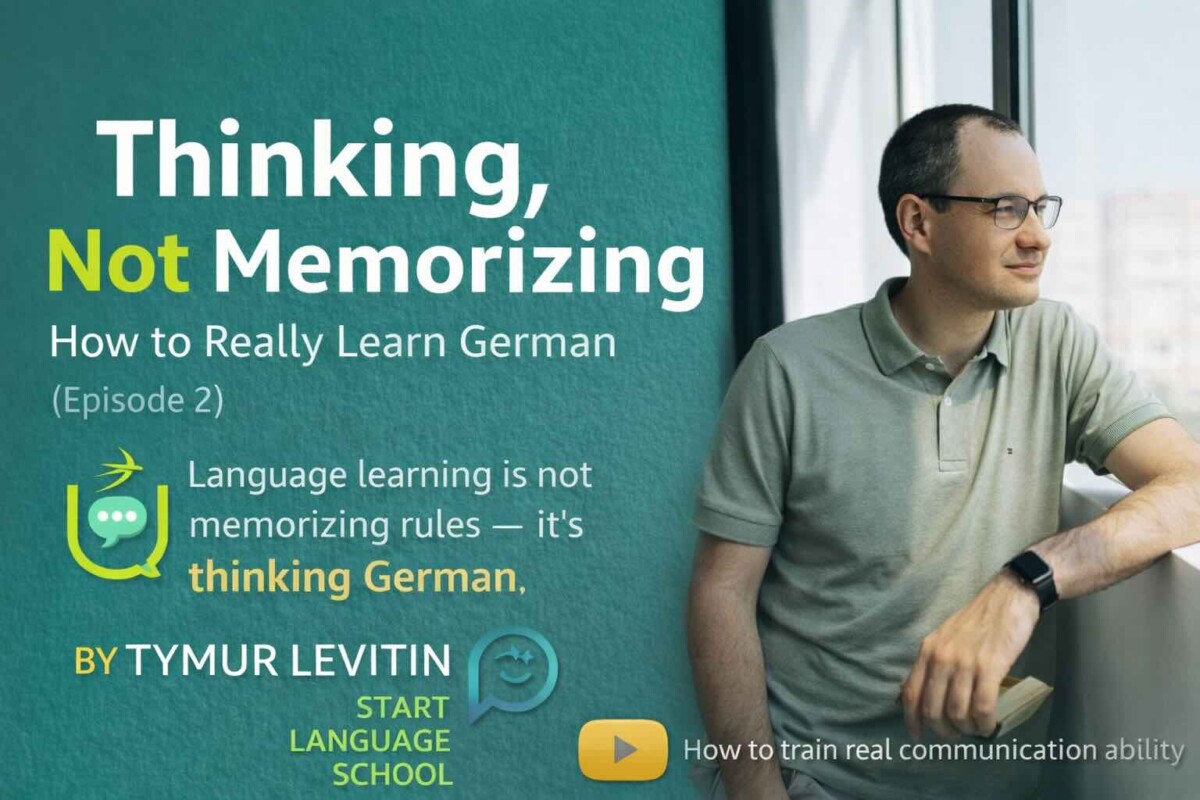
(Podcast Episode Article — English Version 2)
There is a moment almost every serious language learner experiences.
You studied.
You practiced.
You completed exercises correctly.
And yet, when a real person speaks to you — your mind goes blank.
Not because you don’t know the words.
Because you never built a thinking system.
This second episode continues the idea from the first:
language is not learned by accumulating knowledge — it is acquired by reorganizing how the brain processes reality.
▶ Watch the lesson episode:
https://www.youtube.com/watch?v=dsgw11qfqVY&list=PLunccfqAabpL68ydlOBX3ts-vy2NGYG2V
The Hidden Mistake Most Students Never Notice
Students usually believe their main problem is vocabulary.
So they learn more words.
Then more grammar.
Then irregular verbs.
But communication still does not appear.
Why?
Because traditional learning teaches description of language, not operation of language.
You learn about German, not in German.
Your brain stores information in the analytical part of memory —
but speech lives in the automatic part.
And these two systems are not the same.
The Translation Barrier
Let us observe what actually happens inside the mind of a learner during conversation.
A German speaker says:
Was hast du gestern gemacht?
The student understands every word individually.
But the brain processes like this:
- translate “was”
- recognize “hast”
- recall past participle structure
- reconstruct meaning
During that time, the conversation already moved forward.
A fluent speaker does not decode a sentence.
They perceive it instantly as a situation:
Yesterday + you + activity → response.
Fluency is not linguistic knowledge.
Fluency is speed of meaning recognition.
Grammar Is Not Rules — It Is Expectation
Students often fear German grammar.
Articles, cases, word order, verb placement.
But grammar is not complexity.
Grammar is prediction.
When a native speaker hears:
Ich habe gestern…
their brain already anticipates a past event description.
When they hear:
Wenn ich Zeit habe…
they expect a condition.
Grammar functions as a navigation system, not a rulebook.
The learner’s task is not memorizing forms —
it is learning to anticipate meaning.
Once anticipation appears, grammar stops feeling heavy.
Why Exercises Alone Cannot Create Fluency
Exercises train conscious correctness.
Conversation requires unconscious response.
You can complete 100 written tasks correctly and still be unable to answer:
Erzähl mal, was hast du am Wochenende gemacht?
Because exercises train recognition,
but communication requires reaction.
Language learning fails when it remains academic.
Language begins when it becomes behavioral.
The Three Stages of Real Language Acquisition
1. Recognition
You understand when reading or listening slowly.
This is where most students stop.
2. Prediction
You start anticipating what comes next in a sentence.
You no longer process word by word.
3. Spontaneous Expression
You respond without constructing sentences consciously.
This is the stage people call fluency.
Not perfect speech —
but natural speech.
The Turning Point
The first real sign of progress is subtle.
You hear a sentence and react emotionally — before translating.
You laugh.
You disagree.
You answer immediately.
At that moment, the language entered cognition.
You are no longer operating a foreign system.
You are thinking.
How to Reach This Stage
- Listen to full speech, not isolated phrases
- Respond to meaning, not grammar
- Speak imperfectly but immediately
- Build internal dialogue daily
Your goal is not “correct German”.
Your goal is functional German.
Correctness will stabilize automatically after usage appears.
Learn German Through Understanding
Start here:
🌍 https://levitinlanguageschool.com/languages/learning-german/
🌎 https://languagelearnings.com/german/
Teacher profile and methodology:
https://levitinlanguageschool.com/
Podcast Versions (All Languages)
English Podcast:
https://www.youtube.com/watch?v=dsgw11qfqVY&list=PLunccfqAabpL68ydlOBX3ts-vy2NGYG2V
German Podcast:
https://www.youtube.com/watch?v=itE5sKYJGfY&list=PLunccfqAabpLmCmnPGH4oAT0XRSy46ZQf
Russian Podcast:
https://www.youtube.com/watch?v=TN4CJj9WAic&list=PLunccfqAabpKGJCeA0IDmoQGPe21Aa5kY
Ukrainian Podcast:
https://www.youtube.com/watch?v=ZEZx9ZsMsNk&list=PLz06ZxEi5yTQr_ilM5aC3l0Tk_waFEvTh
Other Language Versions of This Article
German version:
https://timurlevitin.blogspot.com/2026/02/denken-nicht-auswendiglernen-wie.html
Russian version:
https://timurlevitin.blogspot.com/2026/02/blog-post_52.html
Ukrainian version:
https://timurlevitin.blogspot.com/2026/02/blog-post_70.html
Final Thought
Memorization creates students who know the language.
Thinking creates people who live in it.
The difference is not talent.
The difference is training.
And once thinking begins, the language stops being foreign.
It becomes a tool of identity.
© Tymur Levitin — Start Language School by Tymur Levitin. All rights reserved.