









































Author’s Column by Tymur Levitin — Founder, Director, Senior Teacher of Levitin Language School / Start Language School by Tymur Levitin
Global Learning. Personal Approach. | Speak free!
Choose your language: https://levitinlanguageschool.com/#languages
“Why does this sound so cold?”
This question comes up again and again.
Students read an email.
Applicants read a form.
Employees read a policy.
Exam candidates read a text.
And the reaction is often emotional:
“This sounds rude.”
“This feels aggressive.”
“It’s like they don’t care.”
“Why is the tone so harsh?”
But linguistically, something else is happening.
What feels hostile is often not hostility, but the absence of tone.
Tone is a human feature. Institutions remove it on purpose.
Human speech is full of signals:
- politeness markers,
- hedging,
- empathy,
- emotional softeners,
- shared context.
Institutional language removes most of them.
Not because it wants to offend — but because its function is different.
An institution does not:
- negotiate meaning,
- build rapport,
- mirror emotions.
It executes procedures.
So the language it uses is:
- neutral,
- compressed,
- impersonal,
- function-driven.
The emotional gap appears when readers expect human conversation from a systemic register.
Neutral does not mean polite — and that matters
This is a crucial distinction for language learners.
In everyday English:
- polite language is relational,
- neutral language is functional.
Institutional English prioritizes neutrality over politeness.
That means:
- fewer “please”,
- fewer explanations,
- no emotional framing,
- no reassurance.
For native speakers, this is familiar.
For non-native speakers, it can feel abrupt or even aggressive.
But aggression requires intent.
Neutrality does not.
Why neutrality feels colder in English than in other languages
This is where cross-linguistic perception plays a role.
In many languages:
- grammar encodes politeness,
- formality is built into verb forms,
- indirectness is the default.
English does not do this structurally.
Instead, English uses:
- word choice,
- optional politeness markers,
- contextual softening.
When those elements are removed — as they are in institutional texts — English becomes extremely bare.
To learners, it can feel like something is missing.
And it is: interpersonal cushioning.
Typical phrases that trigger emotional reactions
Here are examples that often scare or irritate learners — but shouldn’t.
- You are required to…
- Failure to comply may result in…
- This application will not be processed unless…
- No exceptions will be made.
- Requests submitted after the deadline will be rejected.
Linguistically, these sentences:
- contain no insult,
- contain no judgment,
- contain no emotional stance.
They simply encode conditions.
The problem arises when readers interpret them through a conversational lens.
Why exams use this language intentionally
In reading and listening tasks, institutional tone is not accidental.
Exams test whether a candidate can:
- recognize neutral register,
- separate function from emotion,
- understand conditional logic,
- avoid projecting meaning that isn’t there.
Students who read emotionally often:
- overinterpret,
- misidentify attitude,
- assume negativity where there is none.
Students who read structurally perform better — even if they personally dislike the tone.
The projection trap
One of the most common mistakes non-native speakers make is emotional projection.
They read:
“Your request has been denied.”
And hear:
“You did something wrong.”
But linguistically, the sentence means only:
“The system cannot proceed under current conditions.”
No tone.
No blame.
No commentary.
Understanding this difference is a survival skill — not just a language skill.
Why institutions avoid warmth
Warmth introduces ambiguity.
Ambiguity creates:
- inconsistent interpretation,
- legal risk,
- procedural loopholes.
So institutions deliberately choose:
- clarity over comfort,
- precision over empathy,
- repeatability over nuance.
This is not cruelty.
It is design.
A practical reading strategy
Before reacting to institutional English, ask one question:
What function does this sentence perform?
Is it:
- defining a condition?
- stating a consequence?
- describing a process?
- setting a boundary?
If you answer that, tone becomes irrelevant.
Meaning becomes clear.
Why this matters in language education
Language education often stops at:
- grammar,
- vocabulary,
- conversation.
But real-life competence requires more.
Students must learn to:
- read systems,
- decode neutrality,
- tolerate tone absence,
- function without emotional feedback.
This is not emotional suppression.
It is linguistic maturity.
Conclusion
Neutral language feels hostile only when we expect it to behave like human speech.
Once we understand:
- why tone disappears,
- how systems speak,
- what neutrality actually means,
the fear disappears with it.
Not because the language changes —
but because our interpretation does.
And that shift is one of the most important milestones in advanced language competence.
Related reading
- Gender, Sex, and LGBTQ+ Terms: What They Mean and How to Use Them Correctly
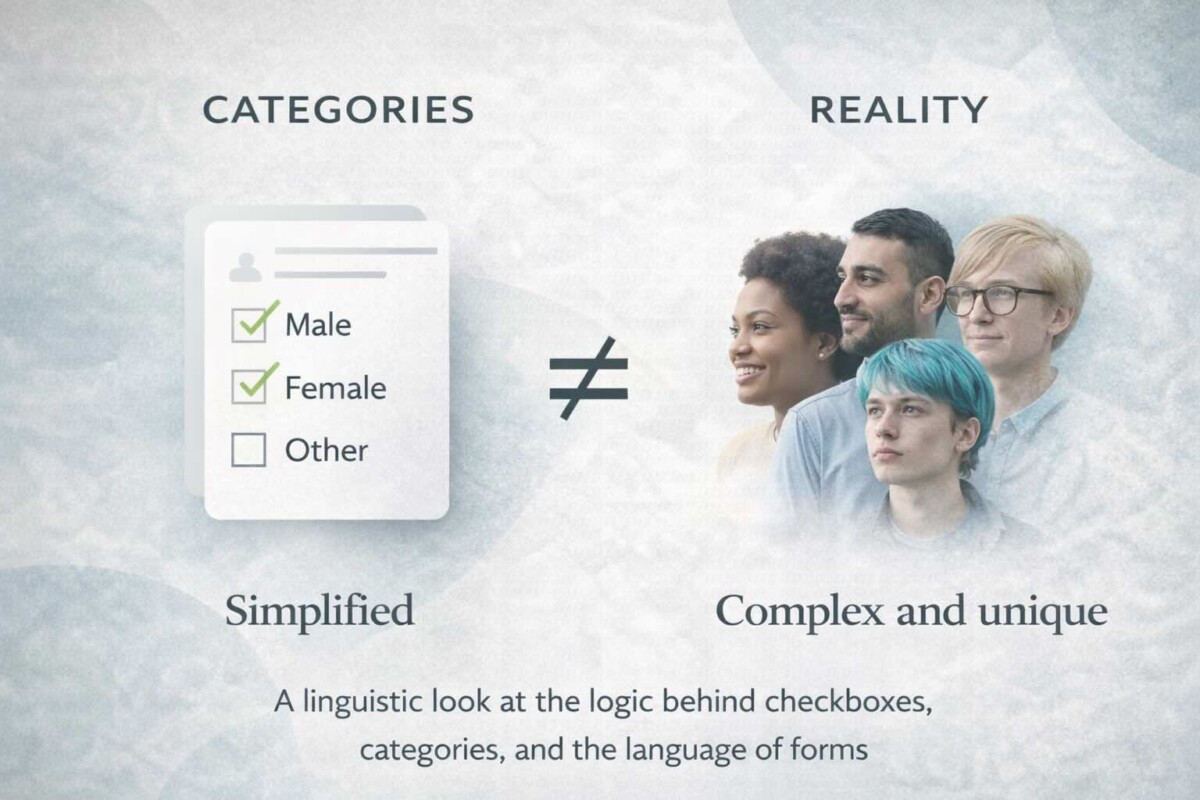
- When Words Become Categories: How Forms Simplify Reality
- Blog hub: https://levitinlanguageschool.com/blog/
- US blog hub: https://languagelearnings.com/blog/
- Video lessons (supporting): https://levitinlanguageschool.com/videos/
Author’s development by Tymur Levitin — Founder, Director, Senior Teacher of Levitin Language School / Start Language School by Tymur Levitin.
© Tymur Levitin