









































How English Chooses What You Are Looking At
Most learners believe that -ly is a grammatical tool.
Something you “add” to make an adverb.
That belief is understandable.
It is also the reason so many learners sound correct — and still miss the point.
Because -ly is not about correctness.
It is about focus.
The Illusion of the Rule
At school, the rule sounds simple:
To describe a verb, add -ly.
And then reality interferes.
English calmly produces sentences like:
- go slow
- think big
- feel free
- stay strong
- die young
No -ly.
No apology.
No explanation.
The problem is not irregularity.
The problem is that the rule was never complete.
What -ly Actually Does
The suffix -ly does not “turn adjectives into adverbs”.
It does something far more precise.
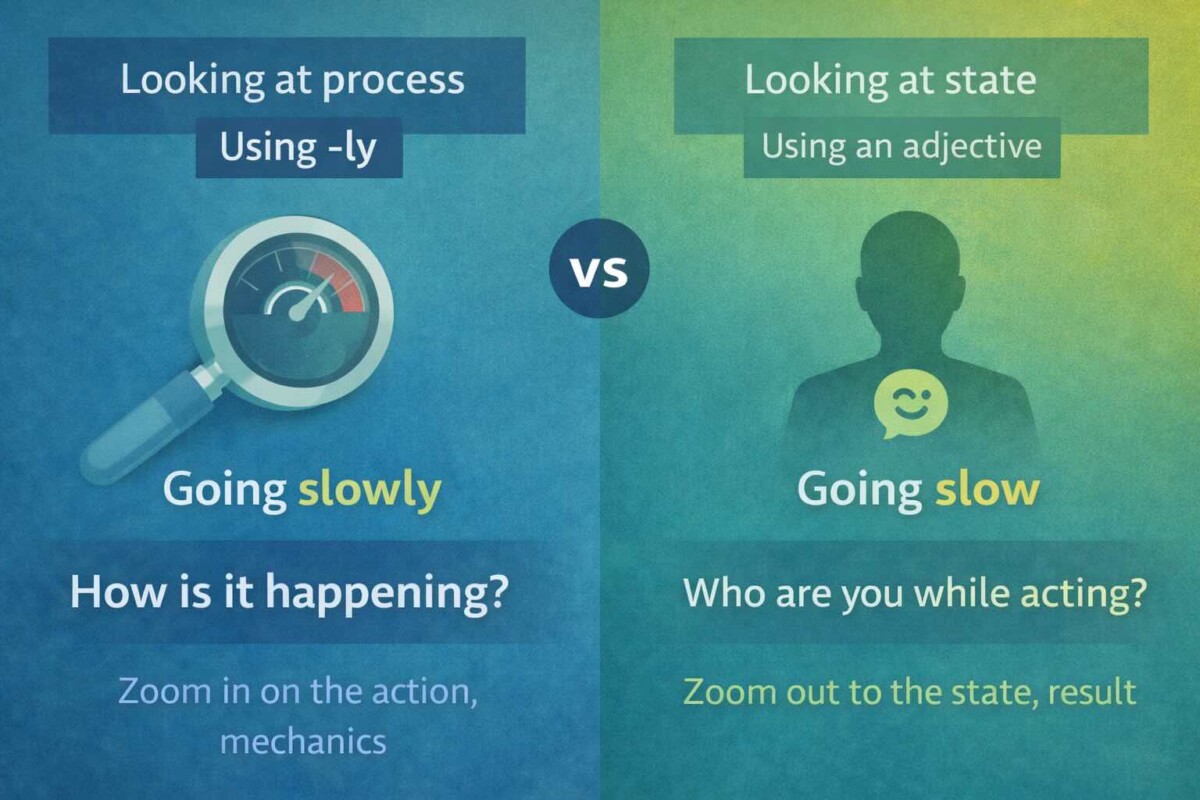
-ly directs attention to the process itself.
When English uses -ly, it tells the listener:
Look at how this action happens.
When English avoids -ly, it sends a different signal:
Look at what state the person is in while acting.
This is not grammar.
This is perspective.
Action Focus vs State Focus
Compare these pairs carefully.
Go slowly
The language zooms in on the movement.
Speed, manner, control — the action itself is under the microscope.
Go slow
The language describes a condition.
Not how the movement unfolds, but the mode in which the person exists while moving.
The same difference appears again and again.
Why Some Forms Simply Do Not Exist
Learners often ask:
“Why can’t we say think bigly or die youngly?”
Because those verbs do not invite process analysis.
You do not “think big” as a manner.
You are big in your thinking.
You do not “die young” as a technique.
You end in a state.
Adding -ly would force English to describe something it does not want to describe.
The language refuses — quietly.
Verbs That Connect Action and Being
English has a wide class of verbs that sit between action and state:
- feel
- sound
- look
- stay
- remain
- become
- go
After these verbs, adjectives are not mistakes.
They are the point.
- feel free
- stay calm
- go quiet
- look confident
In all these cases, English is not describing behavior.
It is naming a state of existence.
Why Learners Get This Wrong
Learners trained by rules ask:
“Which form is correct?”
Native speakers — unconsciously — ask something else:
“What am I actually describing here?”
As long as learning focuses on rules, -ly feels unpredictable.
Once learning shifts to meaning, the system becomes visible.
Grammar Follows Attention, Not the Other Way Around
English does not start with grammar and then look for meaning.
It starts with meaning and then selects structure.
If the speaker’s attention is on:
- the action → -ly appears
- the person’s state → -ly disappears
This is why memorizing suffixes never leads to natural speech.
From Fluency to Freedom
This is also why fluency alone is not enough.
You can speak fluently and still describe the wrong thing.
You can use perfect grammar and still miss the meaning you want.
Understanding where your attention goes —
to the action or to the self —
is what changes speech.
Not faster.
Not smoother.
But truer.
The Real Lesson of -ly
The suffix -ly is not a grammatical ending.
It is a camera lens.
It tells the listener where you are looking.
And once you see that, English stops being a system of rules
and starts being what it really is:
a system of choices.
Author’s column by Tymur Levitin
Founder, Director, Senior Teacher
Levitin Language School / Start Language School by Tymur Levitin
© Tymur Levitin