








































🔗 Choose your language: https://levitinlanguageschool.com/#languages
German personal pronouns are one of the first grammar topics every beginner learns. They replace nouns and help you build basic sentences. This guide explains German subject pronouns in a clear and simple way, with examples and common mistakes.
What Are German Personal Pronouns?
Personal pronouns replace the subject of a sentence.
In German, subject pronouns change depending on the person and number.
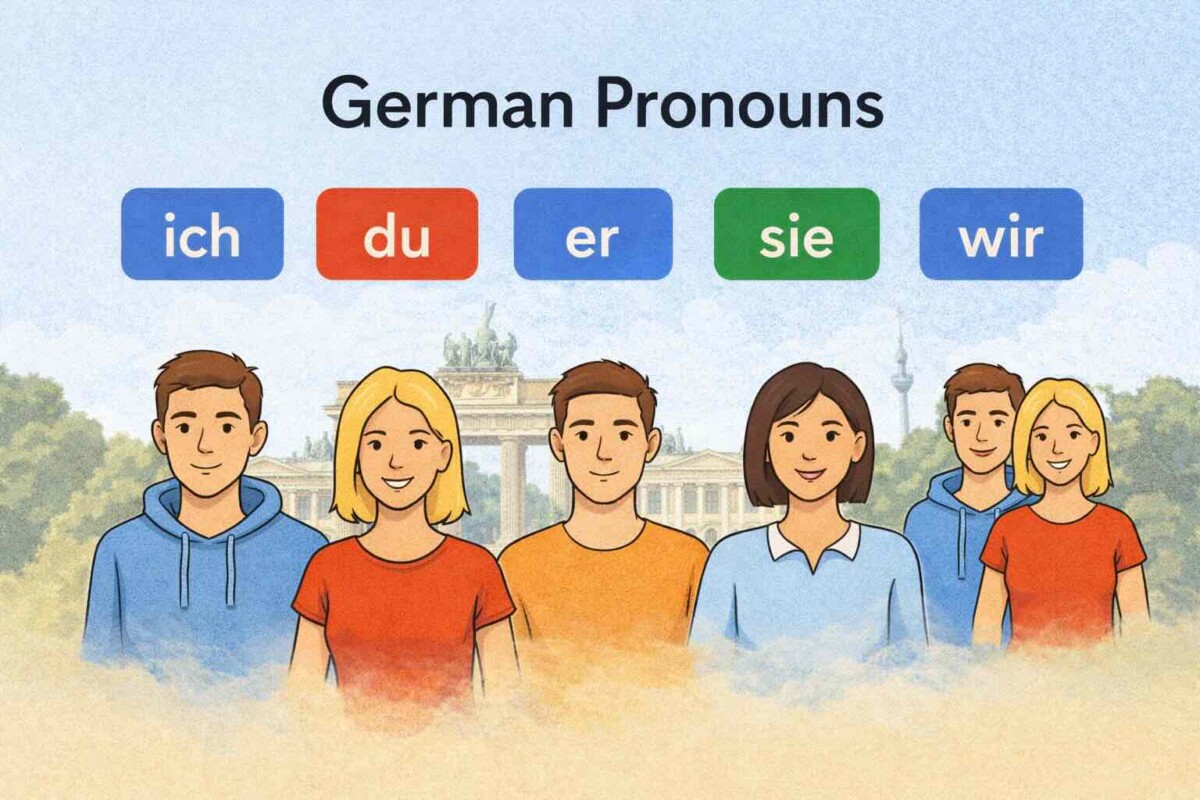
German Subject Pronouns (Nominative Case)
| Person | German | English |
|---|---|---|
| 1st singular | ich | I |
| 2nd singular | du | you (informal) |
| 3rd singular (m.) | er | he |
| 3rd singular (f.) | sie | she |
| 3rd singular (n.) | es | it |
| 1st plural | wir | we |
| 2nd plural | ihr | you (plural, informal) |
| 3rd plural | sie | they |
| formal | Sie | you (formal) |
Examples in Simple Sentences
- Ich lerne Deutsch. (I learn German.)
- Du arbeitest hier. (You work here.)
- Er kommt aus Berlin. (He comes from Berlin.)
- Sie ist Lehrerin. (She is a teacher.)
- Es regnet. (It is raining.)
- Wir wohnen hier. (We live here.)
- Ihr seid müde. (You are tired.)
- Sie sprechen Deutsch. (They speak German.)
- Sie sind willkommen. (You are welcome – formal)
Sie vs sie — A Very Common Mistake
- sie = she / they
- Sie = you (formal)
The difference is only capitalization, but the meaning changes completely.
Examples:
- Sie arbeiten hier. (You work here – formal)
- sie arbeiten hier. (They work here)
Pronouns and Verb Conjugation
In German, the verb changes depending on the pronoun.
Examples with sein (to be):
- ich bin
- du bist
- er/sie/es ist
- wir sind
- ihr seid
- sie/Sie sind
Common Mistakes — and How to Avoid Them
- ❌ Ich ist müde.
✔️ Ich bin müde. - ❌ Er kommen aus Deutschland.
✔️ Er kommt aus Deutschland. - ❌ sie sind Lehrer (when you mean formal “you”)
✔️ Sie sind Lehrer.
FAQ: German Pronouns
Q: Do pronouns change in German cases?
Yes, but this article covers only the nominative (subject) form.
Q: Should beginners learn Sie from the start?
Yes. Formal address is very common in German.
Q: Is es only used for things?
Mostly yes, but also for weather and general situations (Es ist kalt).
Final Note
German personal pronouns are simple once you learn them together with verb forms. They are essential for every sentence you build.
👉 For a deeper reflection on how pronouns relate to identity and communication, see Tymur Levitin’s Author’s Column.
🔗 Related Articles (internal linking)
- https://levitinlanguageschool.com/german/how-to-use-articles-in-german-der-die-das-for-beginners/
- https://levitinlanguageschool.com/german/german-adjectives-for-beginners-rules-and-examples/
- https://levitinlanguageschool.com/german/german-cases-explained-nominative-accusative-dative-genitive/
Author: Tymur Levitin — Founder, Director, Senior Teacher
Levitin Language School | Start Language School by Tymur Levitin
👤 Teacher profile: https://levitinlanguageschool.com/teachers/tymur-levitin/
🌍 Learn German: https://levitinlanguageschool.com/languages/learning-german/
Category: German Grammar for Beginners
© Tymur Levitin