































“All the world’s a stage, and all the men and women merely players.”
Shakespeare understood what most textbooks don’t: we speak to play roles.
And sometimes, saying the wrong line can cost you more than a grade — it can cost you your safety, your dignity, or even your life.
I’m not here to dramatize. I’m here to teach survival.
Because after 22 years of teaching — and just as many years listening — I know one thing for sure:
Language isn’t about vocabulary. It’s about context. And context can be dangerous.
You’re Always Saying More Than You Think
Whether you like it or not, every word you say is a signal. A message. A move in a game you may not even know you’re playing.
When you say “Hey man” in an American suburb — you sound relaxed, friendly.
Say the same words in a rough neighborhood to the wrong person — and you might trigger a completely different outcome.
Why?
Because words are codes, and each group has its own interpretation.
Tattoo or Prison Ink? They’re Not the Same Thing
In Russian, “татуировка” is body art — aesthetics, identity, beauty.
But “наколка”? That’s prison language. That’s hierarchy. That’s risk.
They translate the same — “tattoo” — but the code is different.
Even in English:
- “Cool ink, bro” sounds casual.
- “Nice prison tat” implies a story — and possibly a past.
Understanding the difference can protect you.
Shit Isn’t Just Shit
Let’s talk English. Most learners think shit means “poop” or “swear word.”
But that’s way down the list. Here’s what it actually means in real life:
- “That’s my shit!” — I love this.
- “He’s got his shit together” — He’s stable.
- “Don’t give me that shit” — Stop lying.
- “You’re shit lucky” — You’re incredibly lucky (UK).
Now think about what happens when a student hears it once and assumes it’s just “bad language.”
They’re not wrong — they’re just not safe.
Words That Can Kill — Literally
In Russian criminal slang, calling someone “козёл” is not just an insult — it’s a categorical attack.
In the wrong setting, you won’t get corrected — you’ll get punished.
In English, there are places where saying the n-word — even casually, even as a joke — can lead to serious consequences.
You may hear it in music, films, conversations. But if it’s not your code, don’t use it.
Because language is access. And it’s also boundary.
German, English, Ukrainian — Every Language Has Layers
In German:
- Digger, Alter, Bruder — depending on tone, they mean “bro” or “are you looking for a fight?”
- Ehrenmann — sounds noble, until it’s ironic.
In Ukrainian:
- Certain expressions carry cultural tension or political charge.
- The same word can sound proud, humorous, or offensive — depending on who says it, and how.
That’s why real fluency isn’t about knowing the word.
It’s about knowing when to say it — and when to stay silent.
Why This Matters in Language Learning
Many students believe:
“If I know grammar, I’ll be okay.”
But here’s the truth:
If you say the right words in the wrong place, grammar won’t save you.
Language is survival.
Language is identity.
Language is role.
If you don’t understand the unspoken codes, you might accidentally walk into a situation you can’t control.
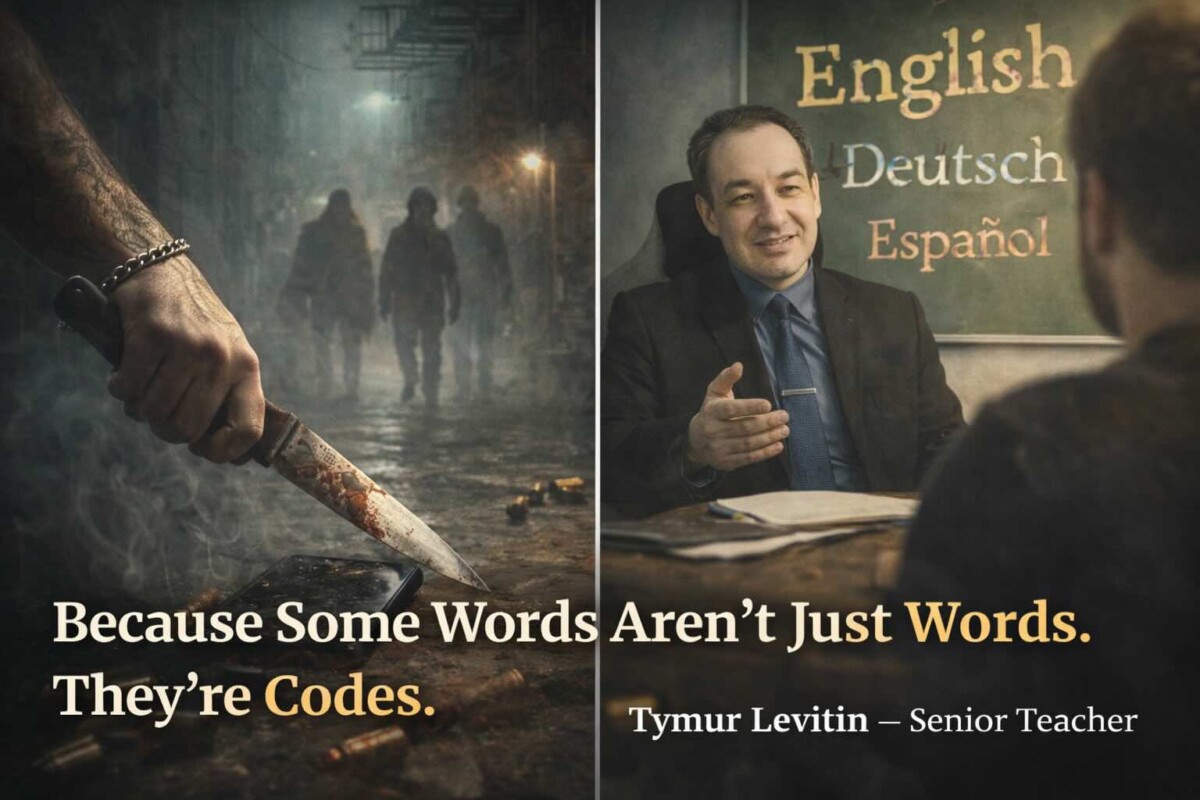
A Man Is Always Proving Himself
Let me speak honestly, not just as a teacher — but as a man.
I’m 41. Not 18. Not 60.
And I’ve spent a lifetime using language to prove things:
- To my boss: “I’m competent.”
- To my partner: “I’m strong, but kind.”
- To my students: “You can trust me.”
Sometimes I’ve used language to fight.
Sometimes to survive.
Sometimes just to be heard.
That’s the reality — not of grammar books, but of real life.
And I know I’m not the only one.
Language Is a Code. You Must Learn to Read It — and Not Trigger It
This is why I teach.
Not to drill verb tenses. Not to impress anyone with idioms.
Understanding idioms is not only vocabulary. It is part of how a speaker becomes natural in communication. I explained this mechanism in detail here:
https://levitinlanguageschool.com/authors-column-tymur-levitin-on-language-meaning-and-respect/why-dont-push-the-horses-sounds-wrong-even-though-it-makes-perfect-sense/
I teach to keep people safe.
To help them speak with clarity, confidence — and cultural awareness.
Because language is not about grammar.
It’s about survival.
And some words can get you killed.
Others can save you.
You choose.
© Tymur Levitin — Founder, Director, and Senior Teacher
Start Language School by Tymur Levitin
Explore our international programs
View my teacher profile
Choose your language:
English,
German,
Spanish